
Last Updated on 2026-06-25 by Daev Roehr
Incept date: 2024.03.30
2024.05.12 – First round review comments folded in
2024.10.21 – Rewrote for better clarity and flow, discuss SPL before watts
2026.0525 – Clarity edit pass
So, you’re asking “How many watts do I need for my stereo?”
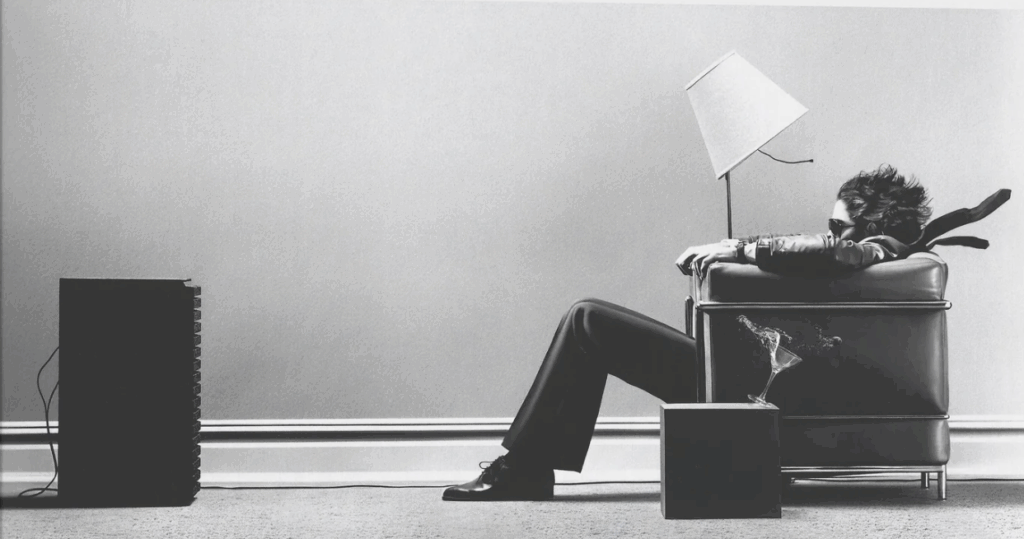
(The classic Maxell Ad from 1979)
That’s actually the *wrong* place to start.
Watts have about as much do to with how good a stereo sounds or how loudly it can play… as a car engine’s max RPM has to do with how well your car corners or it’s top speed. In other words, not much, and not directly.
Your starting point is really “I want my sound system to play cleanly at a ‘satisfying’ volume”, where ‘satisfying’ is measured as “X” dB SPL.
But first, the classic tl;dr:
– Watts is a meaningless term without the measurement parameters.
– Speaker sensitivity, room size, listening distance, and the desired SPL matter. A lot.
– Lastly, “watts” do not map to loudness in a linear fashion. A 3 dB SPL increase is barely perceptible, yet takes 2X the amplifier power in watts. A 10 dB SPL increase is perceived as about twice as loud, but requires 10X the amplifier power in watts!
Right-o, let’s get to it.
What is Sound?
Our ears perceive air pressure changes as sound. The range of perception is the audio spectrum, and in young adults it extends from about 20 Hz (very low bass) to around 20,000 Hz (very high treble).
Age, gender, and prior noise exposure can have a profound effect on your hearing range. These factors typically decrease your high frequency perception, much more so for males than females. It’s not unusual for 50 yr old male humans to not hear frequencies much above 8 kHz… causing them to crank up the treble, much to their younger (and female) friend’s! dismay.
1 More sound facts
Sound Pressure Level
Sound Pressure Level “SPL” is how we measure the volume or loudness of sound.
Like many things in the physical world, sound is perceived in a non-linear fashion, so a modified “yardstick” (i.e. a log scale) is used to quantify it. This log scale more closely maps to how our hearing actually works and it reduces the numeric range scale to something manageable.
The base unit is a Bel, but it’s a rather large step between whole numbers. For audio work SPL is measured in deciBels, “dB” . The scale usefully ranges from about 50 dB SPL (a quiet living room) to 110 dB SPL (a studio control room playing way too too loud.)
Warning: A few minutes of extremely loud noise exposure will permanently degrade your hearing!
OSHA defines a reference safe point as 85 dB for 8 hours, with the safe time decreasing rapidly with increased volume. For example, 106 dB SPL(A) for 4 minutes has a high probability of causing permanent hearing damage.
Another interesting property of sound is as it moves through the air from the source, the intensity (SPL) decreases by the square of the distance.
Yep, another non-linear scale. 🙂
IOW, for every doubling of distance, the SPL will drop by approximately 6 dB.
As an example, a speaker generating 100 dB SPL at 1 meter will drop to 94 dB at 2 meters, and 88 dB at 4 meters. Conversely, those bluetooth earbuds are very close to your ears, and can thusly achieve literal ear-splitting volumes easily.
2A few more comments on safe SPL
Another point to consider is our hearing system is rather non linear in terms of frequency, and those non linearities change based on the SPL. To compensate for this, variety of “correction factors”, or “weightings” are often used, with “A” and “C” weighting historically being the most common. So a proper SPL measurement would be specified like 88 dB SPL(A) and include the reference location, i.e. one meter, on axis from front of speaker, at ear height.
A non-intuitive attribute of sound is a 3 dB SPL increase is barely perceptible, it’s a 10 dB increase that is perceived as twice as loud. But that small 3 dB takes twice the amplifier wattage power, and that 10 dB (twice as loud) takes ten times the amplifier power in watts! (More on this in the following discussion.)
First, the watts “numbers racket”
Audio power amplifier manufacturers (especially in the low cost levels) have engaged in the “more watts is better” numbers war for so long now, most people think it’s the most important criteria in an audio amplifier. Ugh.
Focusing solely on amplifier wattage numbers obscures much more important parameters for sound levels and quality reproduction. Let’s look at some tips for more correctly sizing your amplifier power requirements, based on what SPL you trying to achieve.
First, some terms and basic info
Watts are a simple measurement of electrical power. But before you can understand watts, you must first understand the cornerstone formula of electricity, Ohm’s Law.
Don’t worry, it’s a simple algebraic formula. It states the basic relationship of electricity is V = I x R, where V (or E) is Voltage in Volts, I is Current in Amps, and R is Resistance in Ohms.
This humorous drawing shows these basic parts and their function.
(Found on the ‘net, author unknown or multiple sources)
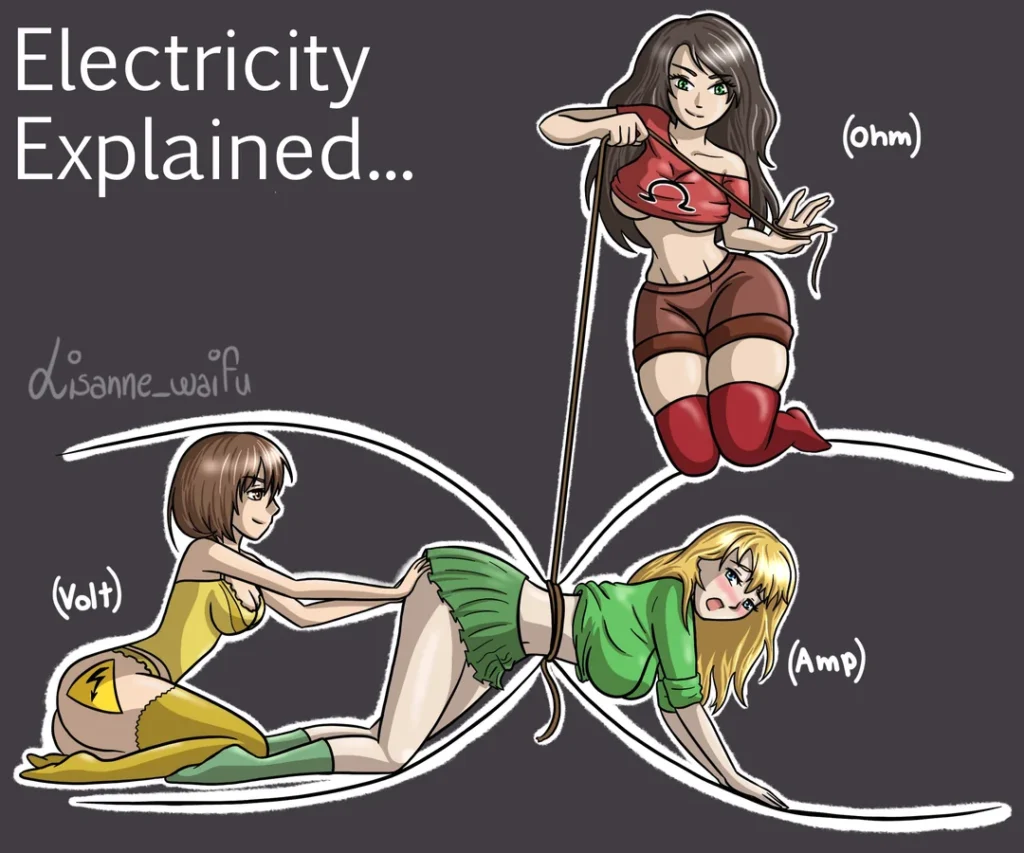
Wherein Ms. Volts is akin to a pressure pushing Miss Amps butt along, but holding them back is the resistance of Mistress Ohms. Or something. 🙂
Notice this basic algebraic equation can also be stated as:
I = V / R or Current equals Voltage divided by Resistance
or:
R = V / I or Resistance equals Voltage divided by Current
meaning if you know any two of these values, you can always calculate the third.
Math is magical, huh. 🙂
Importantly, and with all three values in hand, you can figure power in watts with this simple multiplication: Watts = Volts x Amps.
For example if your amp outputs 8 volts into 8 ohms, that means there is 1 amp of current. 1 amp of current at 8 volts is 8 watts. (Theoretically, and maximum.)
*Note: This is a simplification based on easy to understand DC voltages. Audio is actually an AC signal, and AC resistance is actually an impedance, and it’s all a bit more complex in the details. But the basic principles remain the same and the numbers are close enough for this introduction.*
Yet, this watts thing has still next to nothing to do with sound.
Stay with me.
Loudspeaker, or Speaker: A magical device that converts an electrical signal into an acoustic soundwave. This is a most difficult transition to do well, and there are a wide variety of ways to accomplish the task. There is also a wide variety of ways to measure the successfulness (i.e. accuracy) or lack thereof, of this conversion. Frequency response, dispersion, dynamic range, various distortions, the rooms acoustical properties, and even the speakers location in the room are all parameters that influence this conversion. It is also a highly inefficient process.
Sensitivity: A poorly understood but very important specification is the sensitivity specification. This is basically what SPL (remember this from above?) the speaker will generate with a standardized reference signal at a standardized reference distance and location. This rating is key to understanding how much power you need from the amp for a given speaker to achieve the desired SPL.
Watts: And the most misunderstood speaker specification is watts.
Yes, the same “watts” term used by power amplifiers, but here it means basically nothing, null, nada.
Watts by itself on a speaker is meaningless, it needs context.
Sometimes it means the recommended amplifier power range, sometimes it means the long term continuous power the speaker can withstand without thermal failure, sometimes it means the short term max power before physical damage… but usually it’s meaningless marketing mumbo jumbo, an inflated number to make the speaker seem impressive somehow.
Audio power amplifier: Often shortened to “amplifier” or “amp”, although those terms are used in a myriad of other ways that can be confusing, so watch the context.
This is the last active electronics stage before your speakers. The power amp provides the “muscle” (or power) for the speaker to do it’s thing. Note that the speaker and the power amplifier can (and do) interact with each other in complex and difficult to quantify ways.
Amplifier power is traditionally, yet misleadingly, specified in “watts”, which is merely voltage (“V”, in volts) times current (“I”, in amperes). Again, note the specification is meaningless without the third value, via ohms law, and also the test conditions.
Amplifier specifications and other games
People like simple answers to complicated questions. And the nice thing about wattage specs is they seem simple: some is good, more is better, right?
Ummm, it’s not that simple.
First off, a number without the measurement conditions is meaningless. (Remember?)
For example, in the early days of high fidelity (and now again, sigh) amplifier power specifications and conditions were cherry picked by the manufacturer as key way to make their products look better than the competition.
As time went on, this numbers game escalated into a grim and rather stupid battle called “the wattage wars”, where ridiculous conditions were used to get the largest possible wattage number for the marketing materials. At the worst point, a 1 watt amp (like an inexpensive car radio) could get rated as 10 watt amp if you ignored how distorted the audio it was… or a 100 watt amp if you overdrove the amp, shorted the speaker connection and measured the max instantaneous current before the amp self destructed!
If the marketing blurb says something like peak or instantaneous watts, then it’s hyperbole; divide by 10 (at least) to get a sense of the real rating. And there are other tricks like adding the channel wattage together (doubles the “watts”), so beware.
The wattage ratings got so ridiculous the FTC and several trade organizations stepped in with some standard methods to allow rational comparisons in the mid 1970s.
A standard FTC “wattage” spec will look something like “80 watts per channel into 8 ohms, RMS continuous, from 20Hz to 20000Hz, both channels driven, at less than 0.05% THD”, and will specify which standard was used to measure with, eg FTC, IEC, etc.
Standardized yes, but even the this standard wattage spec is still a fairly useless gauge of an amplifiers ability to generate a desired SPL with your speakers, as it doesn’t factor in the speakers average sensitivity and the impedance curve’s interaction with the amp.
And keep in mind the relationship of amp power out to speaker loudness is another nonlinear relationship and the speakers impedance will vary with frequency.
(For this discussion, impedance may be thought of as a complex AC version of resistance, with other AC unique factor to complicate matters further. And if the impedance varies, so does power; remember ohms law previously? )
Wattage also doesn’t cover other key amplifier “quality” parameters, like the amps noise floor, types and levels of harmonic distortion, the more abrasive Intermodulation distortion, damping factor & output impedance, slew rate, wideband frequency response at 1 watt, power bandwidth, dynamic range, overload characteristics… And whatever else I’ve forgotten off-hand.
As if that isn’t complicated enough, all audio electronics have a limited range of conditions they work well in. For a power amplifier, too little input signal (underdrive) means you won’t get your max amplifier power, or worse your signal will be buried in the noise floor.
And too much input signal (overdrive) can cause clipping in the input stages or cause the amplifier output stage to exceed it’s power ability and go non-linear. This causes the most common form of overdrive distortion, clipping, and it is both horrible sounding and possibly dangerous to your amp, speakers, and ears.
Short story, you want to operate your amp in its design range in the sweet spot.
To sum up:
-The wattage wars have resurfaced, with the ridiculous claims used in the past now the norm again.
-Watts are a poor indicator of how loud a speaker/amplifier combination will play.
So, “buyer beware” on watts.
So, what *is* important?
Ok, so why all the previous dull definitions? The point is in hi-fi, you don’t really care about watts, you care about how good your system sounds. And part of that good is “Does it achieve a satisfyingly dynamic experience while still “sounding good”.
Unfortunately, only some parts of “sounding good” can be measured, as part of “sounding good” is very subjective, i.e. your personal musical preferences, your speakers and how they interact with your room, your mood, and your particular set of ears and hearing system.
Notice that “Can it play stupid loud, that’s goodsound!’ is w-a-a-a-y down my list (and should be way down on yours too), but “can the system achieve a satisfying sound level in my room” *is* a valid criteria. In my case, a satisfyingly loud SPL at my listening position is about 85 dB(A), average, as I value my hearing. Or what’s left of it.
Armed with all that, we can now discuss audio system goals. But first, let’s get the amp power thing out of the way with some real world speaker examples.
Example 1: Klipsch Heresy 3
I own a set of Klipsch Heresy 3 speakers, with a quoted sensitivity of 99dB @ 1 meter using a standard reference signal of 2.83V. That’s the current way of saying “1 watt into 8 ohms”, the old reference standard.
If I listen from a distance of 4 meters, that “1 watt” will produce about 87 dB SPL at my listening position. OK, that 1 watt is plenty loud for me…
But wait! Music isn’t static test tones, it has dynamic range! If the music has modest 10 dB peaks, then I’ll need an amplifier with more “headroom” power to handle those peaks, in this case 10x, or 10 watts. And if the music has a very realistic 20 dB peaks over average, then I would need 100x the power or a 100 watt amplifier for those 107 dB peaks!
But wait again! 87 dB SPL average is too loud for me, so I turn down the volume to my usual 75 dB, which equates to about 0.1 watt. That leaves plenty of headroom for the occasional +20 dB peaks @ 95 dB on my theoretical 10 watt amp at my listening position.
The fact that I’m using a pair of Dynaco Mark IV monoblocks @ 35 WPC tube amp (3 x the calculated wattage requirement) means I have about 4 dB of extra dynamic range headroom. This is a fine pairing, power wise… and otherwise too!
Example 2: Bose 901, series VI
OK, now let’s run some numbers for the unorthodox and controversial Bose 901 speakers.
Bose was (and is) notoriously dismissive of most specifications for their consumer gear, but various third parties have measured the sensitivity at abut 82 dB SPL @ 1 meter. That means 76 dB at 2 meters, and a rather quiet 70 dB at 4 meters. 10 watts would push it up to 80 dB, but it takes a 100 watt amp to get to a reasonably loud 90 dB.
(Actually, the SPL fall off in-room isn’t quite that much due to the 901’s reflecting driver setup, but for the 10x amp power requirement “thought puzzle” we’re looking at right now, it basically applies.)
But wait! These speakers make use of an “active equalizer”, which is a purpose built active equalizer tuned to modify and smooth the frequency response of the speaker system. Electronically, this takes the form of about a 9 dB bass boost and about 11 dB of treble boost, relative to the Bose series VI EQ 3200 Hz unity gain reference point. And we’ve already seen 10 dB means 10X power, so the amp needs to have a fair amount of power reserve to handle that extra energy without distortion. Since I tend to listen around 75 dB SPL average, a 100 watt power amp will work fine here. (The active equalizer’s bass and treble boost is the other reason the 901’s need a beefy power amp.)
Example 3: Pioneer SP-8541-LR
Another pair of speakers I have are the “book shelf” sized Pioneer SP-8541-LR, with a rated sensitivity of 89 dB @1W/1M. So that means 1 watt is 77dB at my listening position, and a 100 watt amp would produce 97 dB SPL, yielding a healthy 17 dB of headroom when I listen at my usual 80 dB or so.
Since the speakers are rated for 130 watts max, they should be operating in their safe zone at that sound level as well, making this a good matchup, power to desired SPL- wise. (These Pioneer speakers are speaker guru Andrew Jones design, and sound great, amazingly so considering the low price point.)
Example 4: Realistic Minimus 7’s
These vintage speakers were incredibly popular. And they were incredibly cheap for the decent sound quality they projected. (Especially when they were on the yearly half price sale, 2 for $50 USD!)
The sensitivity was not specified, but aftermarket testing yields a figure of about 86 dB SPL @1W/1M sensitivity. This makes my 4 meters away listening spot about 74 dB SPL, with a 10 watt amp achieving 84 dB.
However, these are somewhat bass shy and cranking in another 6 dB or so at 80 Hz makes ’em sound a lot better. But that will need 5x the power, or 50 watts.
Oops, they are rated at 40 watts max! So these are best used for lower volumes and near field work; exercise caution in larger spaces and with medium sized power amplifiers. Or, better yet, use a sub-woofer.
And thus endeth the wattage/power/spl lessons for today.
Watts to dbW conversion table
Here’s a handy amp “wattage” table to consider. It uses the dBW log power scale that follows the SPL measurement dB perceptual scale.
I put an asterisk by the 1 watt reference and subsequent decade entries to highlight them.
Watts(RMS) to dBW
*1.0 = 0.0 dBW
2.5 = 3.98 dBW
5.0 = 6.99 dBW
*10 = 10.0 dBW
25 = 13.98 dBW
50 = 16.99 dBW
75 = 18.8 dBW
*100 = 20 dBW
200 = 23.01 dBW
250 = 23.98 dBW
400 = 26.02 dBW
500 = 26.99 dBW
800 = 29.03 dBW
*1000 = 30.0 dBW
2000 = 33.01 dBW
2500 = 33.98 dBW
5000 = 36.99 dBW
*10000 = 40.0 dBW – (:-0)
Remember:
A 3 dB SPL increase is barely perceptible, yet takes 2X the amplifier power watts.
A 10 dB SPL increase is perceived as about twice as loud, and requires 10X the amplifier power watts!
(Puts a different light on those “watts” doesn’t it?)
(following areas under construction)
Next up: The room is part of the speaker system!
OK, now practically speaking the acoustic space the speaker is in has an enormous effect on the sound, so one must factor that in too. For example, my listening room has good acoustic diffusion and absorption and measures about about 20′ by 18′ with an 8′ ceiling height. A modest size room of some 2900 cubic feet.
To be continued…
Addendum:
For theory and practice of how to hook up a 901 system, see: Bose 901 Active Equalizer hookup guide
Daev’s notes:
https://geoffthegreygeek.com/amplifier-power/
https://www.erinsaudiocorner.com/loudspeakers/bose_901_series_v/
FootNotes:
- Sound moves through the atmosphere at 20 °C (68 °F) at about 343 m/s (1,125 ft/s, or in more useful terms for hi-fi, that’s about 34.4 centimeters or 1.13 feet per millisecond. Altitude and temperature affect the speed somewhat, and in other mediums sound can travel at vastly different rates. The speed of sound means relatively small changes in distance are readily discernable and typically perceived as directional cues. (Note: The speed of sound isn’t directly relevant to the wattage discussion, but it is a key factor for understanding sound propagation in a space.) ↩︎
- Being exposed to 91dB SPL(A) for 2 hours, or 106 dB SPL(A) for 4 minutes will likely damage your hearing permanently.
-OSHA caps safe noise at 85dB SPL(A) for 8 hours.
-The Greek theater in Berkeley, CA. limits concert levels levels to 94.8db (“A” weighted, 15 minute average) at the mix position.
↩︎