
Last Updated on 2026-10-22 by Daev Roehr
Incept date: 2026.10.12
I picked up one of these to check out, as it seems to be “too good to be true”: a 300 watt amp for $120 USD.
[[ insert pic here ]]
tl;dr:
As usual these days, the power output is somewhat overstated.
The power supply is rated at 140 watts, so it’s quite impossible to get a full 300 watts of clean audio out of it. Indeed, quick testing with a more realistic distortion criteria of 0.5%THD max into 8 ohms shows it’s a 50 watt per channel amp.
Disclaimer:
I do not have a AES-17 low-pass filter (the special Class D amp noise filter) in my ancient but still reliable Audio Precision One audio analyzer.
(UPDATE: I have a INHAUS LP-2010 filter on order, will re-run tests when it arrives.)
I instead set the analyzer input bandwidth to 30 kHz as an approximation for the missing low-pass filter set typically used for class D amps. That means my noise floor numbers are probably somewhat higher than the published specs, as the audio analyzer’s input gain stage reacts to the amps HF switching hash.
Note: Not having the filter is unlikely to change the power vs frequency measurements or the full power THD vs frequency results, but we shall see.
Clean Max Power and Frequency vs THD
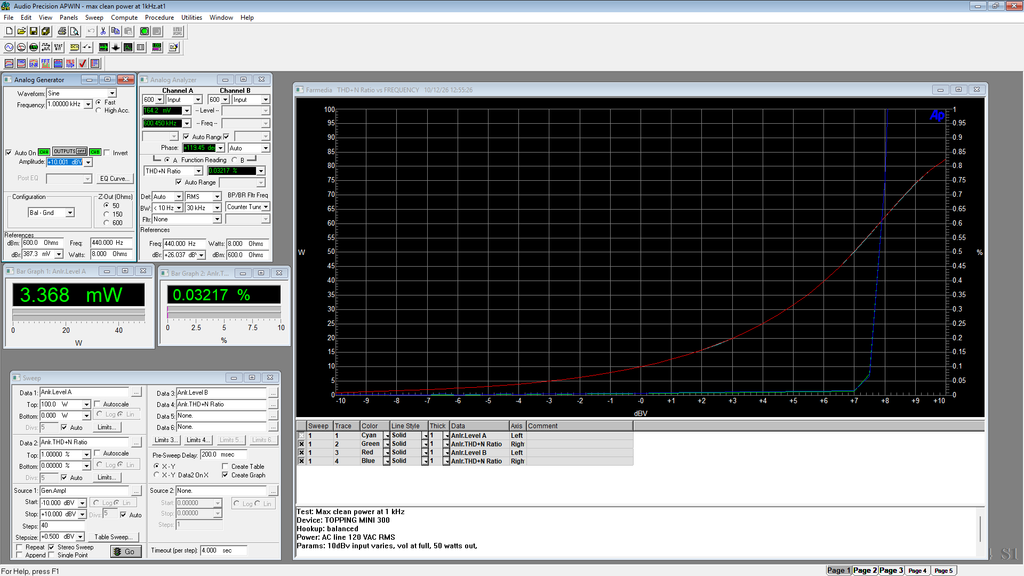
Here’s a plot of THD against output at 1 kHz, both channels driven into 8 ohm resistive load.
The left axis is power, and it “knees” sharply upwards at 50 watts. By 60 watts, it’s at approaching an unpleasant (for a solid state) amp) 0.5% THD (-46 dB).
For grins and giggles, a single channel into a 4 and 8 ohm load, followed by both into 8 ohms.
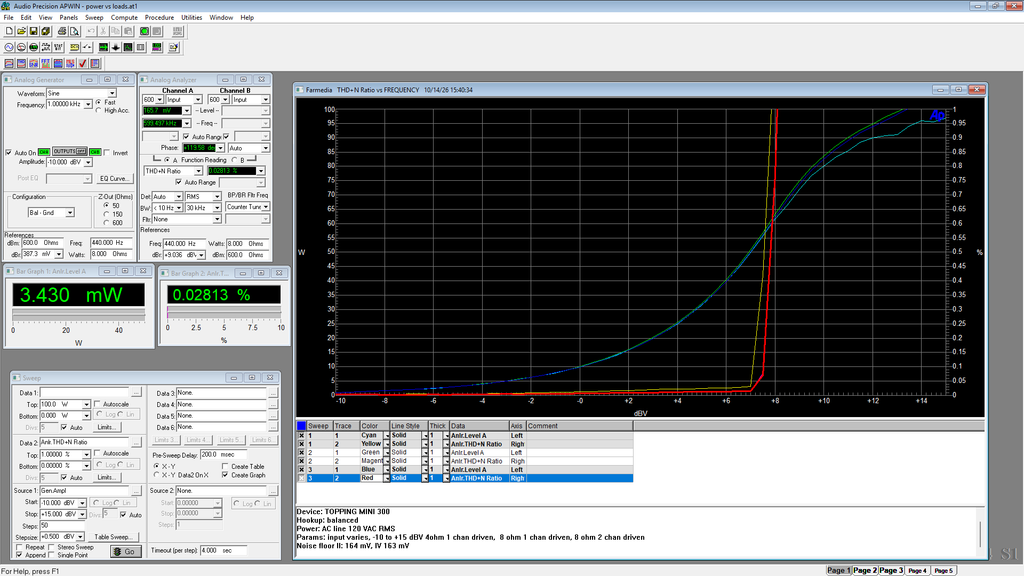
An all three case, the THD takes off with a +7dBV input and zooms past 0.5% THD at about 50 watts. I didn’t bother to go further, case closed, it’s a 50 watt/chan amp.
Next, here’s the frequency response vs THD at 50 watts. Again, specified with old school real amp specs: 20-20Khz, less than 0.5% THD, both channels driven into 8 ohm resistive load.
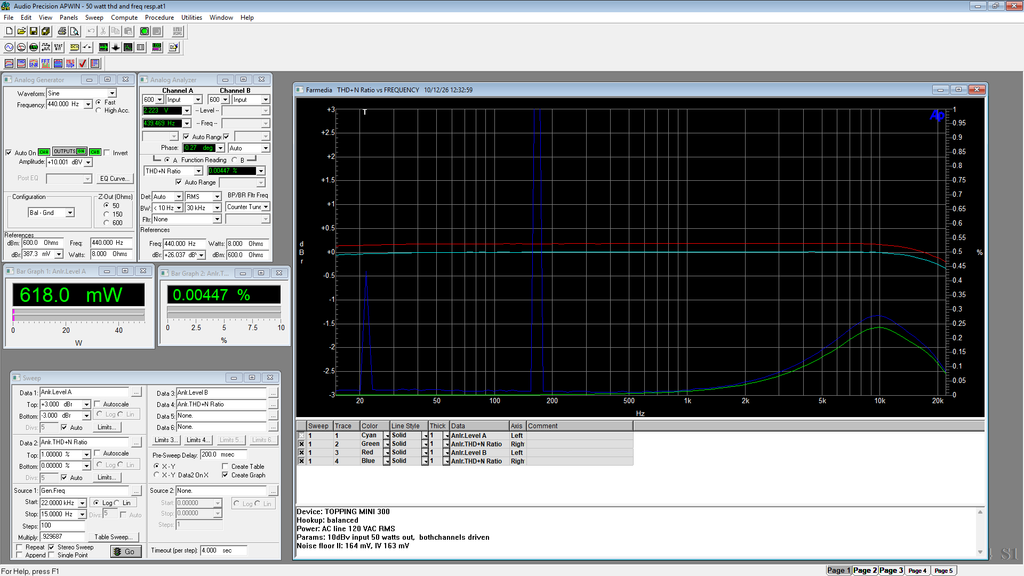
This shows the typical class D THD rising at the high end distortion (around 10 kHz), increasing to about 0.25%.
Next up, a closer look at the noise floor. Soon.
(One of my tests is to listen to the speaker outputs with headphones to hear the noise floor first hand. Since this amp has a bridged output, I have to modify a set of headphones to *not* have a common ground.)
Note:
1) The output is a bridged design, so make sure there is *no common ground* in the speaker path!
2) The speaker banana posts are spaced incorrectly for a standard dual banana plug to fit. Annoying, but typical.
3) The noise floor is rather high on my AP voltmeter(appx 160 mV), even with the 8 ohm resistive load. And it’s not HF hash, engaging the AP bandwidth filter didn’t lower it.
I need to investigate further, as it might be also be an artifact of not having the AES filter. (A quiet power amp is .5 mV or less.)