
Last Updated on 2026-08-13 by Daev Roehr
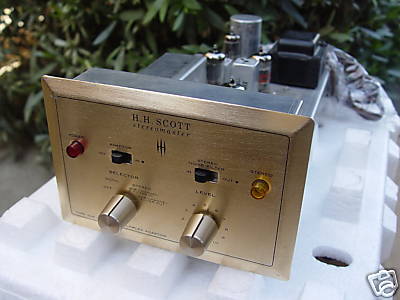
This page covers the Scott vacuum tube multiplex stereo decoder initially used in the outboard multiplex stereo adaptors (the 335/kit 35) and in the 350/kit LT-110 FM stereo tuners. The optional (and quite rare) C-55, an add-on multiplex stereo indicator light kit is also covered on this page.
Background
Around mid-1958, stereo LPs were becoming available for home use but there wasn’t a way to hear these new stereo records over the air; radio was just mono.
This lack caused keen interest in finding a way to transmit stereo (records and tapes) over the FM band. As usual, there were multiple competing incompatible systems proposed and presented to the FCC, the body in charge of regulating the airwaves in the US.
A couple of key requirements for a stereo system was cross compatibility, both with the current mono FM transmitters and tuners, as well as preserving the SCA cmmercial music channel (a key revenue stream for many FM stations).
Other requirements around audio quality, cost, and guardrails to minimize adjacent channel interference were also concerns. There were a variety of techniques proposed, but to prevent market mayhem only one would be approved by the FCC.
Competition was fierce.
As a side note note, observe that once the standard was established radio stations would have to upgrade most of their audio chain equipment at a considerable cost.
And customers would need to buy new tuners or an adaptor for the their current tuners, also costly. With all this going on, the ecosystems conversion from FM mono to FM stereo would take a while.
Back to our story: HH Scott’s chief engineer (and key inventor) Daniel von RecklingHausen was heavily involved in the FCC evaluation and approval process for this future FM Stereo system. It appears he created prototypes for the testing process, which gave him early insight to the pros and cons of the various systems and decoders. Once the stereo standard (based on the GE/Zenith system) was finalized April 1961, HH Scott Co used that early knowledge to quickly ready their FM stereo adaptor/decoder to be used with existing customers compatible tuners. As HH Scott Co had cleverly been shipping their tuners for years with a compatible MPX out jack for just this purpose, there was already a large and loyal Scott brand audience for such an adaptor.
The FCC authorized stereo FM broadcasting to begin on June 1, 1961. WGFM in Schenectady, NY was the very first to broadcast at midnight local time, followed shortly by WEFM in Chicago. The age of FM stereo had begun!
HH Scott multiplex adaptors
The Scott multiplex decoder design was cleverly built on a modular sub-chassis, which permitted the quick deployment of the 335 FM stereo adaptor housed in a small form-factor chassis. It was shipping within a few months of the FCC FM stereo system approval.
The Model 335 adaptor was about $100 USD in 1961, and there was a kit version that came along later, the Model 35.
The modular sub chassis design also enabled a quick production change to their current mono FM tuners to produce a new integrated stereo tuner, the 350 (and later the kit version, the LT-110). The 350 was available just a few months after the decoder shipped and was about $200 USD.
Based on how many of these units are still around, the tuners and adaptors sold quite well.
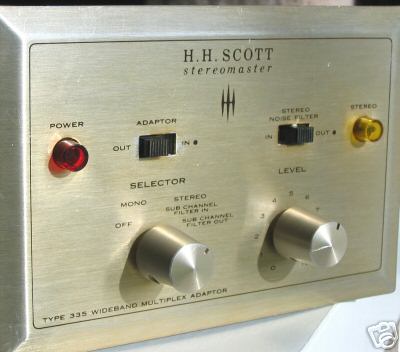
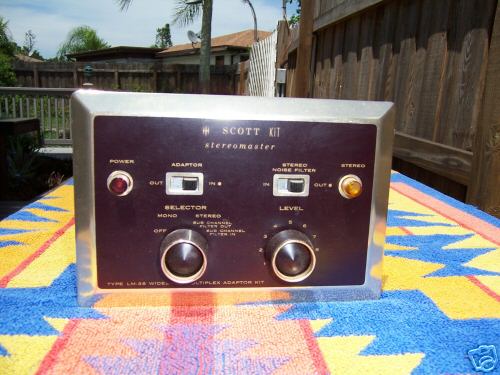
Model 335 adaptor (Assembled) and the later Model 35 adaptor (Kit)
The two have identical circuitry, just the knobs and faceplate differed. An oddity of the time is the stereo light, which merely meant the adaptor was set to decode stereo, not that a stereo broadcast was being received. Stereo program detection and decoder switching was a thorny problem that took a while to get right.
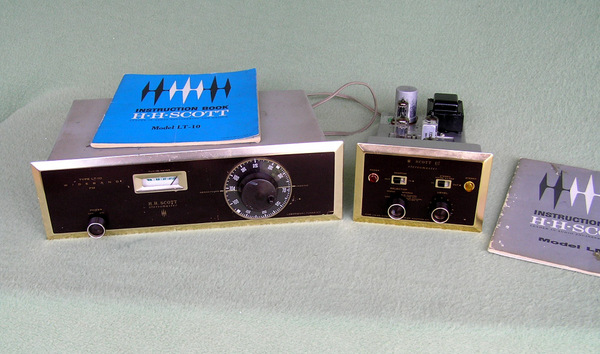
The “brown face” was originally the kit color theme, as seen here with a LT-10 tuner.
C-55 Stereo guide
The rare C-55 Stereo Guide option could be fitted to the mpx adaptor and the 350/LT110 tuners to indicate a stereo transmission, although there were some weird idiosyncrasies with false positives that took time to iron out. Also, the C-55 was a rather pricey add-on at about $20 USD in 1966 (about $180 in 2025 dollars!), so not many C-55 examples survive.
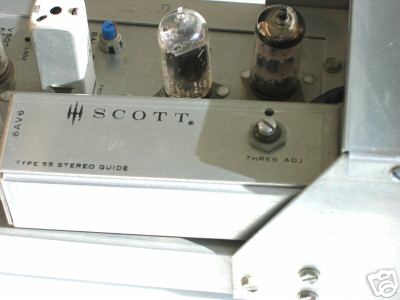
Example of the C55 installed in a 335.
This would be called a “hack job” nowadays. 🙂
And thus endeth the history lesson.
A closer look at the 335
Here’s my sample, purchased in late 2025.
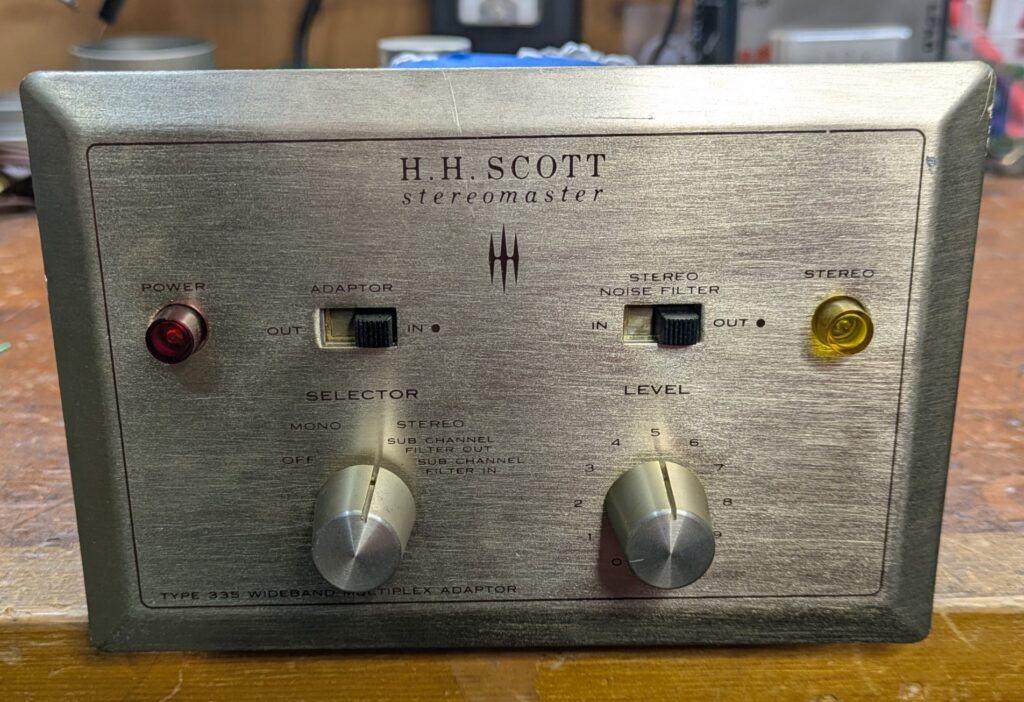
And a view of the wiring underside
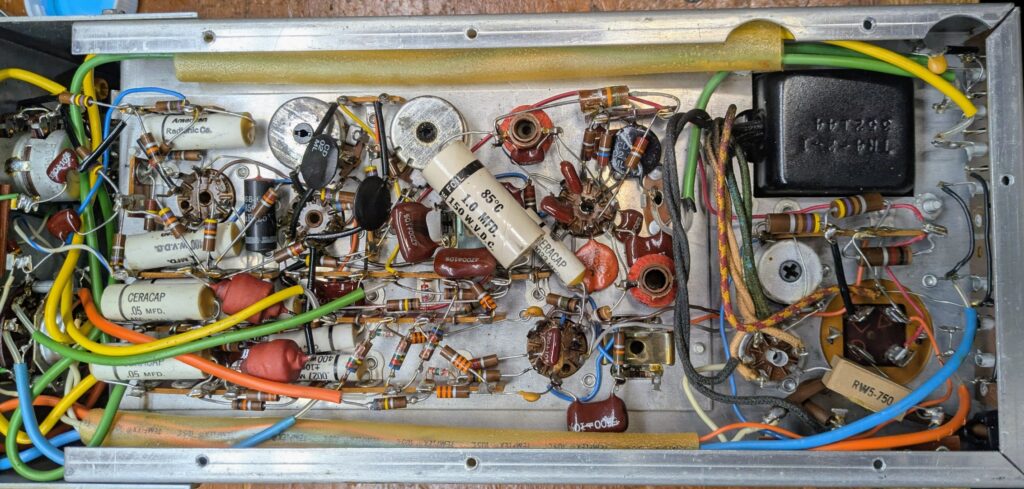
It looks like no one has been in here before, yay!
Based on my experience with Scott tuners, most of those old Ceracaps are leaky and will need replacing. But before I do that, I’ll carefully variac the power up and get some “before restoration” measurements.
( I’ll be restoring it and then re-aligning it, more soon!)