
Last Updated on 2025-11-09 by Daev Roehr
(incept date: 2025.11.02)
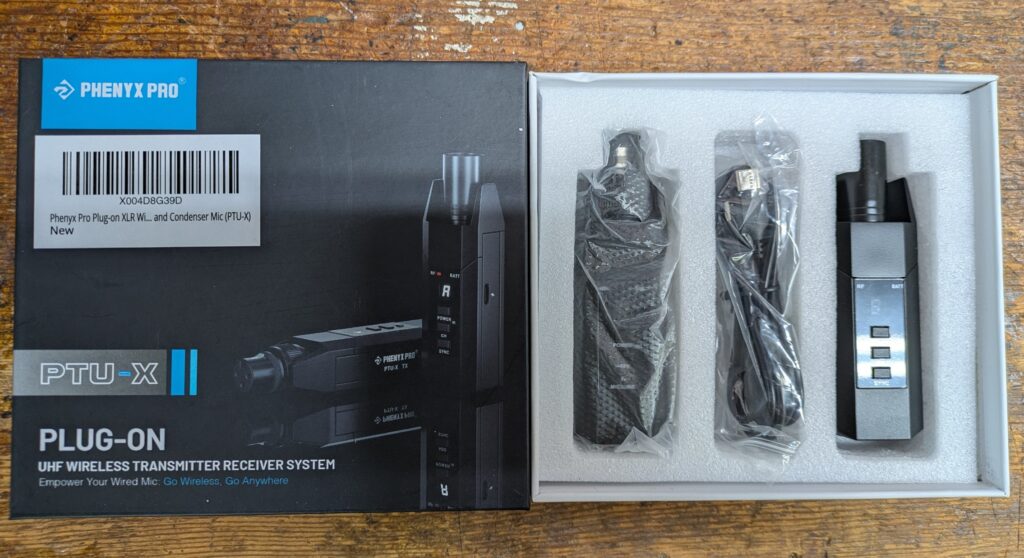
Nice packaging!
Note: This is not a “paid” or “for trade” review.
I purchased two standard production sets from Amazon to use personally. These are my test notes, impressions, and commentary as I play around with the unit.
The product page is here: https://phenyxpro.com/products/ptu-x
MSRP is $99.99 USD.
tl; dr:
Has a few quirks, but an excellent value wireless adaptor.
Great for those sudden “Hey sound guy, I need a mic” or “How about another speaker over there” occasions they didn’t mention until event time.
Description:
The Phenyx PYU-X is intended to let you use your current microphones and go wireless. Has phantom power for your condenser mics too!
Bonus feature: It can also accept line level signals for running remote powered speakers.
PTU-X Specifications:
- Claimed range: 100ft /30 m
- Claimed frequency resp: 50-15kHz, -3dB
- Claimed: SNR: -98dB
- Claimed THD: Not specified.
- Claimed Latency: Not specified, but as an analog system, s/b less than 1 mSec.
- Claimed battery performance is 7/4 hours runtime( phantom off/on).
Charge time not specified. Note that the battery is not swappable. - RF: 10 mW at 550.3-565.3 mHz, 16 channels.
(This spectrum roughly corresponds to the old USA UHF analog TV channels of 27-29.)
PTU-X Testing
Audio quality:
Using my ancient but still trustworthy Audio Precision One, I ran a series of test sweeps to characterize the units audio behavior. I always start with an input voltage sweep to ensure I stay inside the device design parameters for the next tests.
My first test yielded nonsense results until I switched my analyzer’s output to unbalanced output mode. That suggests the Phenyx XLR transmitter has a “single ended” or unbalanced XLR input connection.
This shouldn’t cause issues with mics, but but equipment with a real differential output (like my analyzer, or my TASCAM US1800 that I use for running REW) had severe signal level issues. If you run into signal level oddities with your mixer-to-speaker-amp connection, an audio isolation transformer will take care of it.
[Note to self: check for which pin is “hot” and whether signal polarity is maintained.]
Once that was figured out…
Line position: A 1kHz -10 dBV signal input was output at – 8.5 dBV.
Mic position: A 1kHz -30 dBV signal input was output at -18 dBV.
This implies the line setting is close to system unity gain and there is about a 12 dB boost in the mic position, probably to help improve the noise floor.
Here’s a plot of input voltage against distortion at 1 kHz in both line (blue) and mic (green) switch positions. My starting guess values of -10 (351 mV), and -30 dBV (about 40 mV) are inside the operational ranges, so I’ll keep using them.
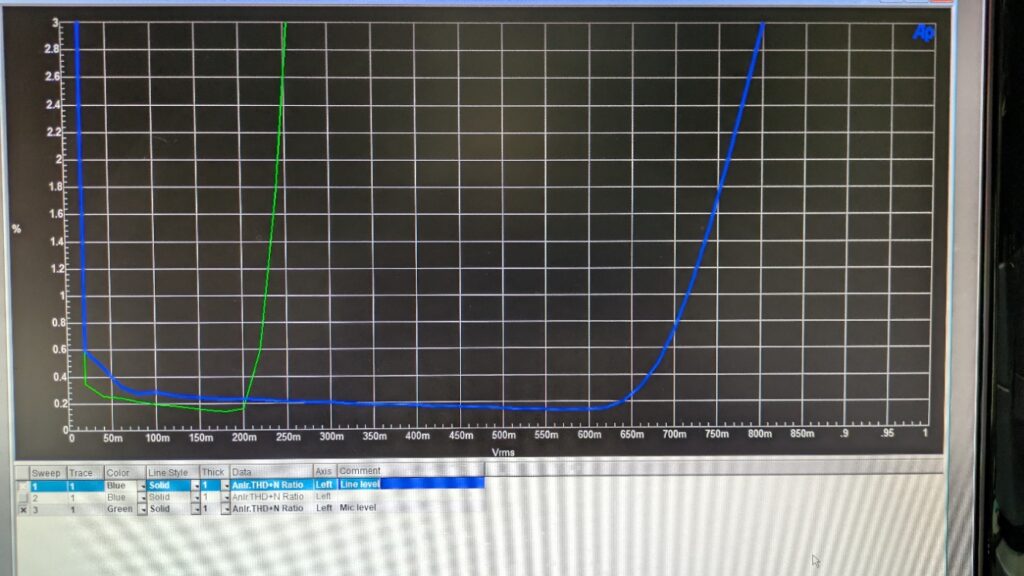
The abrupt transitions from high to reasonable amounts of distortion suggests a compander is in use.
(A compander is a method to increase dynamic range and improve the noise floor. As this is an analog RF system, noise is a serious issue.)
The other thing to see here is the mic/line switch shows the optimizations and tradeoffs for mic signals vs line level signals. The line position trades some low level performance for a much higher overload point.
Next, lets look at the frequency response against distortion, run at -10 dBV line and -30 dBV mic. ( The rise in distortion is a side effect of the rolloffs at the frequency extremes.)
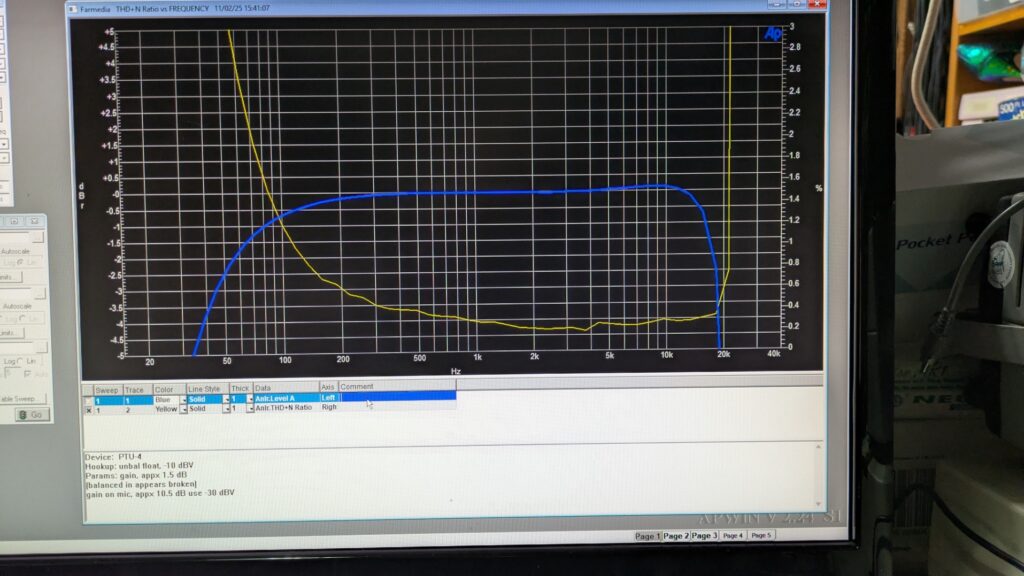
As the unit is specified as 50-15kHz, the system meets it’s frequency response specification handily.
The high frequency rolloff (over 15kHz) won’t be an issue for typical vocal uses, but you might lose a bit of “air” on cymbals or triangles with a high grade condenser mic. Assuming you can still hear that high. 🙂
The low frequency rolloff is again no issue for vocals, or driving a typical remote PA speaker.
However, I’d advise against using it for subwoofer connections. The response is down about 3 dB at 45 hz and falls off rapidly from there.
PTU-X range
(Under construction)
Wireless range is difficult to quantify as it depends on so many variables, like other RF sources, system height, number and type of obstructions, proximity to metal surfaces, antenna alignment, hand position on mic, and what is defined as “acceptable” audio quality.
… and probably other factors I’ve not listed. At the same time is need to be somewhat repeatable so the results can be verified and compared. (sigh)
So I’ll just document the environment I tested in, my audio quality criteria, and the test conditions as a starting point.
Environment:
Tests ran in a in suburban setting with multiple 2.4 and 5 gHz wifi access points on my property and neighbors on 2 sides with wifi coverage as as well.
Observe this doesn’t replicate a typical indoor event space, as there aren’t several hundred cell phones putting out interference. However, the spectrum the PTU-X operates in (550 mHz/UHF) is nowhere near the cell spectrum, nor is it near the typical wifi spectrum either.
Audio quality criteria:
An analog system tends to have increasing noise floor before failing, similar to tuning in a distant FM radio station. This manifests as increasing amounts of hiss or “spitting” noises and increasing to full audio dropouts. I’ll use a full dropout as a fail condition, along with any repetitive noises that are unpleasantly loud compared to the signal.
This is subjective, but as a sound guy with 20+ years of event experience it’s also a somewhat educated criteria; eg one low volume hiss burst can be forgiven, a whole series can not. Nor can 3 seconds of audio dropout, but maybe a single 1/10th second noise free dropout once an hour is OK? Not sure, but it’s a decent metric to start with.
Test conditions:
Test set A, one pair:
I’ll send a 440 Hz sine wave to the transmitter, which I’ll place on a mic stand.
Then I’ll take the receiver and walk away in various directions until objectionable noise of full dropouts are heard.
Test A.1 will be line of site.
Test A.2 will include a wall to replicate the usual remote speaker use case.
Test set B, two pair:
Test B1. will place two transmitters closely together to replicate using the units the stereo outs of a mixer to the main speakers.
Test B.2 will place two receivers close together to replicate the receivers being plugged into a mixer, transmitters as handheld mics.
A Tests:
(in process)
B Tests:
Test B.2
First off, the two receivers won’t physically fit next to each other on my small P.A., A Yamaha Stage PAS 400i. And, even if they did, long experience tells me to always have some space between RF devices. A 500 mHz signal has a 1/4 wavelength of about 5.5 inches; an old rule of thumb was to have at least that spacing.
I’ll use short xlr cables to get that spacing, of course more is theoretically better.
After some tinkering, here’s what i came up with as my test harness: A couple of right angle XLR adaptor’s for one receiver, a shorty XLR cable and a cheapo mic clip and stand for the other. This gets them away from the mixer metal (and each other) a bit.
It also puts them at an angle such that I can see the status panel.
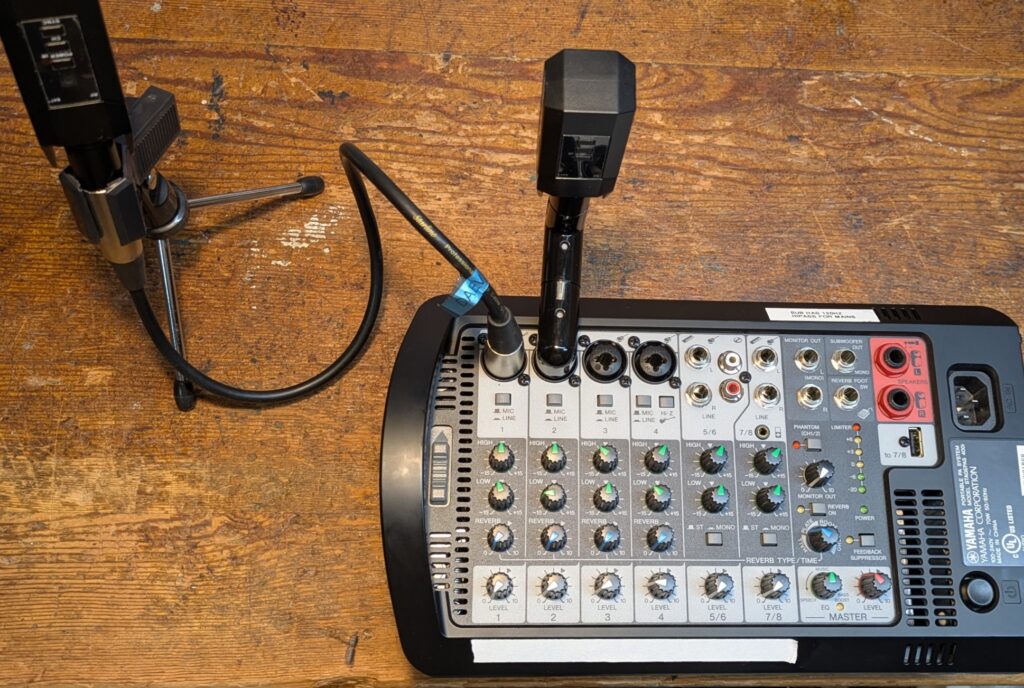
OK, now that I can physically plug the two units in, on to some testing!
(more to come here)
PTU-X Testing results:
- Claimed range: 100ft /30 m
(test being devised) - Multiple unit interaction: Not specified
Tech support responded “Please set each PTU-X unit to a different frequency so that the transmitters can be physically close to each other. But 3-4 units can be used simultaneously.”
(test being devised) - Claimed frequency resp: 50-15kHz, -3dB
Tested: Confirmed, see Audio Precision graphs above. - Claimed SNR: -98dB
Tested: Noise floor is appx 100 uV. SNR rating is quite good, and near the limits of my test system, appears justified. - Claimed max input signal: Not specified.
Tested: The sweep showed a rapid rise in THD past at about 600 mV / -4.5 dBV (line mode), keep it under that. - Claimed THD: Not specified.
Tested: I measured less than 0.3% from 400 to 15kHz, rising to 1% at 100 Hz. - Claimed Latency: “None”. As an analog system, s/b less than 1 mSec.
Tested: I measured 0.14 mSec with a calibrated REW system. - Claimed charge time: Not specified.
Tested charge time: appx 2.5 hours from full discharge.
PTU-X Pluses:
- An excellent performer for the money, meets it’s audio specs. Works quite well for it’s intended use case.
- Phantom power allows use with condenser mics
- Mic and Line level compatible
PTU-X Minuses:
- The XLR input doesn’t appear to be a real balanced input, some use cases will encounter signal integrity issues.
- There is no standby or mute control, and using the power switch for that function causes a noticeable pop in the audio stream.
- The battery power system is not quite ready for all day (i.e. 12 hour) pro use.
I would advise these transmitter changes:
-Allow the battery to be changed. This permits having an external charger with spare charged batteries for those whoops! occasions.
-The USB C charge port only charges at the old USB power standard (5 V, 500 mA rate.) No fast charging here! And no listed recharge time.
-Unclear if the receiver can be run “plugged in” to allow 12 hour operation. - No recommendations or documentation on distance (physical or RF) between units when using multiple units. I have a query into tech support for this. UPDATE 2025.11.06: The question is not being understood by Phenyx, I’m devising a test for this.
- The “autoscan for blank channels” feature mentioned online is not documented in the manual.
Process:
Turn on receiver, push and hold hold the sync button, the unit steps through the channels and selects the first?/best? one available.
Next, press the receivers sync button, power on and hold the transmitter up to the receiver (face-to-face) and the two will sync channels. You can verify this by the displays channel numbers matching. - I’d advise against using it for subwoofer connections. The response is down about 3 dB at 45 hz and falls off rapidly from there. Along with the rapidly climbing THD, it’s enough to affect your EDM “thump and boom” experience.
PTU-X Ergonomic/uX issues
- The receiver’s XLR output jack was upside down for most of my equipment, meaning the status panel was obscured.
- The transmitters buttons are too easy to accidentally depress while handling.
If the switches were placed inside the (recommended) battery compartment or under a sliding panel, they would be protected during performances. - Receiver doesn’t have an RF signal strength indicator. A simple light is not a very helpful tool for figuring out range and interference issues.