
Last Updated on 2026-08-21 by Daev Roehr
… and audio signals
As an old school sound guy, I’ve seen a lot of PA noise and signal quality issues over the years. Most of them are caused by incorrect gain structures, improper impedance matching, mixing balanced and unbalanced signal types and noise and ground loop issues.
D.I. aka “Direct Input” or “Direct Injection” boxes, are conversion and/or isolation boxes that can address these issues and more. This flexibility is the most misunderstood concept about DI boxes, because the name generically applies to a half dozen or so different solutions that may be combined in various ways into a packaged solution, the DI box.
Common issues a DI box can help with are:
-change the physical connection type
-change signal types from balanced to/from unbalanced
-change the signal level
-change or match impedances
-isolate or “lift” grounds to help with noise or hum issues
-isolate sources from phantom voltage
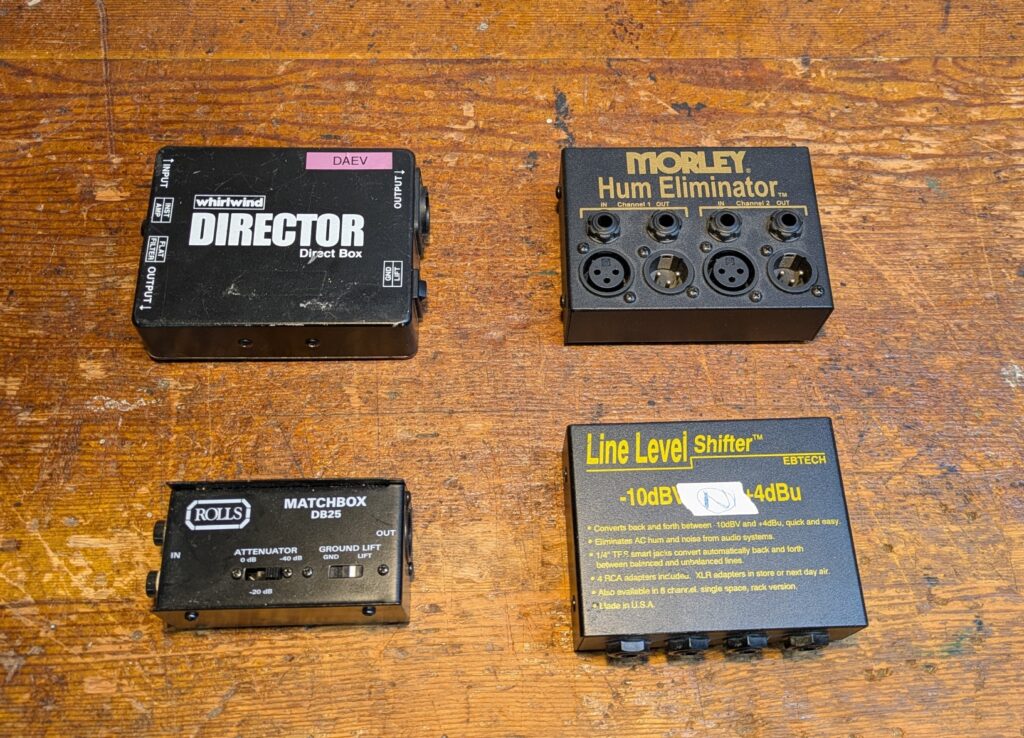
Here’s a small sample of the 30(!) or so DI boxes I keep on hand, all solving different combinations of signal issues.
Physical Connection
Getting connections and cabling sorted is the first task most PA folks encounter.
(“Connection” is fancy word for jacks and plugs.)
Nowadays, the most common audio connections encountered are XLR, 1/4″ (6.36mm), RCA/cinch, 1/8″ (3.17 mm), and Speakon. You will encounter these in all the most awkward ways, so be prepared! Some of these conversions can be handled by a simple adaptor, but many will require a DI box.
Signal type
Balanced/unbalanced signals are not typically directly compatible, usually requiring a conversion stage for optimal signal transfer between the two signal types.
Why two types? Unbalanced is a lot less expensive, Balanced is more resistant to noise and signal loss, so they both serve a legitimate purpose and continue to coexist.
(For example, an electric guitar pickup is typically unbalanced, the mixer is usually balanced; this is probably the most common application for a DI box.)
XLR is supposed to be balanced, although it got used as a speaker connection for a while. (ick)
1/4″ can be either, where unbalanced is called TS (tip/sleeve), and balanced is TRS tip /ring/sleeve).
RCA/cinch is unbalanced.
1/8″ is all over the place, caution is advised.
Signal Level
Signal levels (i.e. signal voltages) can be broadly classified into four groups:
-Low or mic level (mics, piezo pickups, vintage guitars without onboard electronics, most guitar effects pedals). In the vicinity of a few millivolts / -40 to -60 dBV level.
-Consumer line level (usually things with RCA or 1/8″ “line” jacks) are consumer line level, but consumer line level show up on other connections a lot. Sometimes called -10 dBV level.
-Pro line level (music gear keyboards, PA/DI outputs on guitar amps, outboard signal processors). Typically shows up on XLR or 1/4″ connections, also called “Pro” or +4dBV level
-Speaker level (high power) usually characterized by heavier wiring. Historically used an amazing variety of connections, even more than listed here. Signal levels can reach 100 V and 20 amps or more, making most older connections rather hazardous. Uniqueness and safety were two key reasons Neutrik’s SpeakON® system was designed (the other was a secure locking connection).
They’re rated conservatively at 250V and 30 Amps, enough for the foreseeable future of audio speakers.
Note:
-Plugging a consumer or pro line level source into a low level input will likely overload and distort unpleasantly.
-Plugging a low level source into a high level input will be noisy and have very low volume.
-Plugging a speaker level into either of the other two runs the risk of destroying the device, and possibly the amp as well! (Pro tip: don’t do this.)
Knowing the signal level is how you optimize your gain structure (a whole topic unto itself.)
Impedance
Impedances are trickier than levels, but again tend to fall into low or high impedance categories. The general rule of thumb is:
– A low can usually feed into a high impedance OK, but with some signal kevel loss.
– A high impedance source will be “loaded down” when feeding into a low impedance input, resulting in a distorted signal. The effect will not be subtle; the signal level will be unusually low and the bass will be missing.
Grounds
“Grounds” are a complex topic, and to make things worse the term is badly overloaded. “Ground” can mean a safety ground, a chassis ground, a signal ground, part of the power supply, a cabling shield ground, the dirt you’re standing on, and probably a few others I’ve forgotten.
The thing to remember here is all this confusion has two key impacts: your safety and hum & noise in the signal.
Safety grounds
When you get shocked by touching a mic or amp or your guitar, that’s a safety issue.
This hazardous condition can kill!
This is almost always caused by an equipment fault, which you should get repaired immediately.
However, you usually discover this while setting up for a gig. 🙁
Here’s where a isolating transformer based “DI” with ground lift can be a literal lifesaver.
(And never perform with a PA on grass or dirt!)
Signal grounds
The most common hum and noise issue is a ground loop, caused by the voltage differential with multiple parallel grounds. Most DI boxes have a ground lift for the signal line, which is often helpful in this case.
Phantom voltage
Phantom voltage (often indicated by a 48 volt label) is typically used by condenser mics, and is usually supplied by the preamp or mixer. It is current limited to prevent shorts from causing issues, but the mere presence can still damage sensitive ribbon mics and cause odd problems with many devices. Using an isolation transformer DI box can prevent such mishaps.
Now, with all that out of the way…
Which DI box variant you use is dictated by the particular use case, i.e. it’s based on the specific devices you wish to connect and the issues you are encountering.
Let’s look at a few common use cases.
Question: “Can I plug my guitar directly into the mixing board?”
Answer: It depends on the connection type, the signal levels, and the impedances of the two devices.
The connection type is pretty straightforward: It has to plug in, and you need to pay attention to balanced or unbalanced signals, converting if needed. Mixers tend to have balanced XLR inputs which are a low impedance (also called low Z), along with some
If your guitar has a newer style active pickup, then it can probably drive that impedance acceptably well. If you have a more vintage guitar (or a piezo pickup), then it needs a much higher impedance to work into, as evidenced by a unexpectedly low signal and a lack of bass.
This second case is where the typical DI box helps, it “buffers” the high impedance of the guitar to the lower impedance for the mixer. And the isolation aspect often reduces hum and buzz as a matter of course.
(past this point is under construction)
Active vs passive – ie powered vs transformer
Why so many? – different uses, different quality and durability levels