
Last Updated on 2026-09-11 by Daev Roehr
(Incept date: 2023.10.27)
Jump to 80x history: #Bose802link

A nice looking pair of Bose 901 Series V speakers on chrome tulip stands
Bose 901 series Production Run overvieW
(1968 to 2017)
or
“How to Recognize Different Types of 901’s from Quite a Long Way Away”
The Bose 901 speaker system was produced for almost 50 years, from 1968 to 2017.
During that time (unsurprisingly) there were multiple production changes, some minor, some major. Understanding the key major change points is helpful in understanding how to maintain and get the best sound out these interesting and controversial speakers.
This guide has been painstakingly pieced together from many sources. I perused company advertisements and service notes, spoke with ex-employee’s and read their shared memories on the 901 speaker facebook group, sifted and suffered through info found on der webz, and generally mined for info wherever I could. See the references at the end of this page.
To aid in clarity and understanding:
- I have categorized the major product design change points as *generations*, i.e. gen one, two, & three. The changes happened at the odd series version intros, coincidentally.
- I refer to the speaker units as “cabinets” and the raw speakers as “drivers”.
- For clarity, the outboard Bose 901 EQ box will be referred to as the “Active Equalizer”. Many people nowadays mistakenly think any equalizer (or “EQ”) is the same as the now ubiquitous octave or graphic audio equalizer (a “GEQ”), *and* that such a GEQ can replace the Bose Active Equalizer unit. Not so, the specialized Bose Active Equalizer’s appx. 24 dB boost/cut range and the complex tailored response curve is well beyond the capabilities of a simple octave/graphic equalizer’s capabilities. The “Active Equalizer” nomenclature also removes confusion when talking about the frequency shaping curve “GEQ” vs the hardware implementation “Active Equalizer”.
- I’ve also categorized the different series by features that were added/dropped/maintained, and by key technical or marketing points.
The usual common problems with 901 systems
- Using an unrestored “Active Equalizer” box.
Units of this age usually have leaky coupling and filter caps, typical of any vintage electronics. This will cause hum, distortion, and an incorrect eq compensation curve.
(See: Bose 901 EQ – Series II restoration for an example of this.) - Loose speaker terminals
A common issue and an easy fix. You’ll need to get inside the cabinet though, so remove a driver for access. - Surround “Rot”
The very end of Series II, all Series III and IV, and a large part of Series V 901’s are particularly prone to the infamous “speaker surround foam rot” issue. *Foam rot was not an issue for the first “Series I” (cloth surround) and the last “Series VI” versions (changed foam chemistry).*
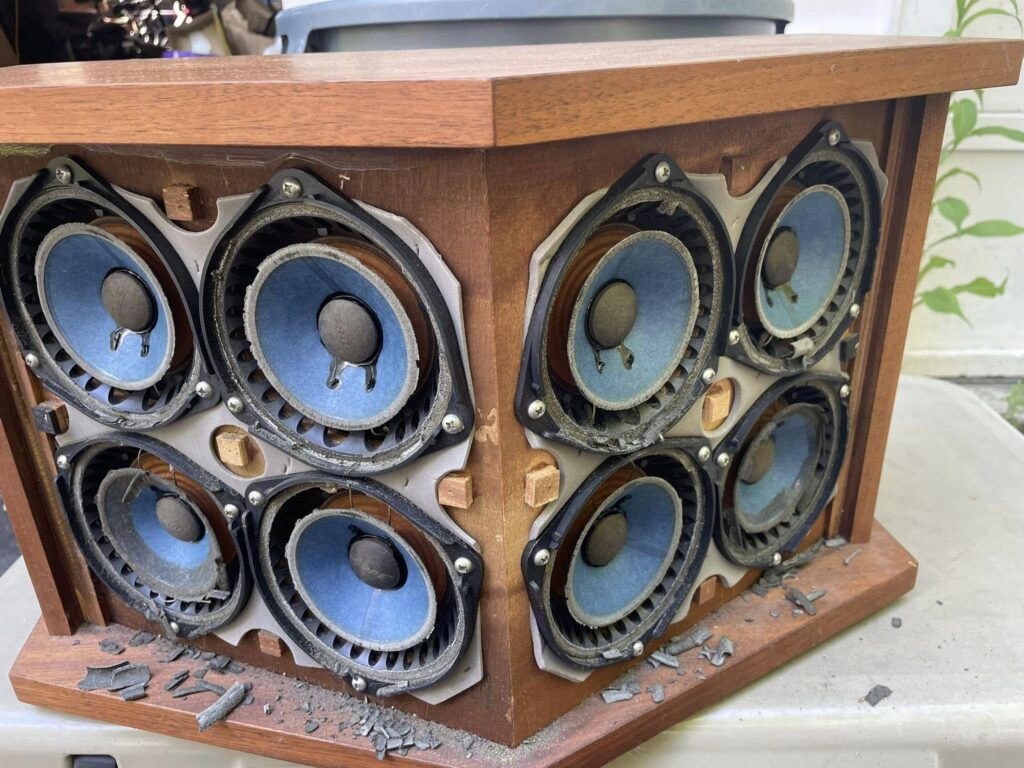
Here’s what surround rot looks like. Ick!
A fix for this rot problem was addressed late-production for the Series V [appx 1986]. (Observe this issue was not unique to Bose, many many manufacturers speaker systems from this time period have the same speaker foam surround rot issues.)
The fix is simple: replace the rotted foam surrounds. With with 18 drivers, this is a time consuming repair on a pair of 901’s, but it’s not difficult for the typical hobbyist.
Not using the required “Active Equalizer”
Using 901 speakers with no (or an incorrect generation) “Active Equalizer” box will yield suboptimal results. Each speaker series is labeled near the speaker terminals, and the “Active Equalizer” boxes have series labels on them (sometimes the back or bottom), just match them up!
If that’s not possible:
– The EQs for Series I & II, the ones for III/IV, and the ones for V/VI are close enough electrically they can swap for each other.
– There are now DSP based third party aftermarket devices (e.g. Deer Creek)
- Hooking up the “Active Equalizer” box incorrectly. Just because your receiver has tape jacks does not mean the tape monitor loop function is implemented, especially if you have a later model surround sound receiver.
( See: Bose 901 – Active Equalizer hookup guide)
Gen One – 901 Introduction, All wood, flat front sealed cabinets, 8 ohm drivers
901 “Series I”: 1968-1972
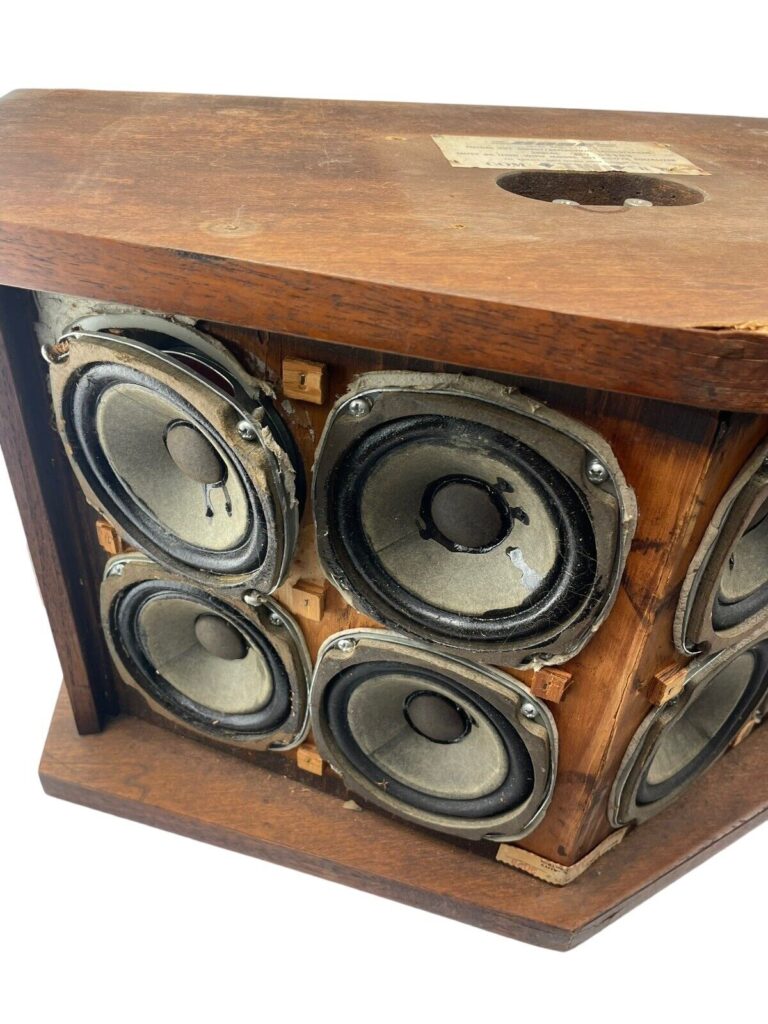
The first shipped 901
Drivers sourced from CTS, 4 screw, 8 ohm, 4.5″ drivers with cloth surrounds. Sealed cabinet, 3 x 3 wiring, fiberglass stuffing.
The drivers are wired in a series/parallel 3×3 arrangement to maintain an appx 8 ohm impedance load for the power amp.
Bose Driver P/N: 103342
CTS Driver P/N: 5804142
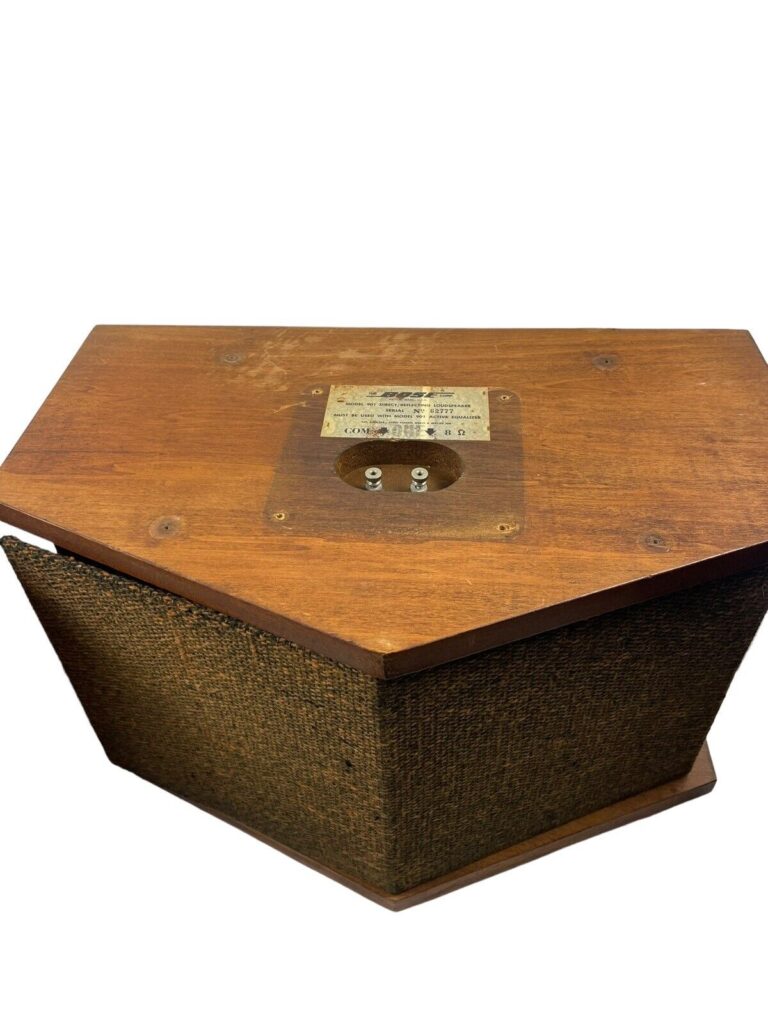
Flat front cabinet: (View of back and bottom) Top and bottom are particle board and middle 5 walls are plywood.
Wood: Wood veneer walnut
Grill: Light, dark, Also a wood slat (walnut?) option
Stands: White, beige?
(Note that the label doesn’t actually say “Series I”, it’s inferred.)
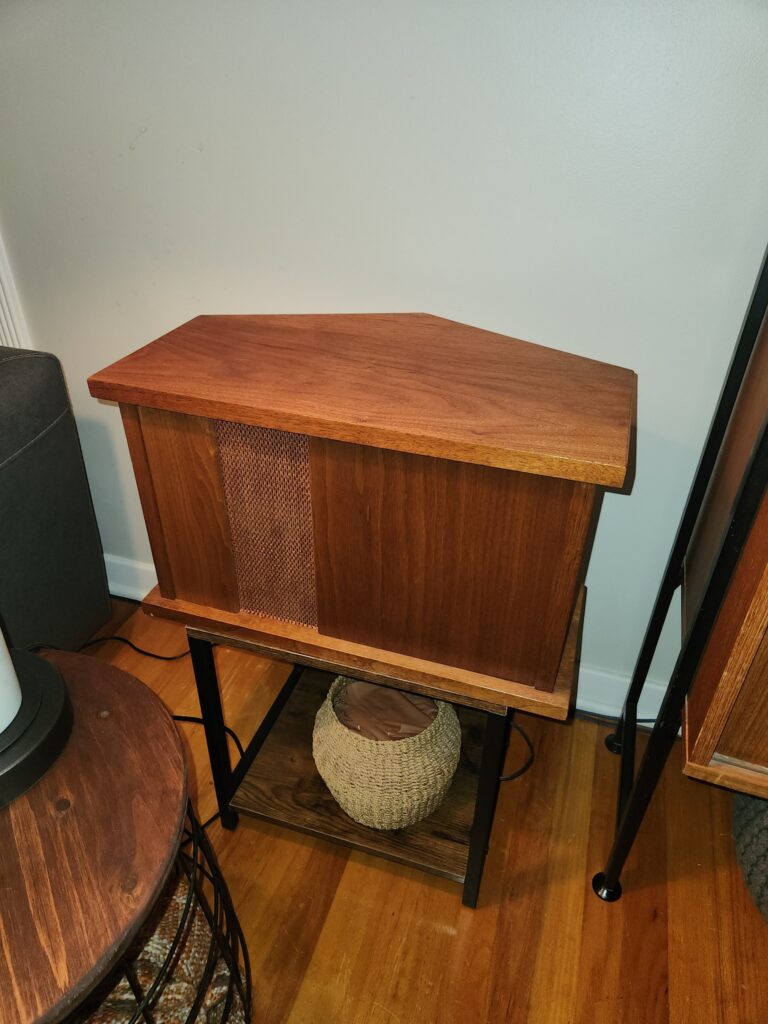
A view of the “slat” front option
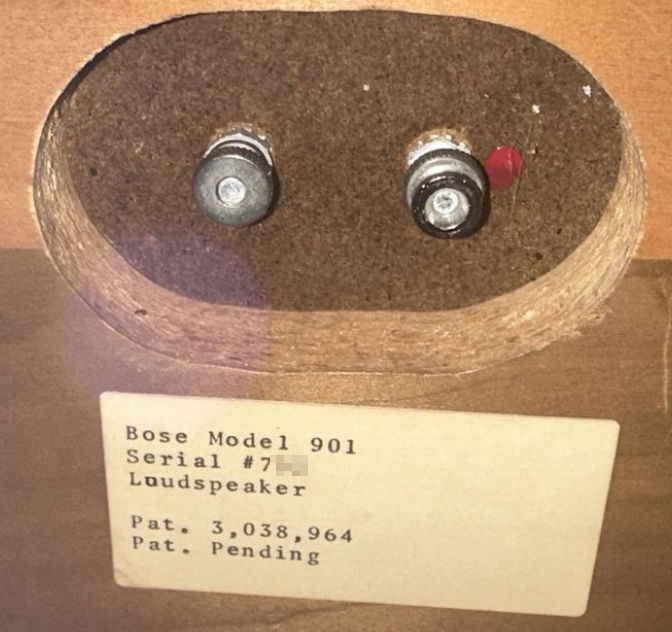
Speaker cabinet connection and serial number. Series I is “assumed”, as there wasn’t an explicit Series I designation at this point in the production.
First or “Series I” “Active Equalizer”
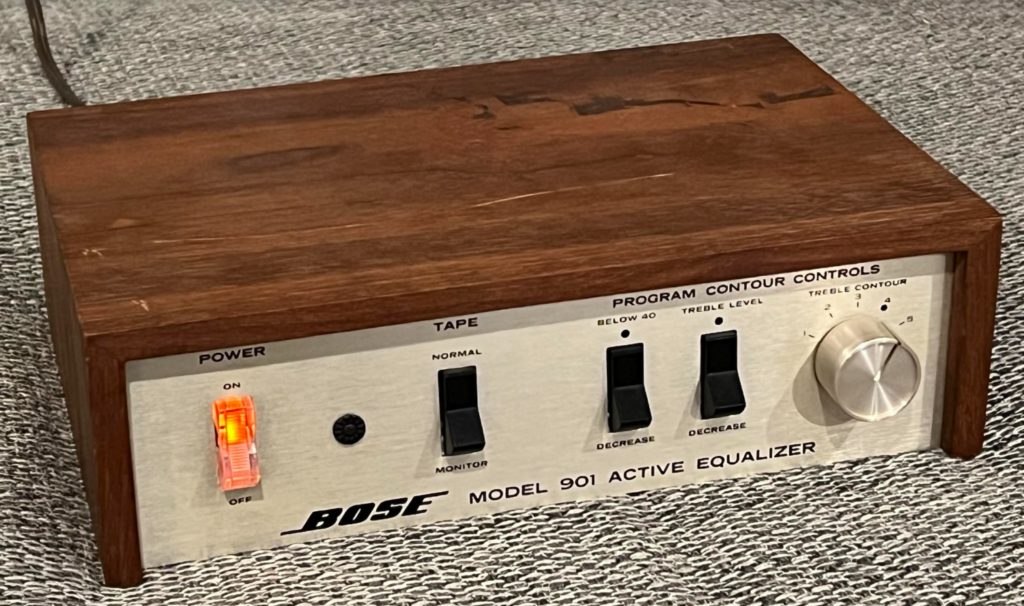
First or “Series I” “Active Equalizer”
Wood grain particle board case, front power rocker switch w neon, 3 widely spaced rockers, 1 rotary control.
A discrete transistor design, initially used 2N3393 transistors, later 2N5088. Has a gradual 6 dB rolloff for the low end as the sealed box provides speaker excursion control.
Controls range: ??
Comments: Made in USA
System price with Active Equalizer: MSRP $476 – $520 (Appx $5000 USD in 2024 dollars!) I saw a 1971 sales receipt for $476, the stands were $39.
It all started here. Overall cabinet build quality seems somewhat crude, almost a hobbyist hand build quality at first. Consistency issues would have likely caused difficulties ramping up production and incentivized a more production friendly design rework.
(Series I – variant sighting)
Early on, Dr. Bose encouraged his students to make 901’s to experiment with, resulting in some “homebrew” versions. Here’s some pics gleaned from the Bose 901 FB group, courtesy of David Leach, who found a set of these “homebrew” in the wild.
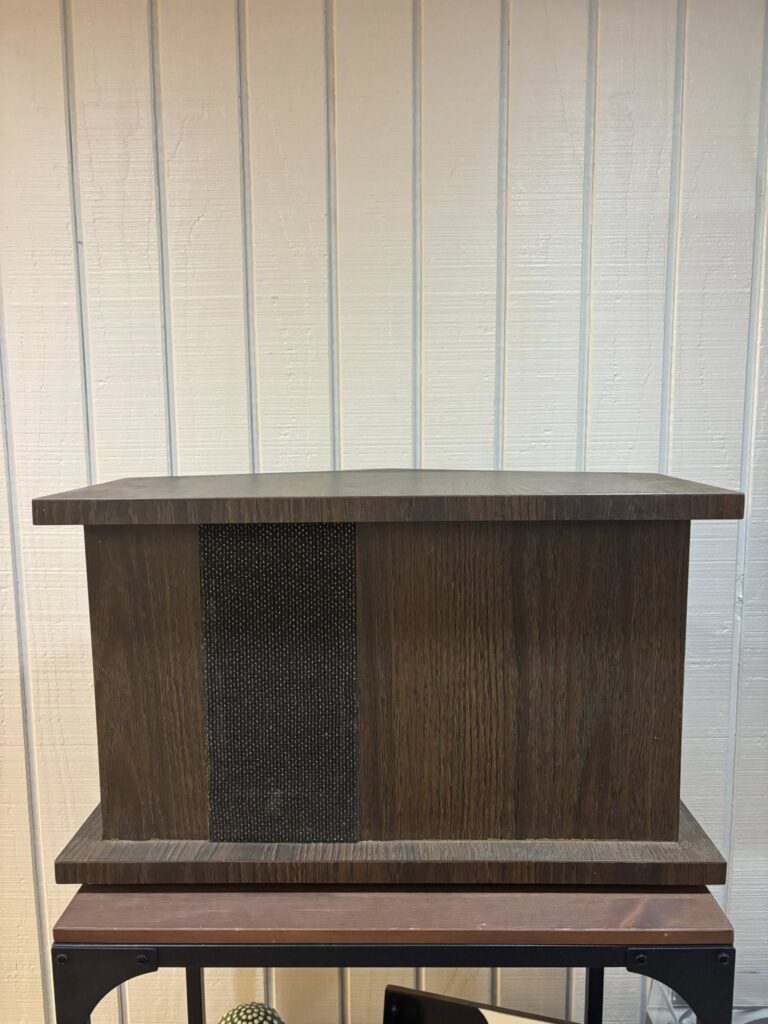
Looks first gen alright.
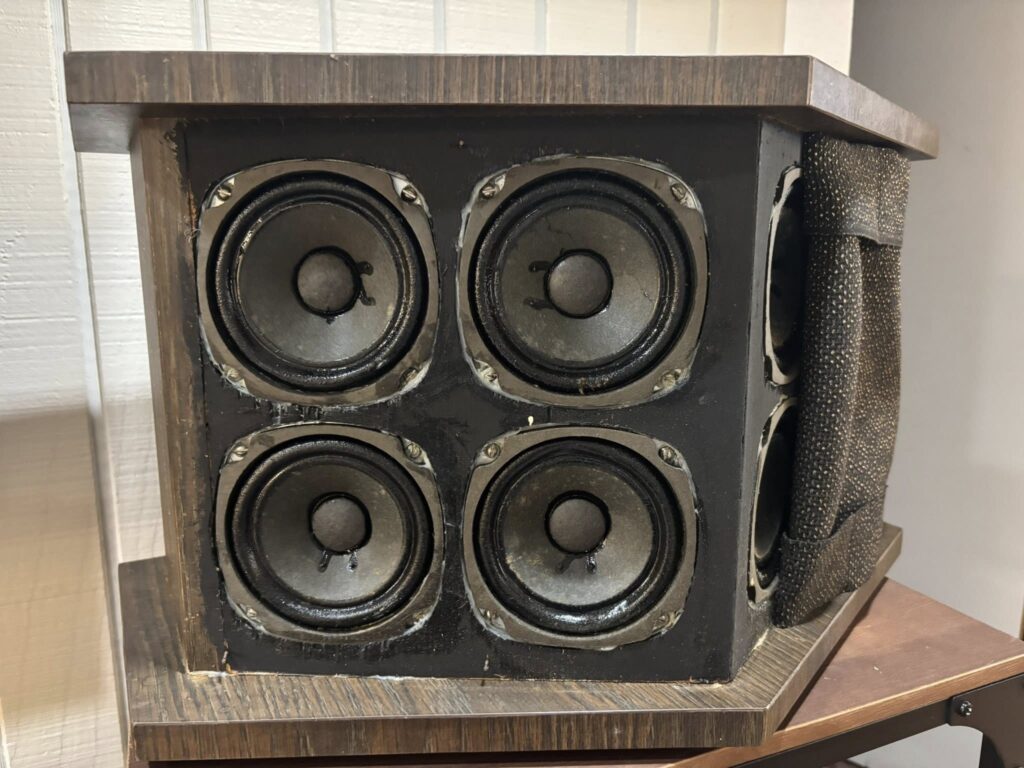
Has 4 screw speakers, so def early version
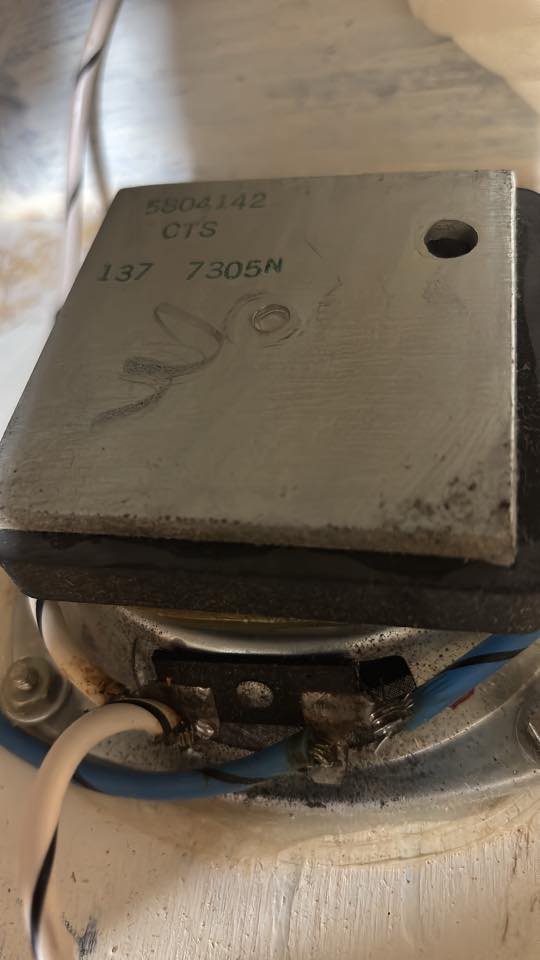
Close up of driver, which stamped CTS. However, none of the
Bose ex-employee’s remember square magnets being used at the factory.
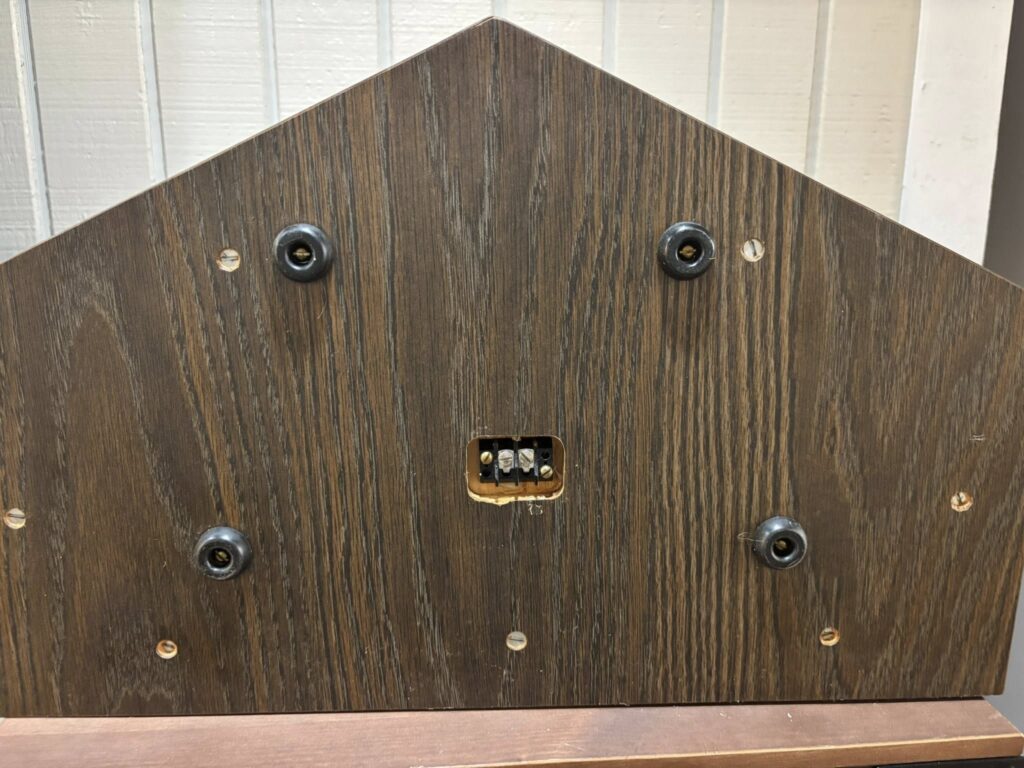
Bottom of cabinet reveals exposed screw heads and a terminal strip; neither were used by Bose factory units.
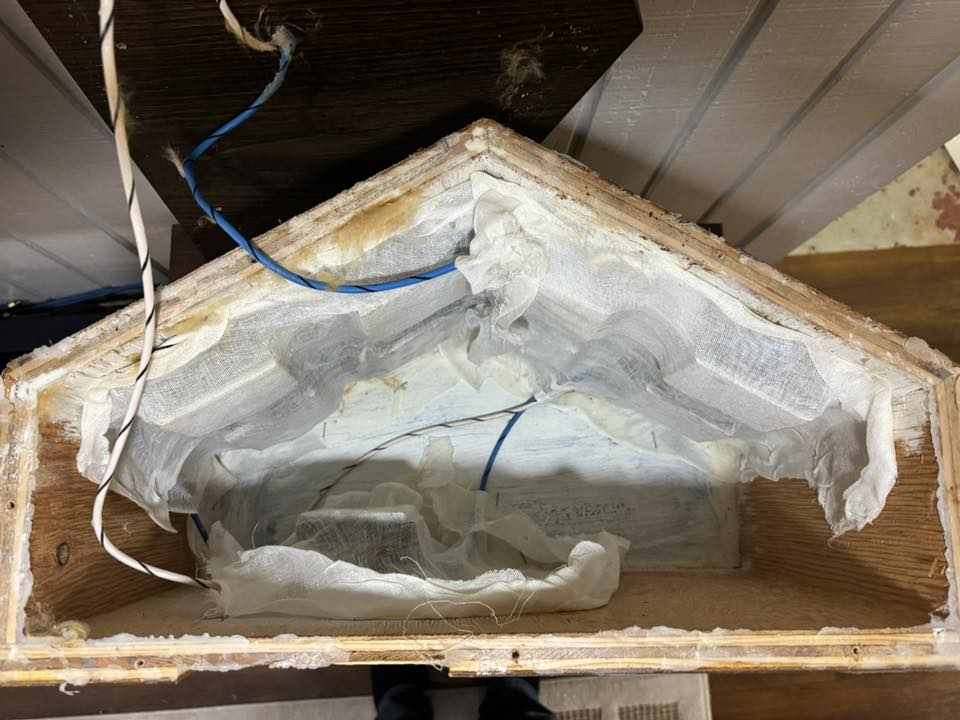
A peek at the inside. Again, not the way Bose factory built these.
Per ex-employees Paul August, Mark Cerasuolo, Bob Douglas, Ray Kimber:
These are most likely one of the “homebilts” . Most notably the visible screws for assembly don’t match the Bose cabinet assembly method, and the terminals are different, so I think the ex-employee’s opinions are most likely correct. They should sound like a factory series I if assembled properly and used with the series I eq.
Forum member Joe Selingo offers:
“There was a place called Disco Electronics on Rt 22 Union NJ (late 70’s) that sold pre-fab cabinets with original CTS Series I drivers.”
And Forum member Paul August chimed in with:
“In the late ‘70’s I worked at a HiFi repair shop in Harvard Sq. At the end of the spring semester there was always a rush of MIT students looking for 18 Bose drivers. Likely one of those [homebilts].
901 Series II: 1972-1976
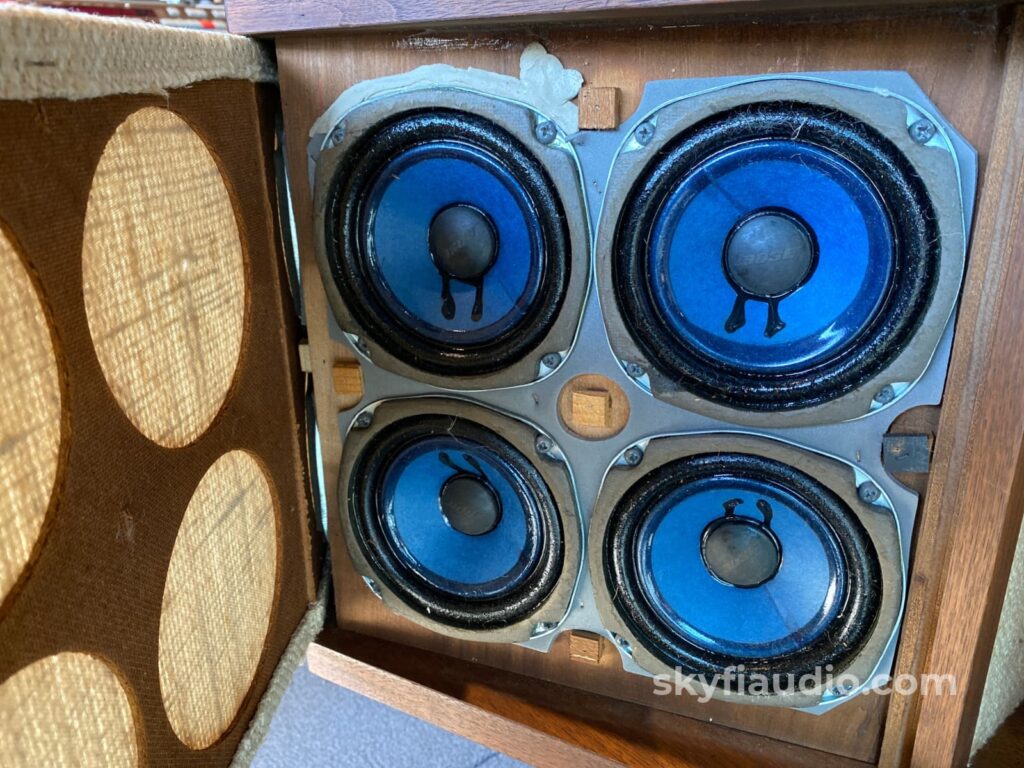
Maintains – 4 screw 8 ohm 4.5″ speaker drivers with cloth surrounds, sealed cabinet, 3×3 wiring, fiberglass stuffing. [See notes at end of Series II section, there were some end of run variants.]
Intros – Drivers now sourced from Rola (not CTS) for this series (proved by the EIA code of 285xxxxx stamped on the drivers back).
Also begins the “sold in pairs” mirror image One/Two speaker set.
Driver P/N: ?
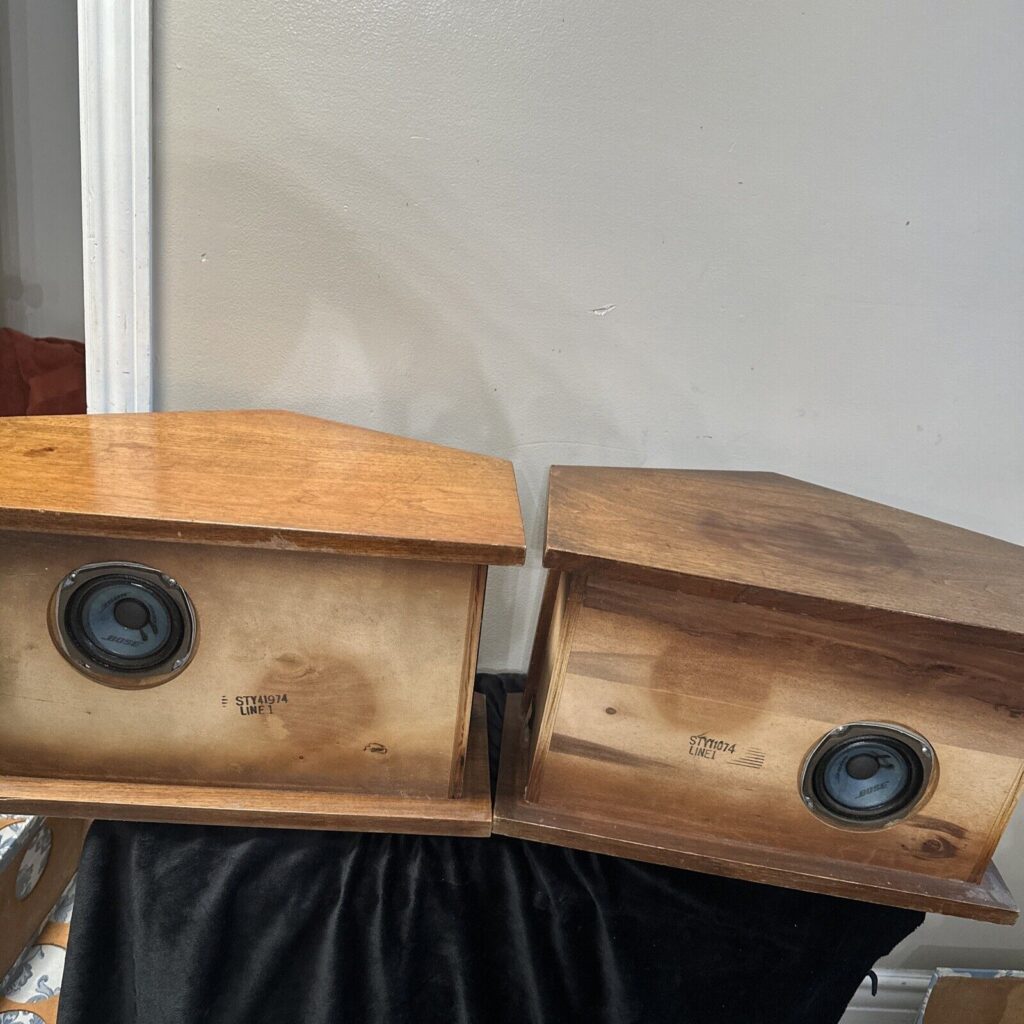
Maintains – asymmetrical front driver position.
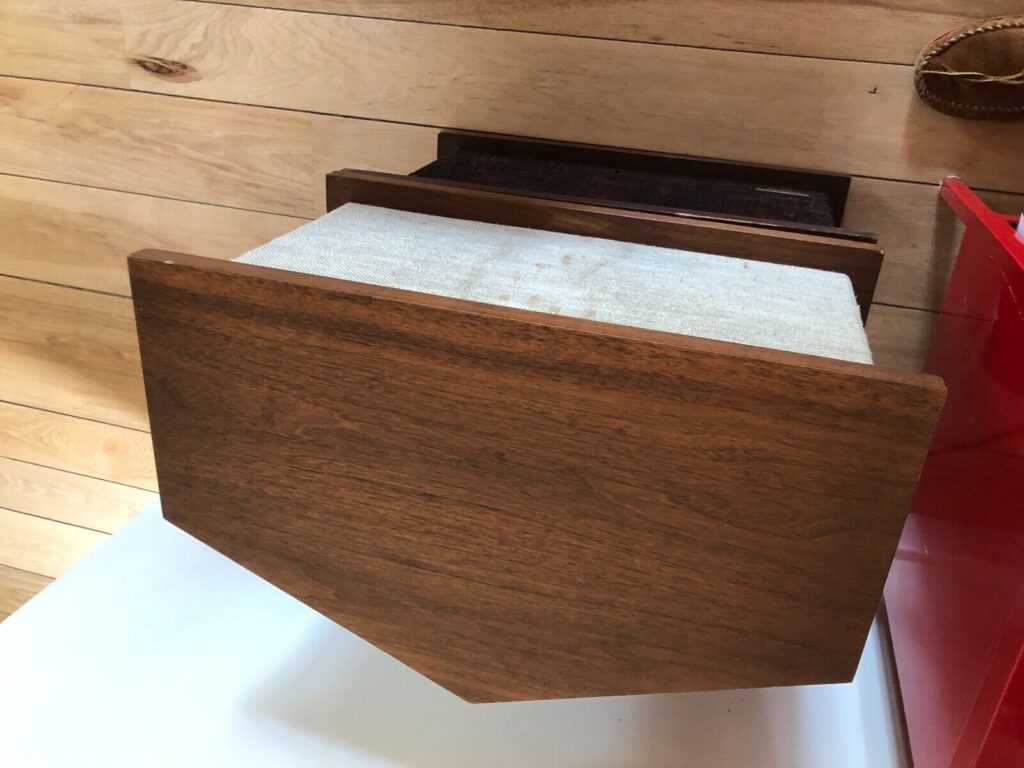
Maintains – flat front cabinet.
(Top and bottom are particle board and middle 5 walls are plywood.)
Wood: Walnut veneer
Grill: Dark, Black, Linen
Stands: White, Black, Chrome
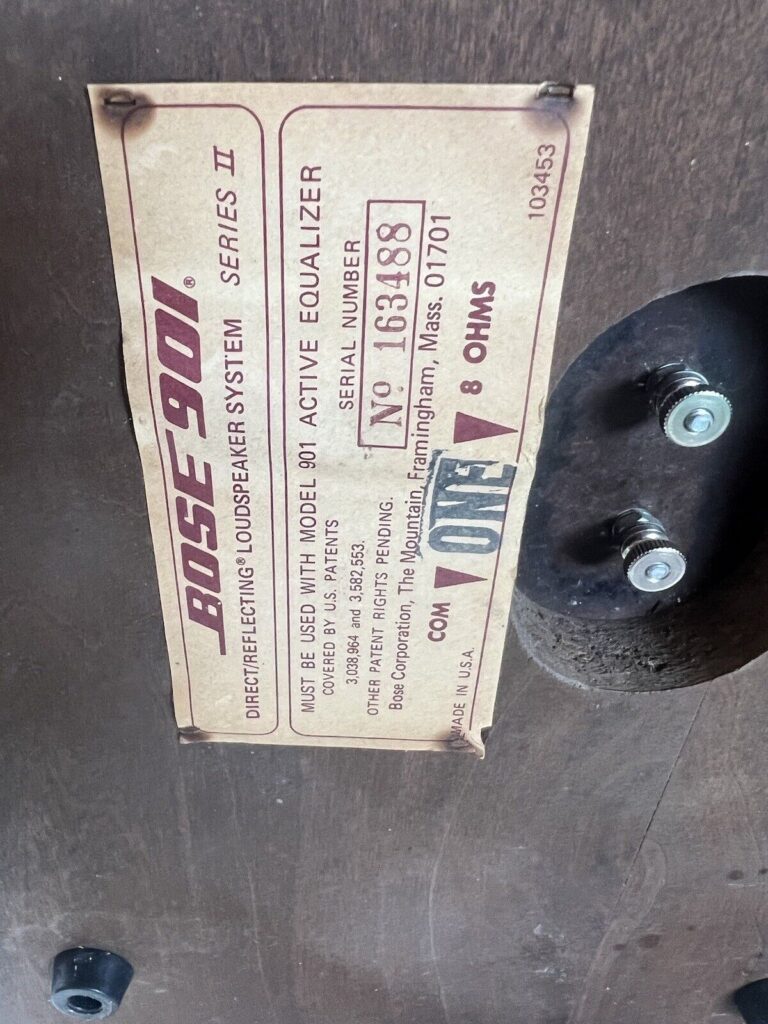
Speaker cabinet connection, serial number, and Series II info.
Note the “ONE”, these were sold in pairs due to the asymmetrical front driver position.
A more professional looking label is now in use
Series II “Active Equalizer”
New: Link to my Series II restoration project page: bose-901-eq-series-ii-restoration/
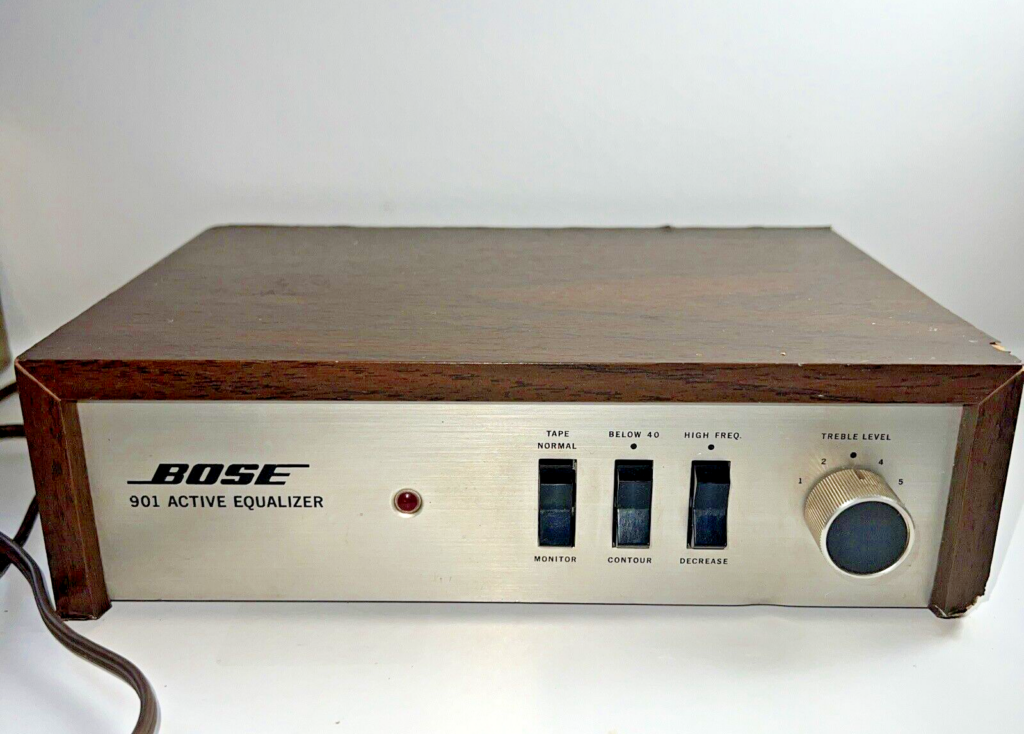
Series II “Active Equalizer” – Front view.
Wood grain case, no power switch, 3 closely spaced rockers & 1 rotary control. Bose spiffed up the front panel a bit too.
Believed to have slightly more bass and treble boost than Series “I”, but same basic circuit design, discrete transistors. Also keeps the gradual 6 dB roll-off for the low end.
Control range: ??
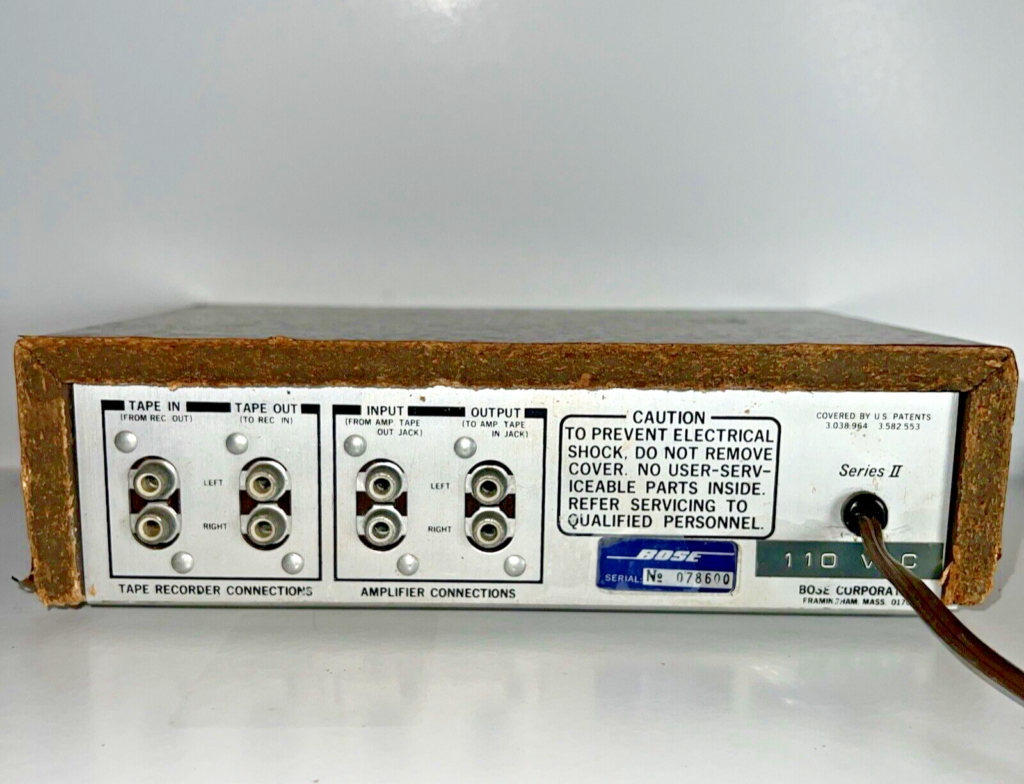
Series II “Active Equalizer” – connections.
Notice voltage label on back.
My sample has a faded UL sticker on the back, unlike this one.
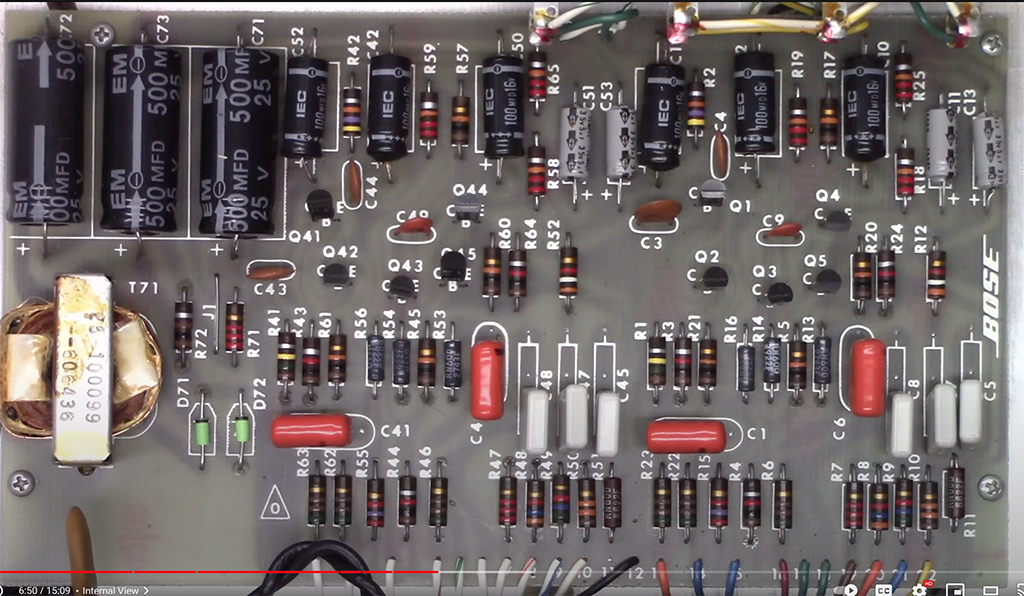
Series II “Active Equalizer” – PCB top view
Still discrete parts
It is believed there may have been some fine tuning of the EQ curves from the Series I to Series II “Active Equalizers”.
Given the speakers design, those subtle differences are likely swamped by room interactions, but it would nonetheless seem prudent to not mix up the Series I and Series II “Active Equalizers” if possible.
UPDATE: I obtained a Series II box in late 2025, the EQ curve is documented here: Bose 901 EQ – Series II
(Perhaps some kind soul will send me a Series I to measure and the precise differences can be quantified?)
Comments: Made in USA
System price with Active Equalizer: SRP $550 – $598 – sales receipt seen for $525
Series II cabinets are basically same as Series “I” but had better driver matching, achieved by using the new “Syncom” grading system (here). Overall cabinet build quality now much better and cleaner looking. Also more speaker cabinet color options and the small silver “BOSE” logo was added to the front grill.
Series II Variants
New Bose driver design phased in.
Per Greg Szekeres, Mark Cerasuolo, and Michael Dienaar – “The end of Series II production (1976-ish) started using the new 3 screw composite basket, but still used a copper coil 8 ohm voice coil instead of the later aluminum wire Helical Voice Coil 0.9 ohm.”
This means the combined series/parallel wiring is still used too.
The end of Series II “3 screw basket” version also switched to the new foam surround, which, sadly, is the beginning of the foam rot story.

Gruesome example of foam rot!
Also, a new cabinet variant intro’d, the Continental”
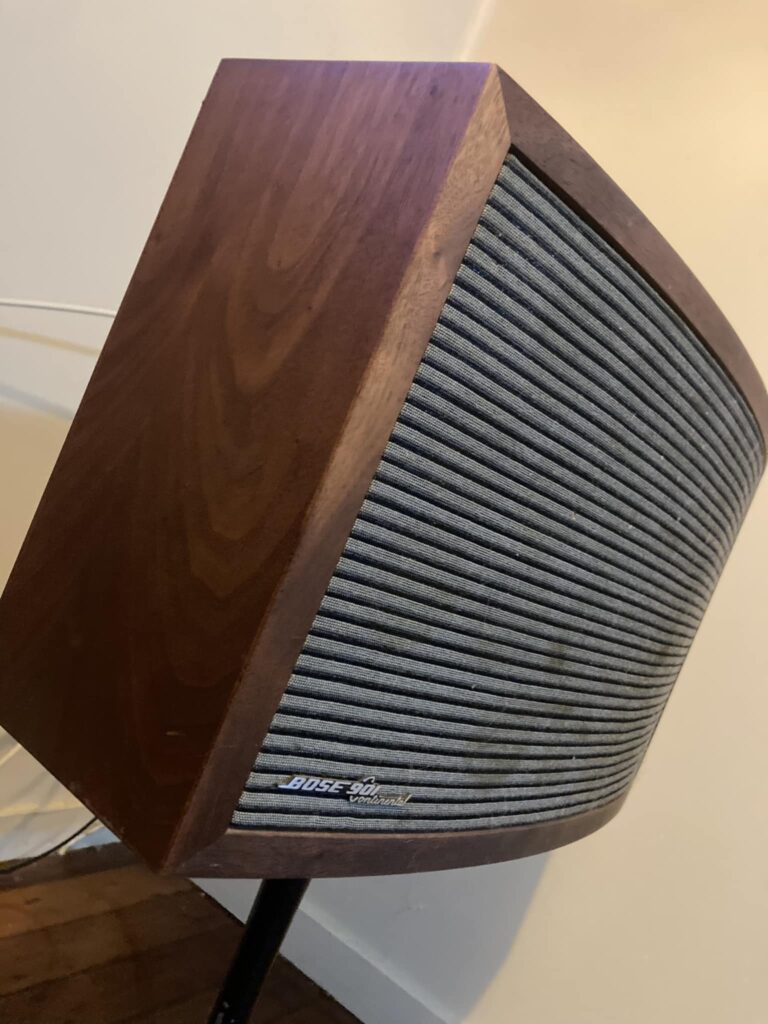
This design pioneered the more elegant looking curved front used on all subsequent models, but still with a sealed box (i.e not ported) design.
It is believed some of these had the standard Series II Rola 8 ohm 4 screw drivers, and some had the new 3 screw composite basket but with a copper coil 8 ohm voice coil. Could have either cloth or foam surrounds as the new driver design was being phased in.
This extra cost option is moderately rare, as it was a short run.
Here’s a link to another page of 901 I and II info: https://community.classicspeakerpages.net/topic/10416-restoration-replication-of-23-a-set-of-a-early-901-system/
Gen Two – Major redesign changes!
New drivers, new injection mold, matrix ported cabinet, new audio processor box, adds third terminal
901 Series III: 1976-1978
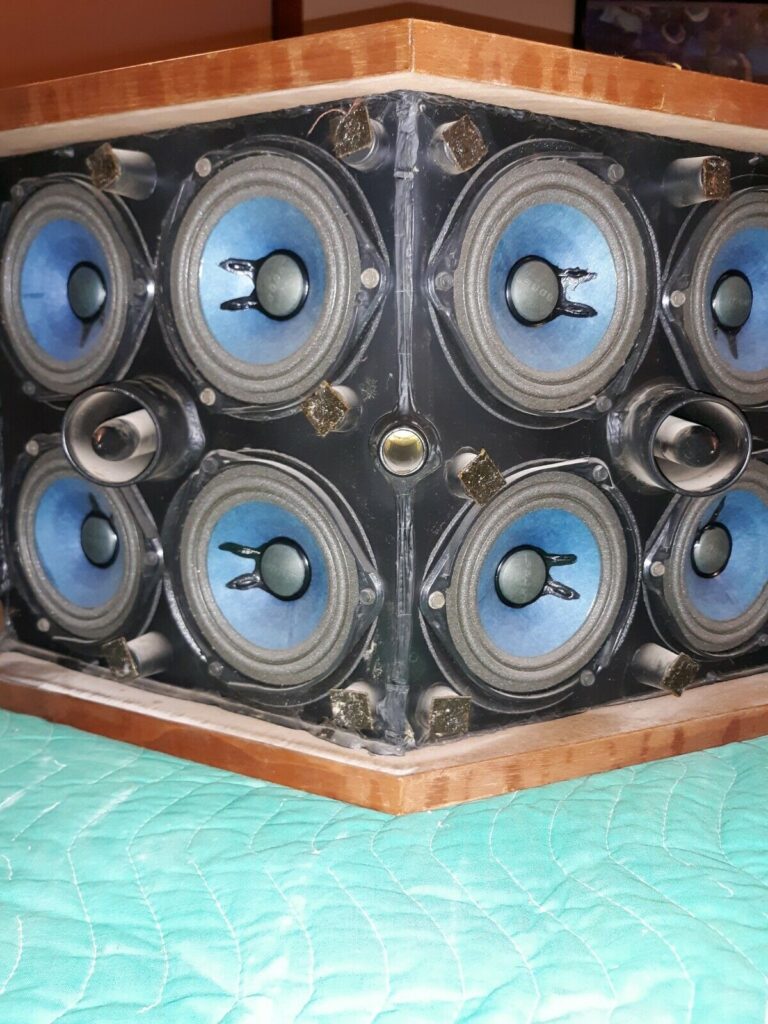
Drops – out-sourced, 4 screw, 8 ohm Rola drivers, flat front cabinet w offset speaker mount.
Intros – First gen of Bose designed 4.5″ driver with a 3 screw basket, 0.9 ohm, aluminum flat wire edge wound voice coil, polyester foam (rot prone) surround. The complex wiring changed, now all 9 driver are just in series.
Also sports the new “Matrix” ported cabinet w curved fronts all around, prototyped by the Series 2 “Continental” model.
Also new is the third speaker cabinet terminal used with the forthcoming Bose “Spatial Receiver” connection.
Maintains – fiberglass stuffing, part one/part two pairing.
Driver P/N: ?
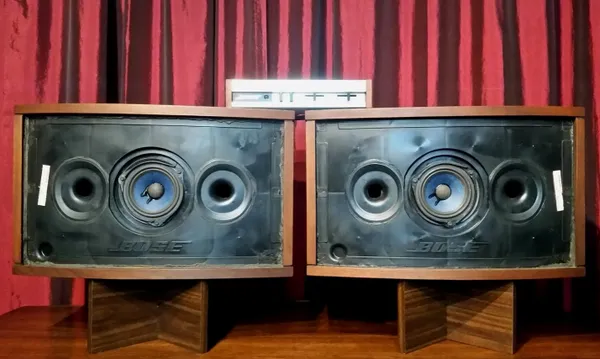
Intros – Front side ports and the centered forward facing driver
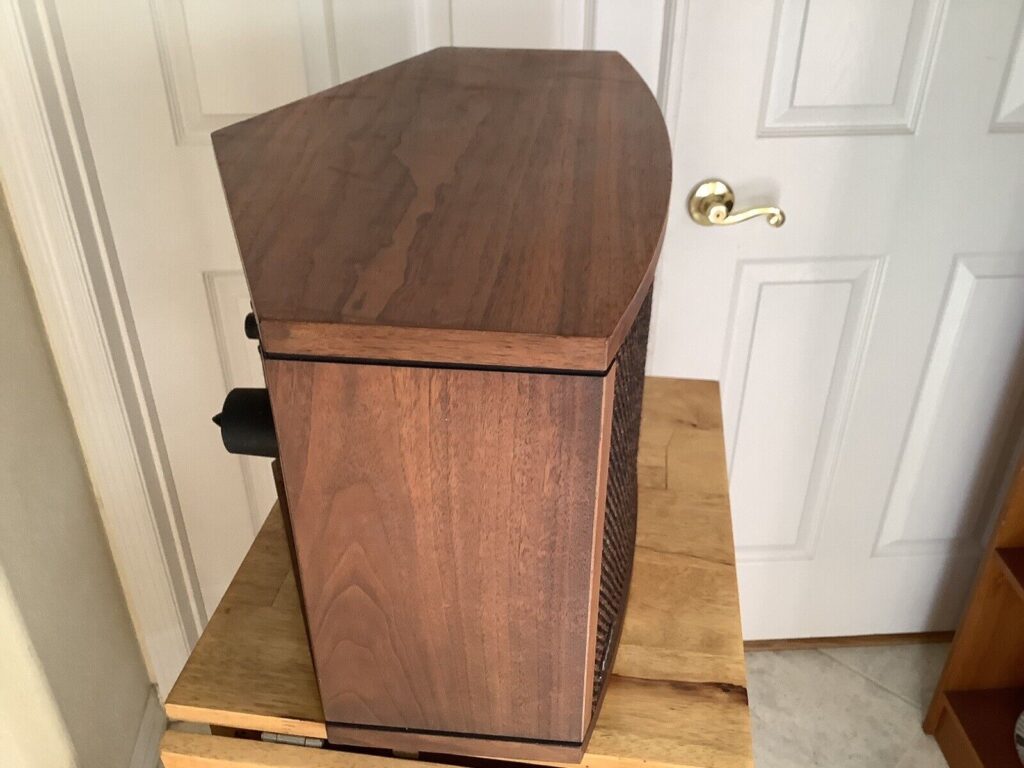
Wood: Walnut veneer,
Grill: Dark
Stands:
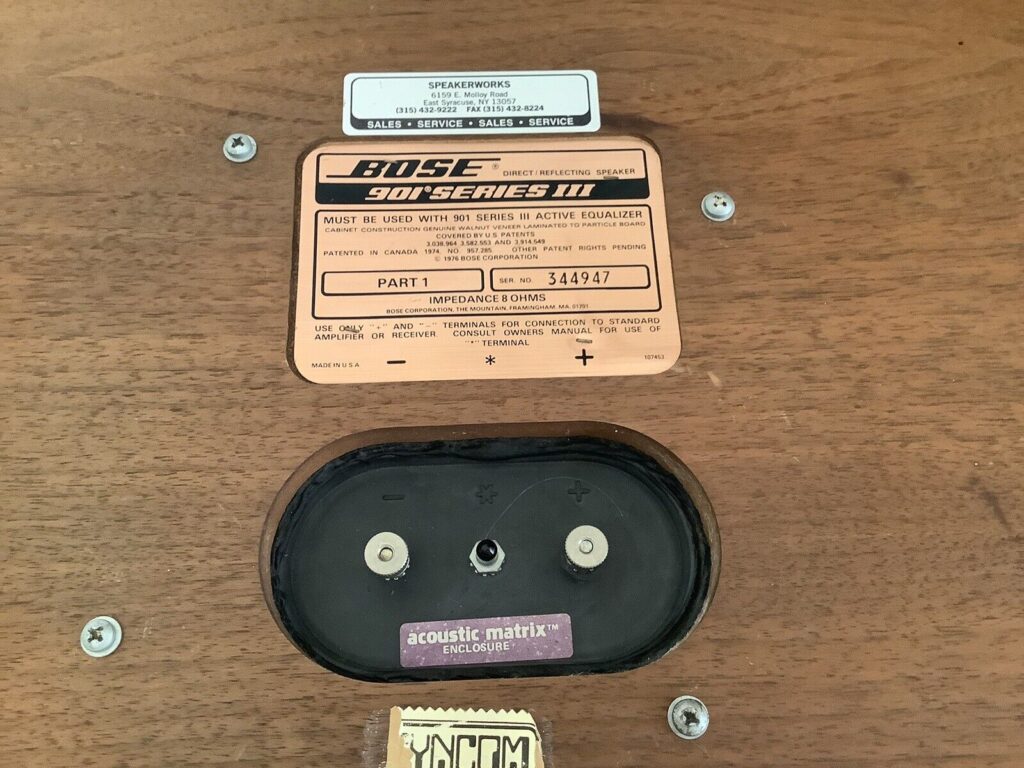
Speaker cabinet connection and serial number.
Shows new third speaker cabinet terminal for the “spatial receiver” connection.
Series III “Active Equalizer”
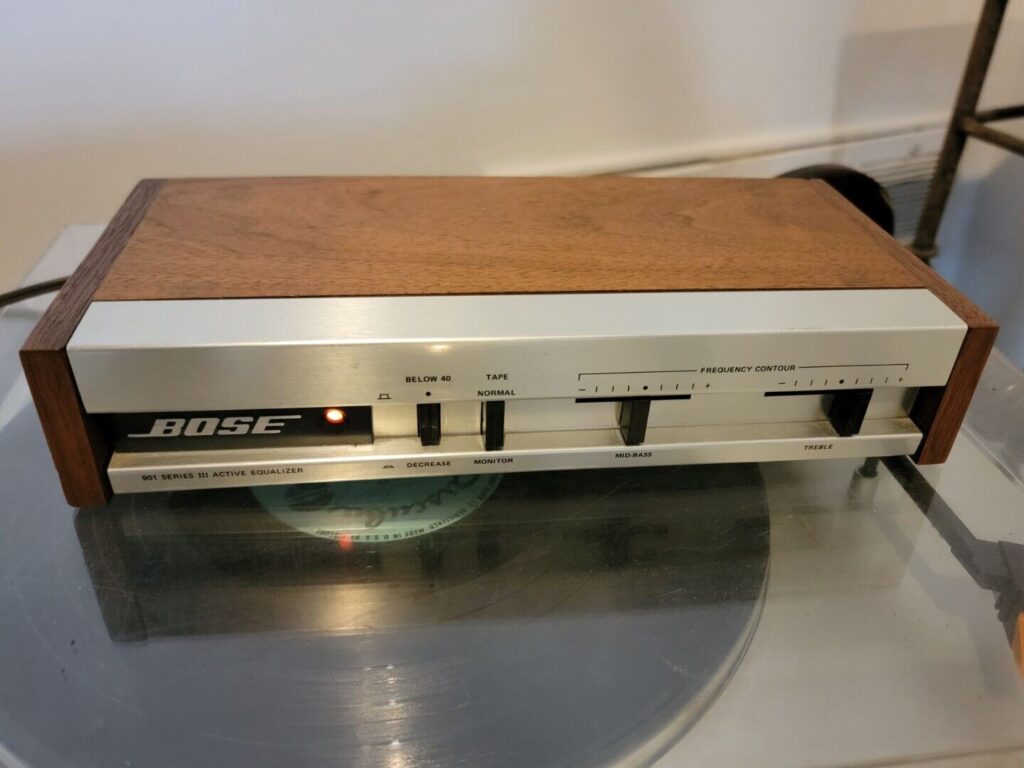
Series III “Active Equalizer”
Intros – Big design change!
New longer wood case w wood caps, sliver faceplate, 2 pushbutton, 2 sliders.
Significant PCB change, but still a discrete transistor based design.
More importantly, the series III “Active Equalizer” intros a significantly modified EQ curve for the new speaker drivers and ported box design, very different from Gen One (Series I and II).
Notably, the new EQ curve was tailored for the ported cabinet redesign with a sharper 12 dB rolloff below 35 Hz. The closed boxes used a more gradual 6 dB rolloff, as the sealed box provided the needed speaker excursion control.
Controls: (from Series IV svc manual, believed to be the same for the III here)
Low filter: -5dB @40Hz
Mid-Bass: +/- 8dB @ appx 250 Hz
Treble: Shelving, +/- 8dB @ 10kHz
Series III “Active Equalizer” PCB
New design with re-dimensioned PCB, but still using discrete transistors.
Comments: Made in USA
System price with Active Equalizer: MSRP $765 – $795
The Series III had a short run, about 2 years. The then-product manager stated the speaker midrange was too pronounced, which is why the Series IV was put out so quickly.
Significantly the eventually “rot-prone” polyester foam driver surround history starts here.
901 Series IV: 1978-1983
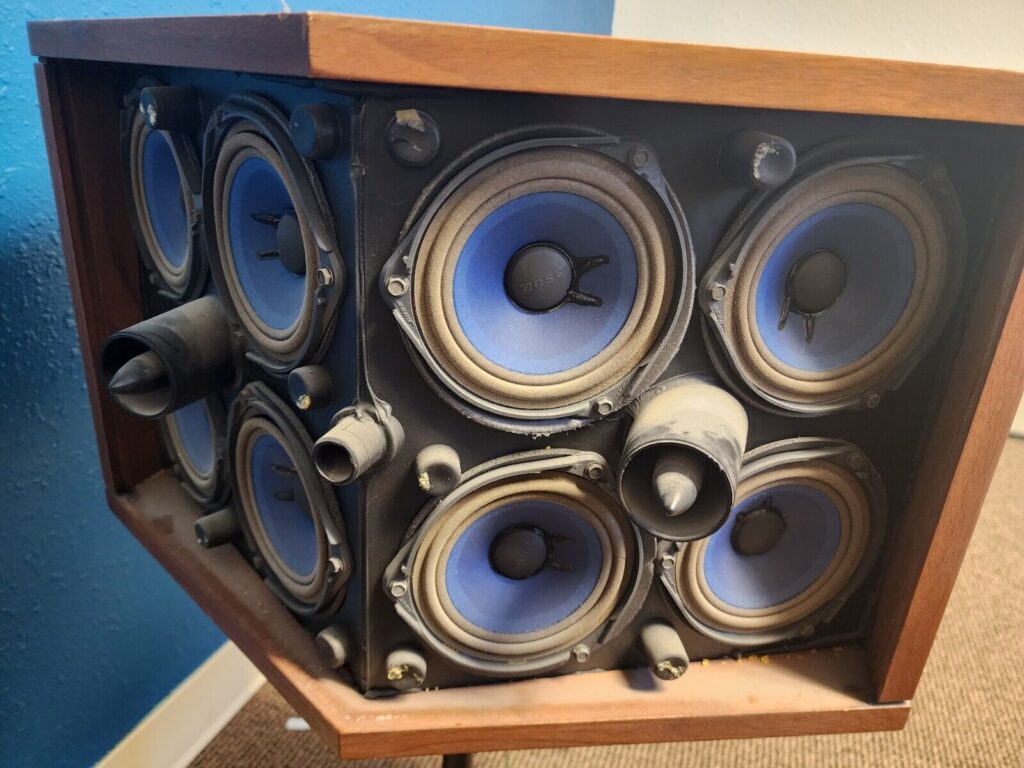
Maintains – 3 screw 4.5″ 0.9 ohm drivers, series wiring, third speaker cabinet terminal for the “spatial receiver” connection, fiberglass stuffing, part one/part two pairing.
(There appears to be a minor driver revision per the Series IV users guide pg 14). (Polyester foam speaker surrounds are still in use, the rot problem hadn’t surfaced yet.)
Intros – New EQ design using op-amps
Driver PN: 111393-5
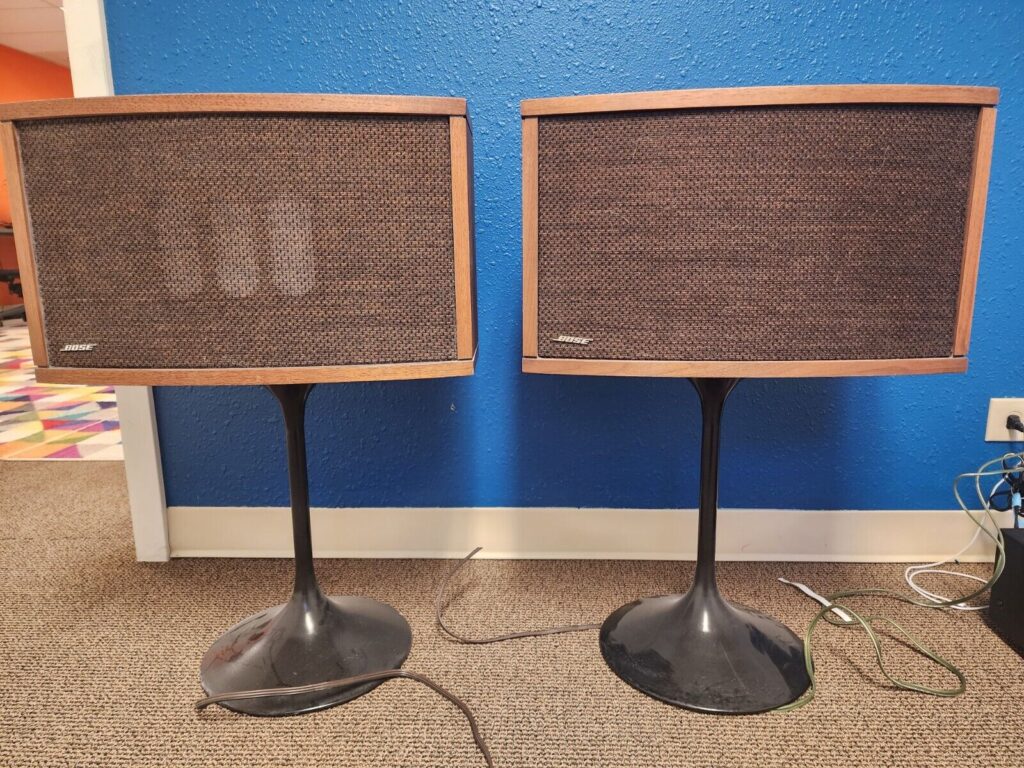
Wood: Walnut veneer,
Grill: Dark,
Stands: Black
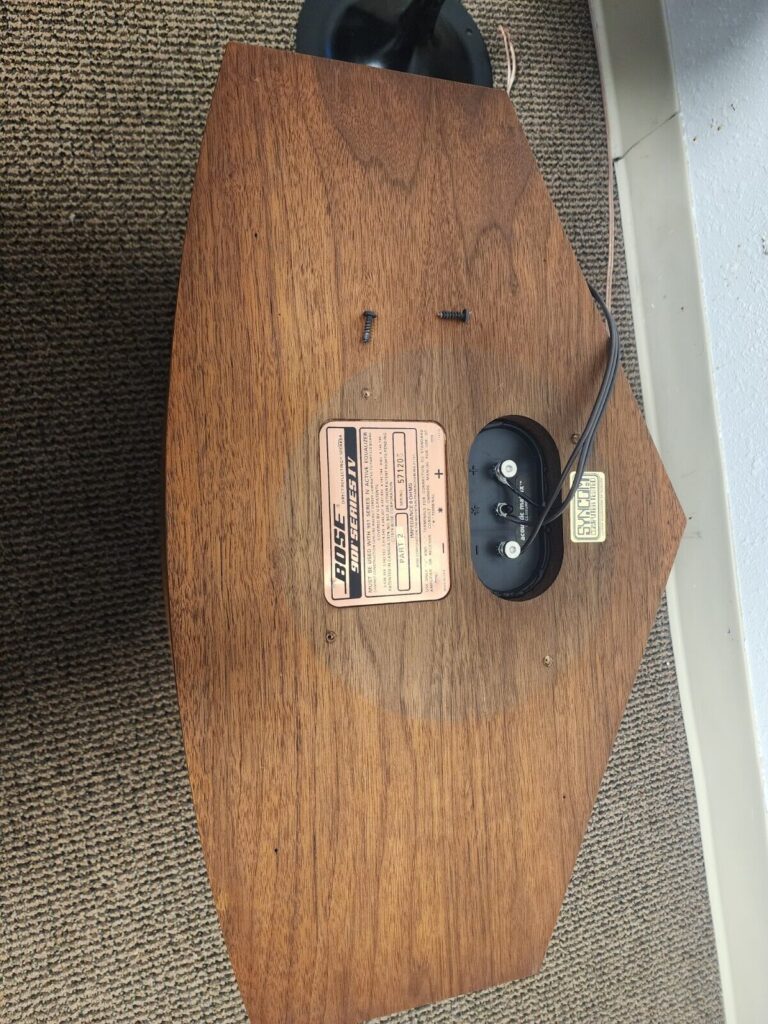
Speaker cabinet connection and serial number.
Note third wire nut is still there.
Series IV “Active Equalizer”
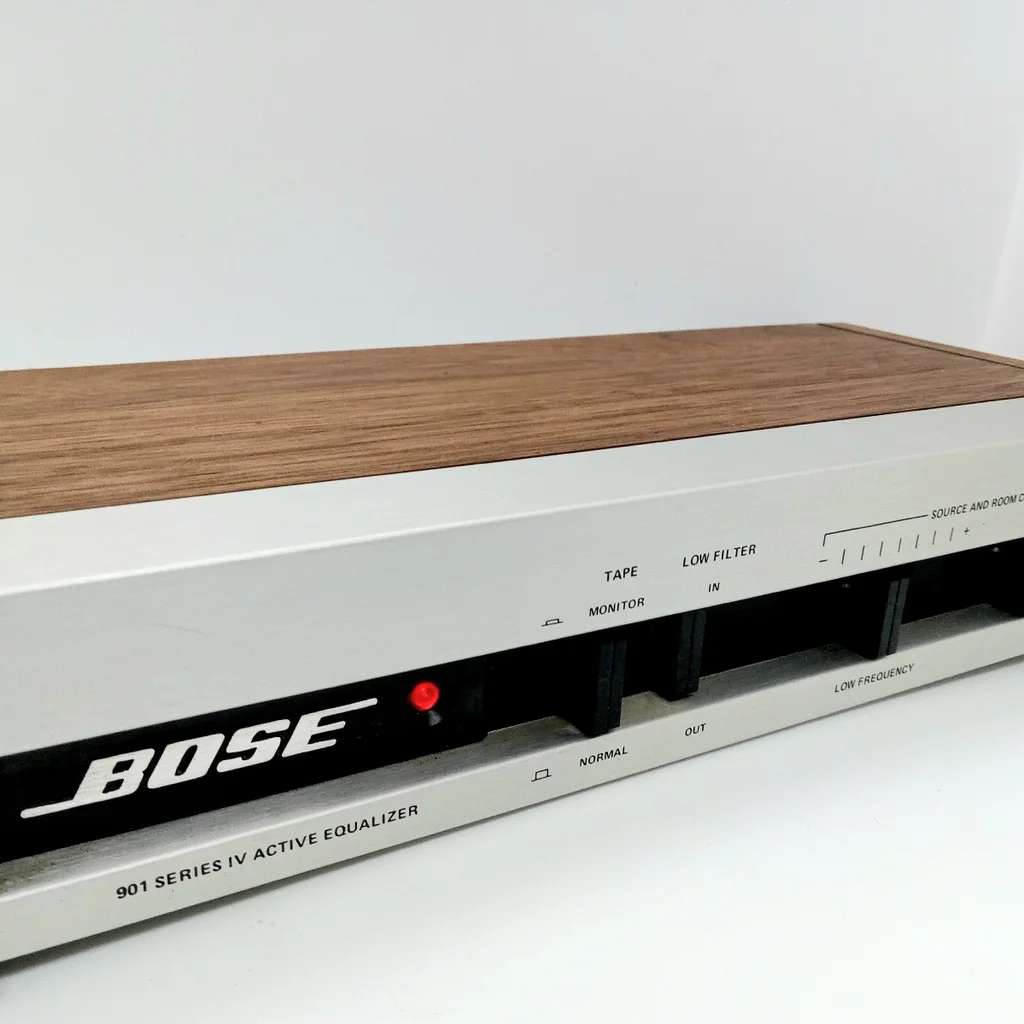
Series IV “Active Equalizer”
Intros – First op-amp based design (instead of discrete transistors).
[ LF353N, TL072, or 4458 op-amps interchangeable, may be replaced with RC4558, among others. ]
Maintains – Long wood case w wood caps, sliver faceplate, 2 pushbutton, 2 sliders, 1 power LED.
No fuse.
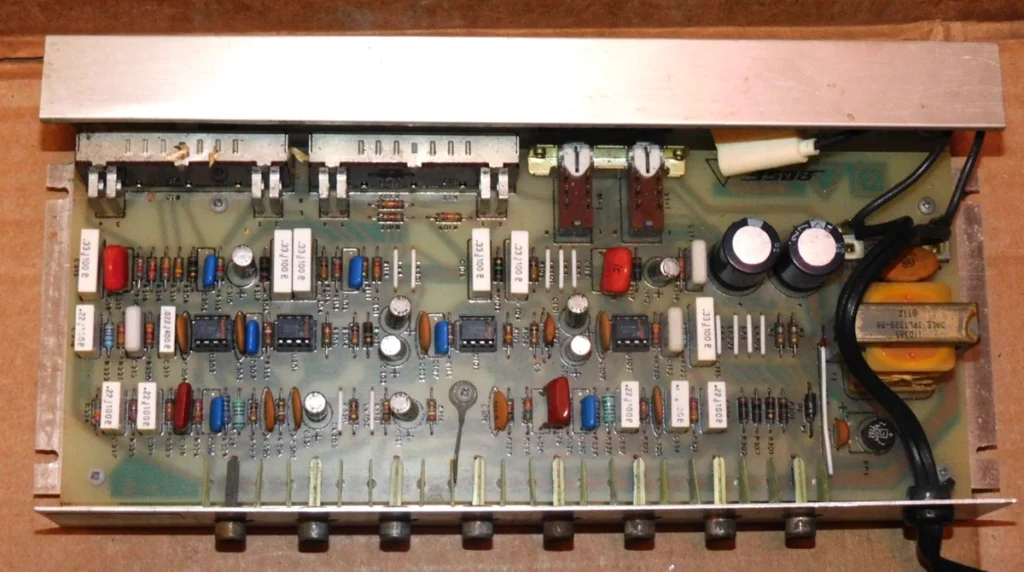
Series IV with op amp PCB, +/- 15 volt power rails, zener regulated
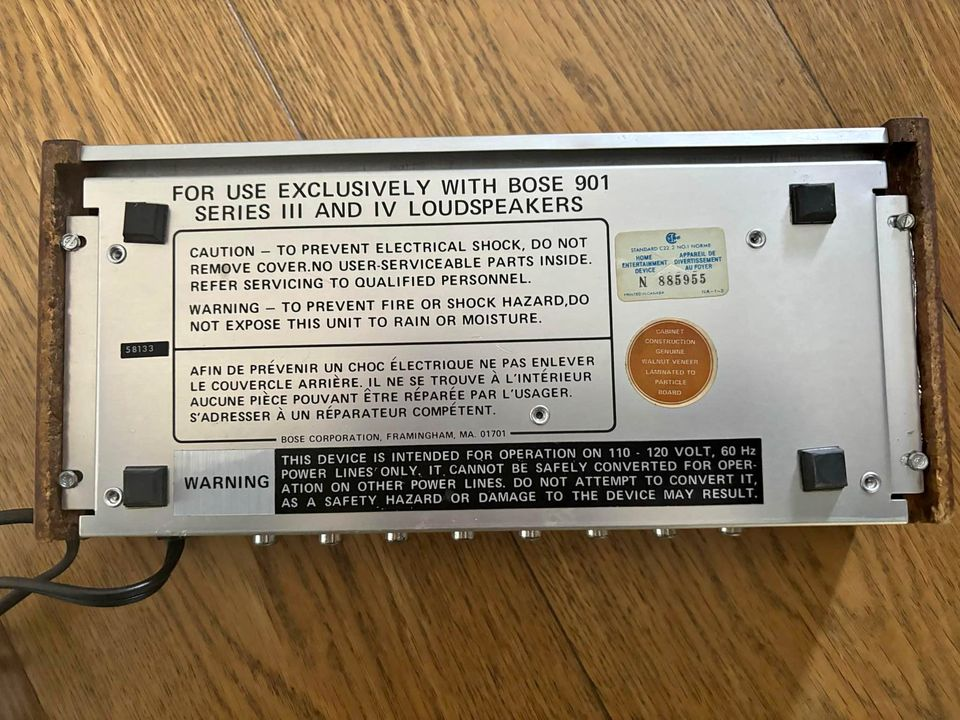
Any questions on whether Series III and IV “Active Equalizers” are interchangeable should be answered by this pic.
The 240 VAC version has jumpers that permit 100/120 operation; however the “100/120 only” version requires the double primary transformer as a service change to run on 240 VAC.
(Here’s a pic of the 240 VAC version set to run on 120 VAC, note the jumpers used to change the AC input voltage.)
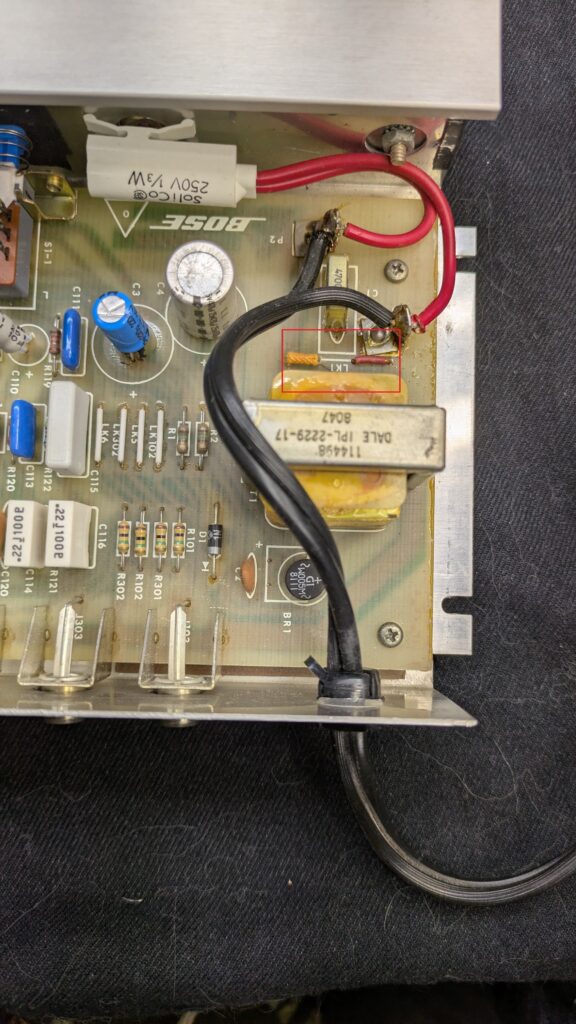
The service manual indicates “the 0 dB reference is at 250 Hz @ 200 mV, may overload at 300 mV.” This is a rather low signal level, it was improved in the next gen box.
Controls: (from Series IV svc manual)
Low filter: -5dB @40Hz
Mid-Bass: +/- 8dB @ appx 250 Hz
Treble: Shelving, +/- 8dB @ 10kHz
NOTE:
The Series V service manual from 1992 refers to a Series “V” and a “IV.B” “Active Equalizer”. Here’s a pic of a Series IV.B box found on eBay
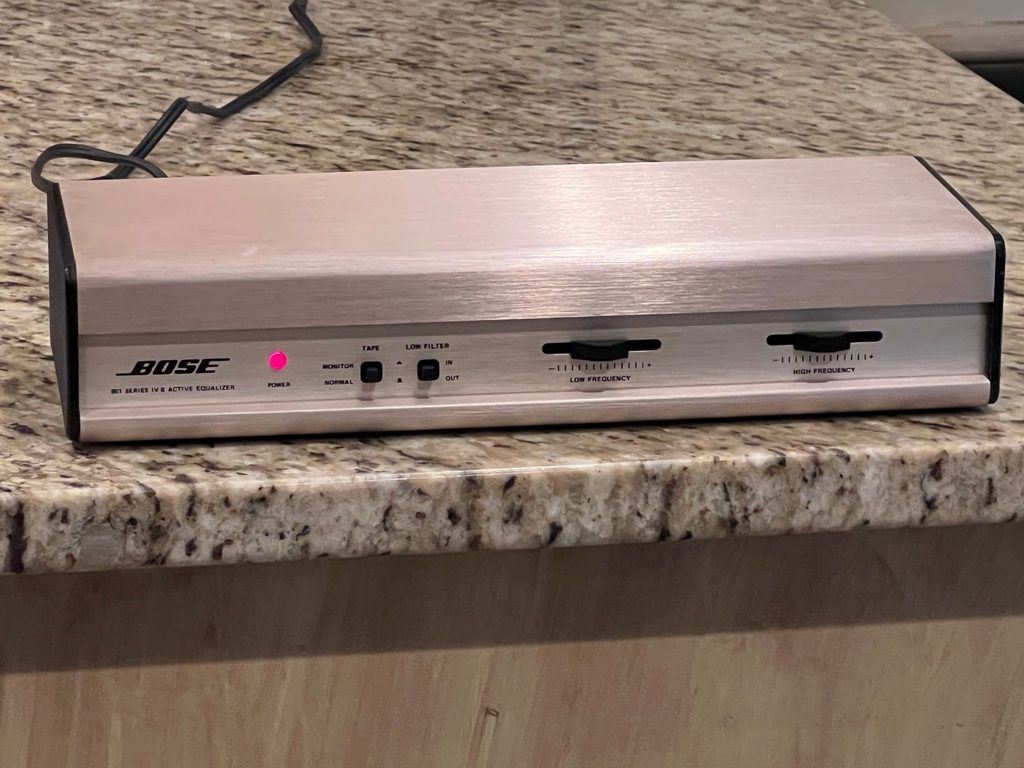
The “IV.B” has the next gen “V” box in a silver color, but has R/C part changes and clear IV.B labeling on the front and back
My best guess is the “IV.B” is production backport of the next gen “V” op amp design and box with the older more aggressive III/IV EQ curve. Probably done for for serviceability and warranty repair reasons, although COGs may have played a part in it too.
Comments: Made in USA
System price with Active Equalize: MSRP $860 – $1399
Series IV service manual also refers to a part one and part two speaker version, with slightly different speaker wiring for the third terminal in each box. It’s probably a tweak for the spatial receivers.
(I have seen a pic of a Series IV speaker label that has a “PART 2” sticker.)
Gen Three – Cabinet and driver foam surround changes, drops third connection
901 Series V: 1983-1987
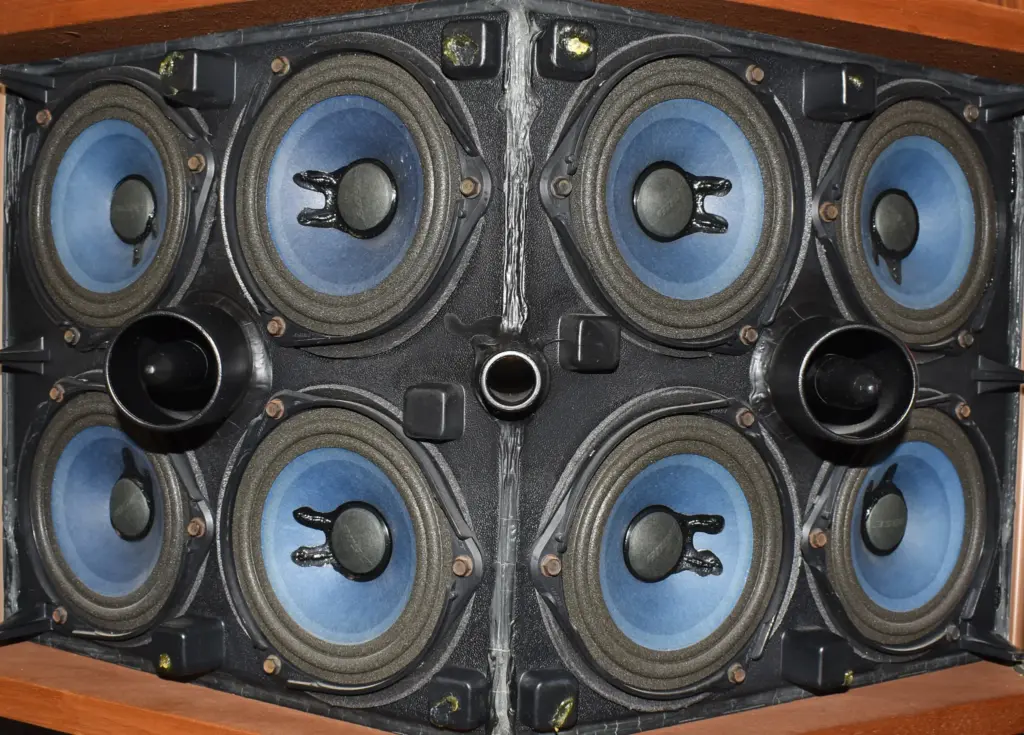
Maintains – Three screw, 4.5″ 0.9 ohm drivers, series wiring.
Drop – 3rd terminal (after 7 years and two series of speakers) and Part One/Two pair sets. (That implies the Spatial receivers were likewise EOL’d about this time.)
Intros – Round speaker cup for terminals, Poly filling behind each driver.
Early run Driver P/N: 124276-5
[ Later “rot free” driver P/N: ? ]
Part/(most?) of the way through the Series V run was the driver surround change. The surround was changed from polyester foam to polyether foam to minimize the bacterial and environmental rot issue. This change is believed to have started shipping about 1986, but there are no known identifications or markings for this change point. Unfortunately.
The surround change may or may not coincide with a bead of hot-melt glue on the back to smooth the response of the driver. An ex Bose employee confirmed glue bead existence, but could not remember not when implemented or how long it was applied.
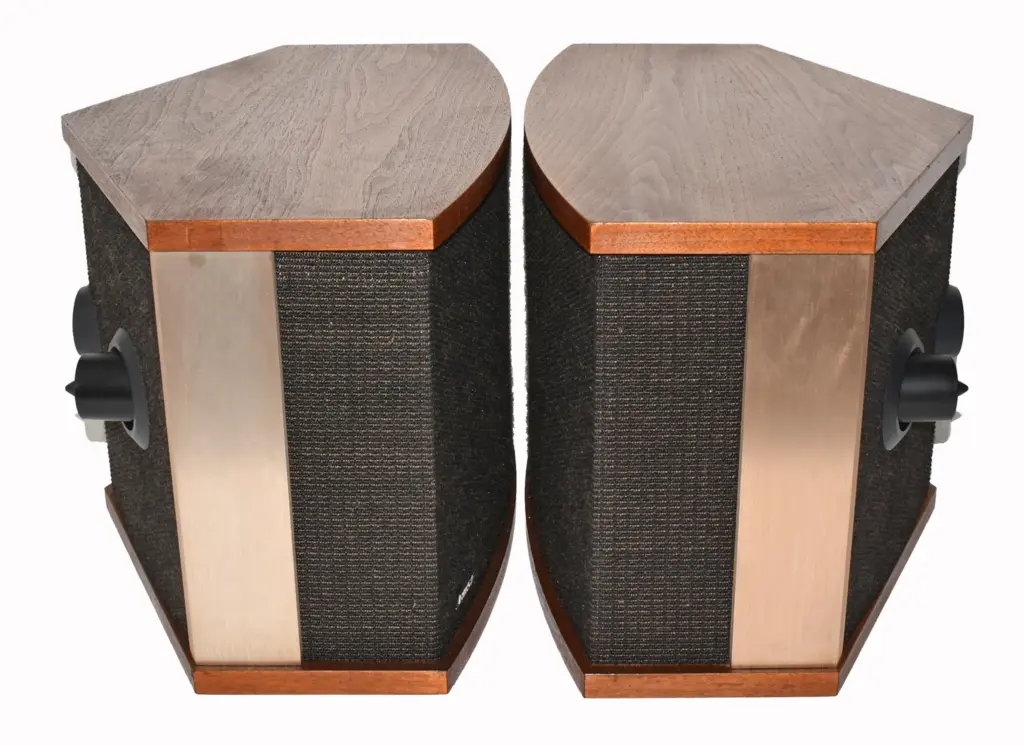
The Series V introduced bronzed aluminum side panels, which were “controversial” (aesthetic and acoustic reasons are cited), and were dropped in next version.
Wood: Walnut veneer
Grill: Dark, plastic frame
(no other colors?)
Stands: Black
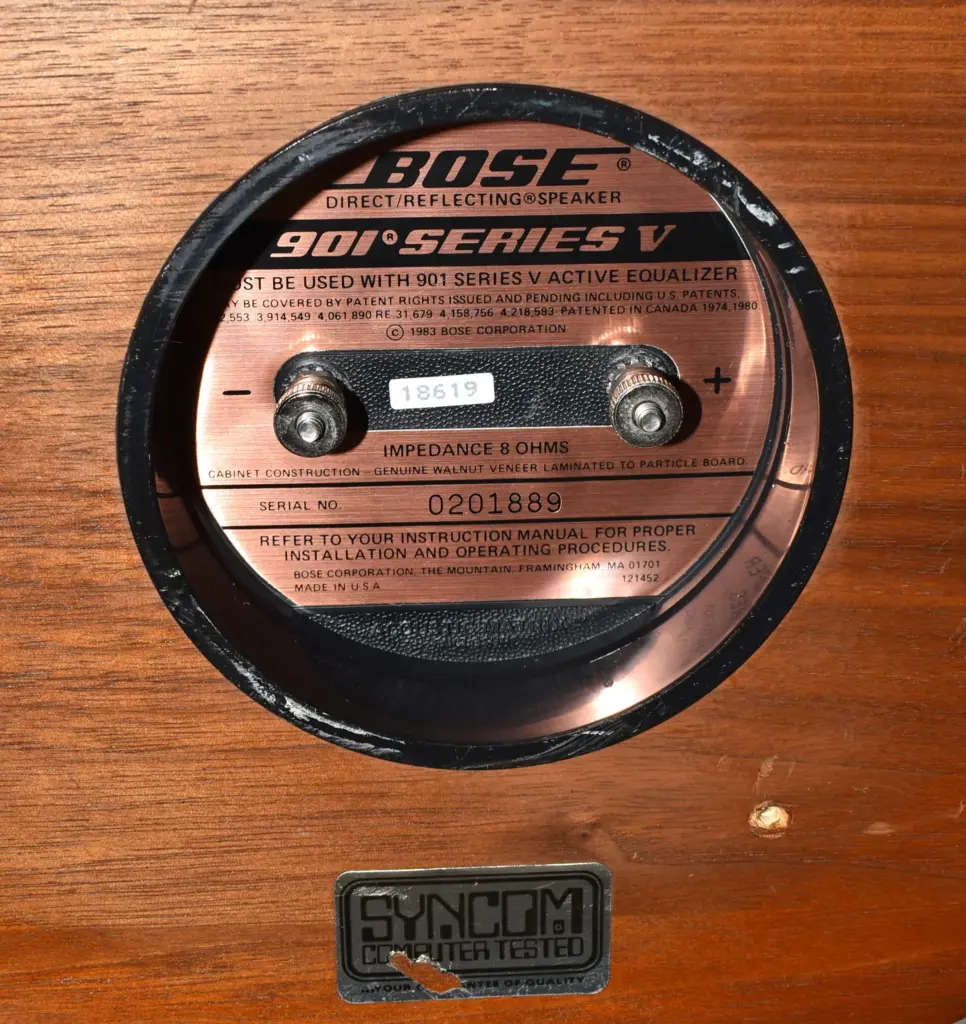
Speaker cabinet connection and serial number. Note intro of the round “cup” for a cleaner look.
Drop – 3rd speaker terminal, which implies the “spatial receiver” had run it’s course too.
Series V “Active Equalizer”
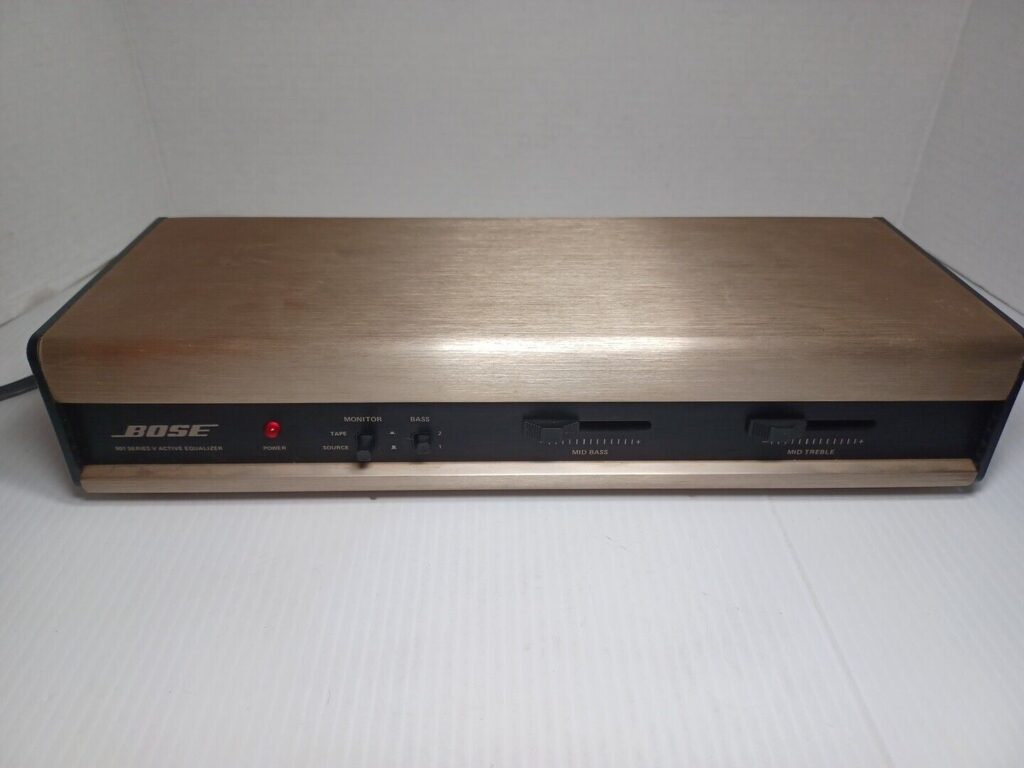
Series V “Active Equalizer”
Intro – wide brushed silver case w black control area, 2 pushbutton, 2 slider, 1 power LED.
Third new EQ curve, different again from from gen one (I-II) & gen two (III-IV) Series.
Here’s a chart that illustrates this change (from the series V service manual):
As mentioned earlier, it appears the silver box Series V also had a “backport” version, the series IV-B. It sports a silver faceplate and is clearly labeled as IV-B
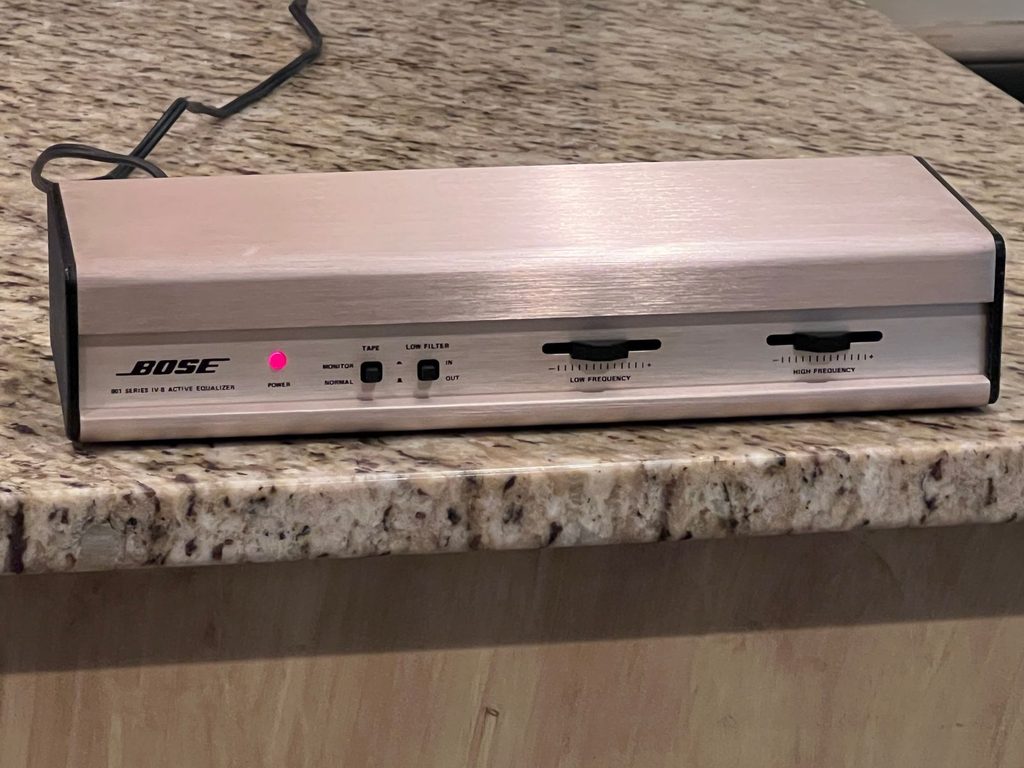
Series V equalization curve Series IV equalization curve
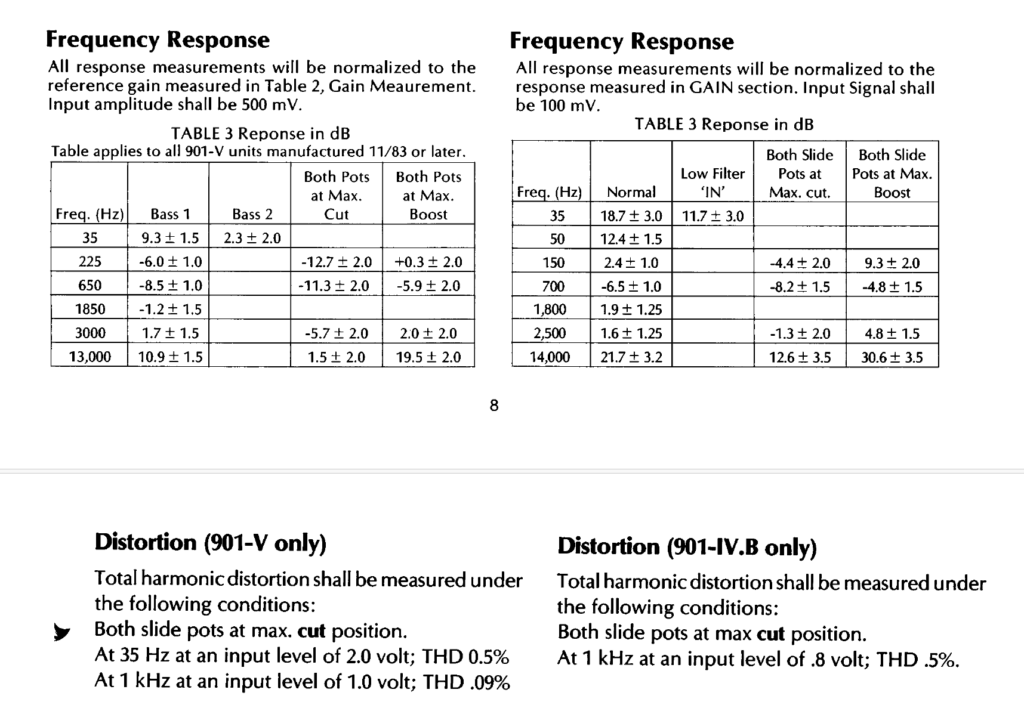
Things to notice:
A) The EQ boosts at the frequency extremes for the series V (and by inference VI) is much less aggressive than the III/IV, about half. (!)
B) The max treble boost for the III/IV is an insane 30.6 dB!
C) The extreme boosts also caused the THD for the III/IV to skyrocket, by 5X or so.
D) Lastly, the boost obviously caused headroom issues; note the reference voltage change.
I theorize two things could account for this:
A) Changing market conditions drove a revoicing effort.
B) Later systems were voiced at a louder SPL, so less “Smiley” EQ boost needed to sound ‘right’. (Ref Fletcher-Munson loudness curves)
Perhaps both.
Series V control range: (from Svc note)
Mid-Bass: +/- 6dB @ 225 Hz
Mid-Treble: +/- 6dB @ 3kHz
Bass (cut) Switch: – 6dB @35 Hz
Comments: Made in USA
System price with Active Equalizer: MSRP $1399 – $1485
Series V and Series VI first version processor box have the same EQ curve, confirmed by Bob Douglas and my own measurements.
901 Series VI 1987-2010
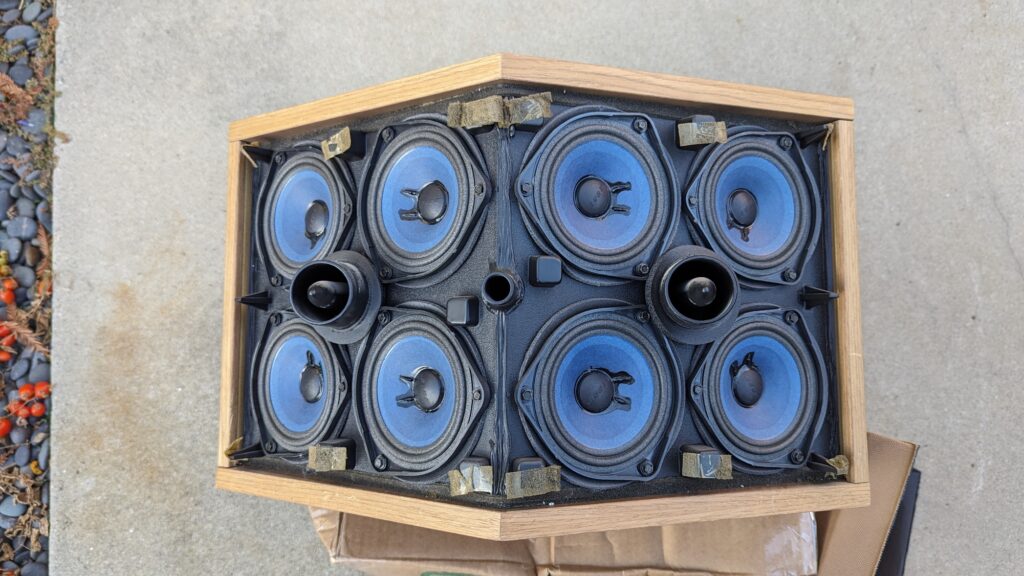
Maintains – 3 screw, 4.5″ 0.9 ohm, polyether foam, drivers, series wiring, poly filling behind each driver.
Driver P/N: 124276-501
Drops – aluminum side panels.
Intros – Simplified grill (no plastic grid frame).
To date, here have been no sightings of Series VI speakers with the polyester rot issue.
My 3 pairs of series VI confirm this.
[ The surrounds were changed from polyester foam (rot prone) to polyether foam (isn’t rot prone) late in the previous Series V speaker production run. ]
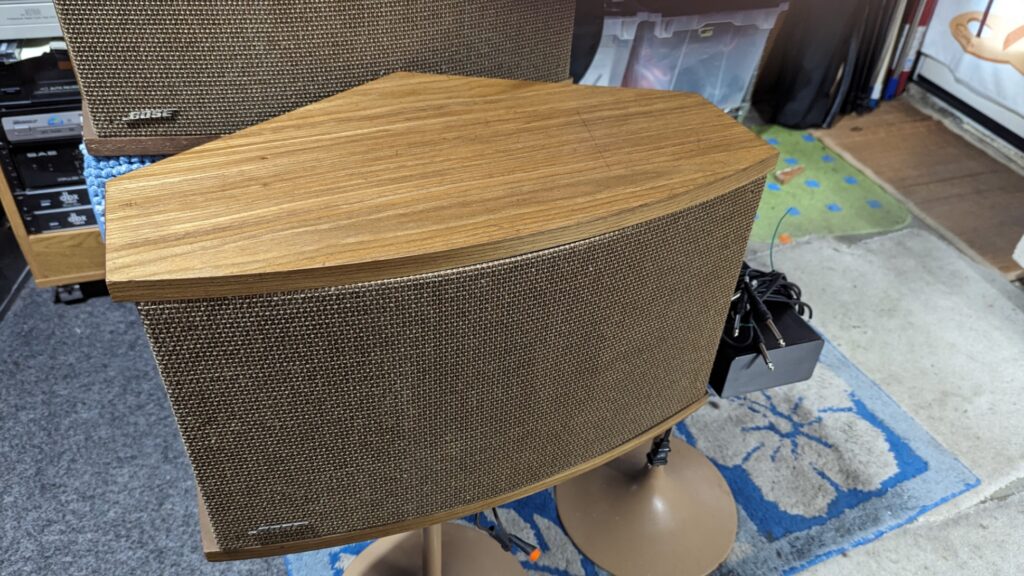
Wood: Walnut, Light Oak, Teak, Black Ash, , also the “concerto” a high gloss black “piano finish” cabinet
Grill: Dark Brown, Sand, Black
Stands: Black, Beige
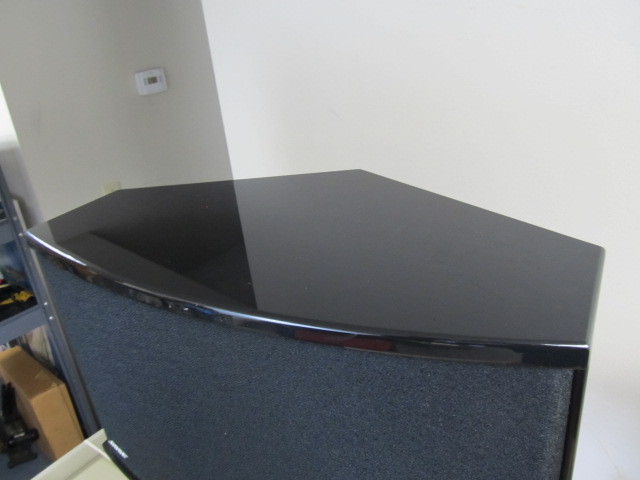
Concerto “Piano gloss black” finish
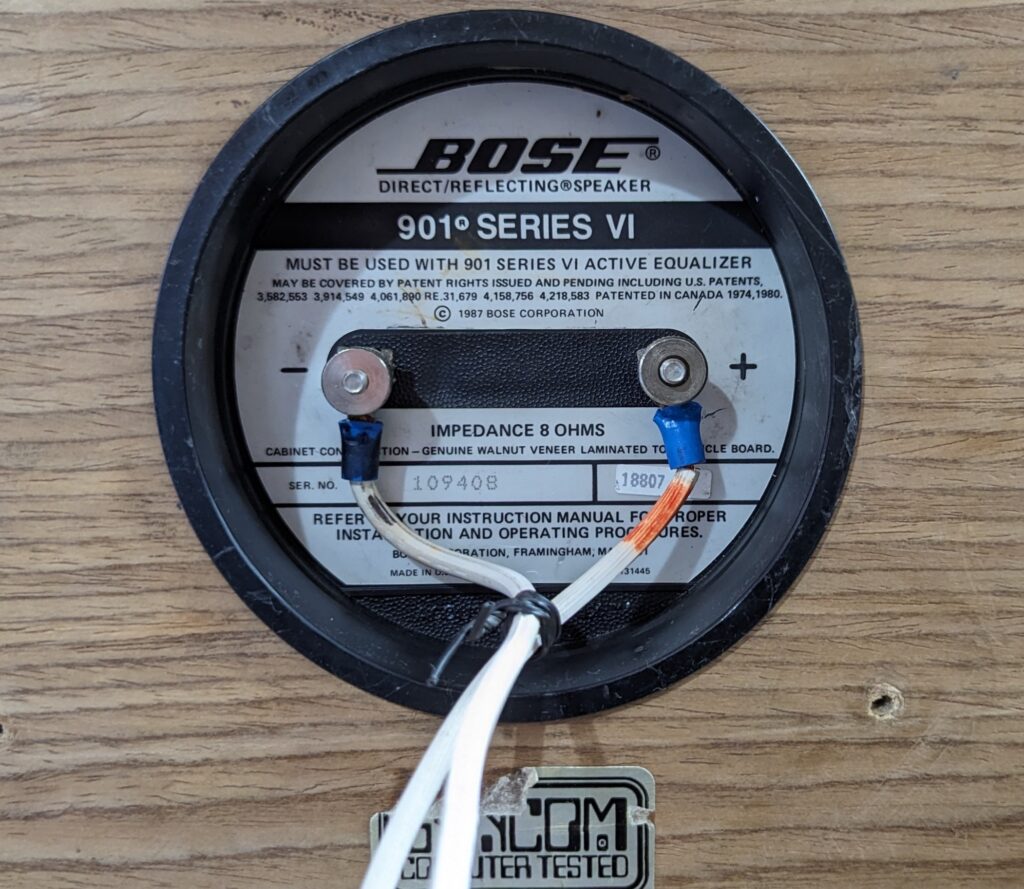
Speaker cabinet connection and serial number.
Series VI “Active Equalizer”
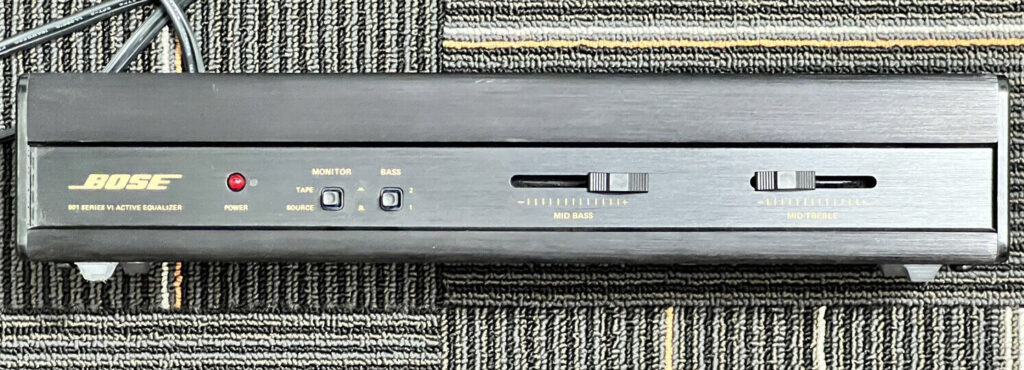
Series VI “Active Equalizer”
Intros – the metal box is now in black, red or green LED. Same as V5 box otherwise, 2 pushbutton, 2 slider, op amp based design.
Same EQ curve as Series V processor, appears to be only case and knob cosmetic changes.
Control range: (from svc note)
Mid-Bass: +/- 6dB @ 225 Hz
Mid-Treble: +/- 6dB @ 3kHz
Bass (cut) Switch: – 6dB @35 Hz
Comments: Made in USA, Canada – longest run by far, 23 years!
System price with Active Equalizer: MSRP $1499
Last Gen – Series VI ver 2 Sept 2010-2017
(Probably should have been called Series VII, based on the significant driver and moderate EQ curve changes.)
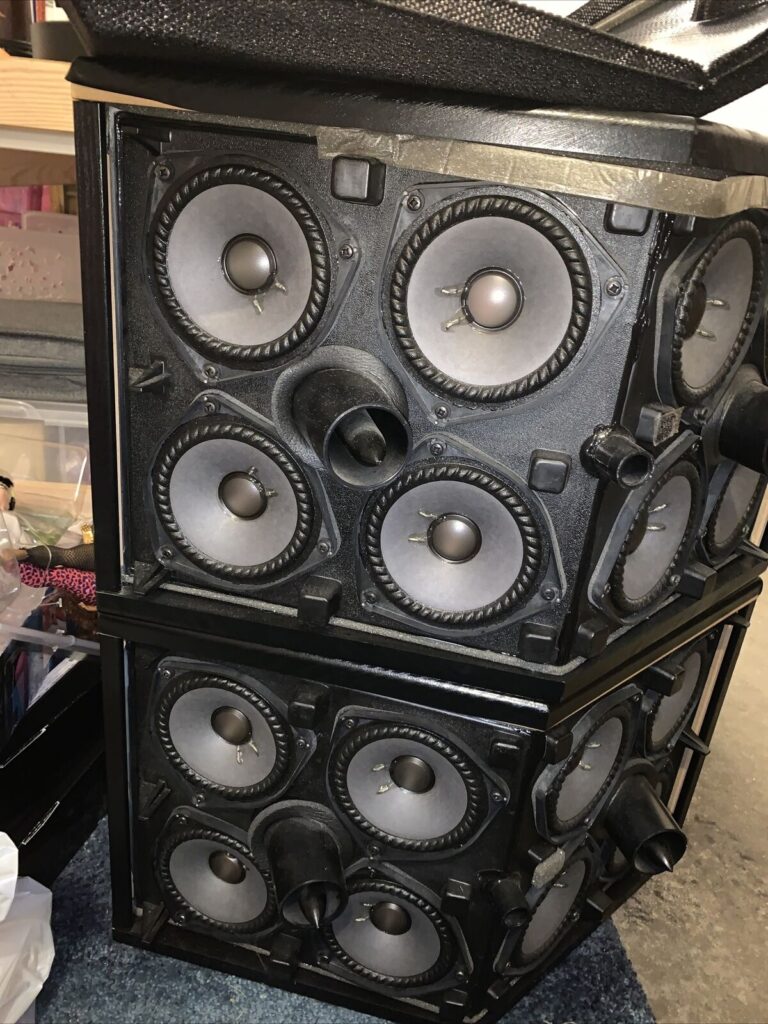
Intros – another driver change! Yay!
New design, 3 screw, 4.5″, 0.9 ohm drivers featuring a new fabric surround, SBR coated cloth. The grooves “control buckling thereby increasing mechanical linearity and reducing distortion”.
Maintains – series wiring.
Uses a different EQ curve from the std VI cabinet; a label on the “Active Equalizer” box identifies this change.
Driver P/N: 296997-001
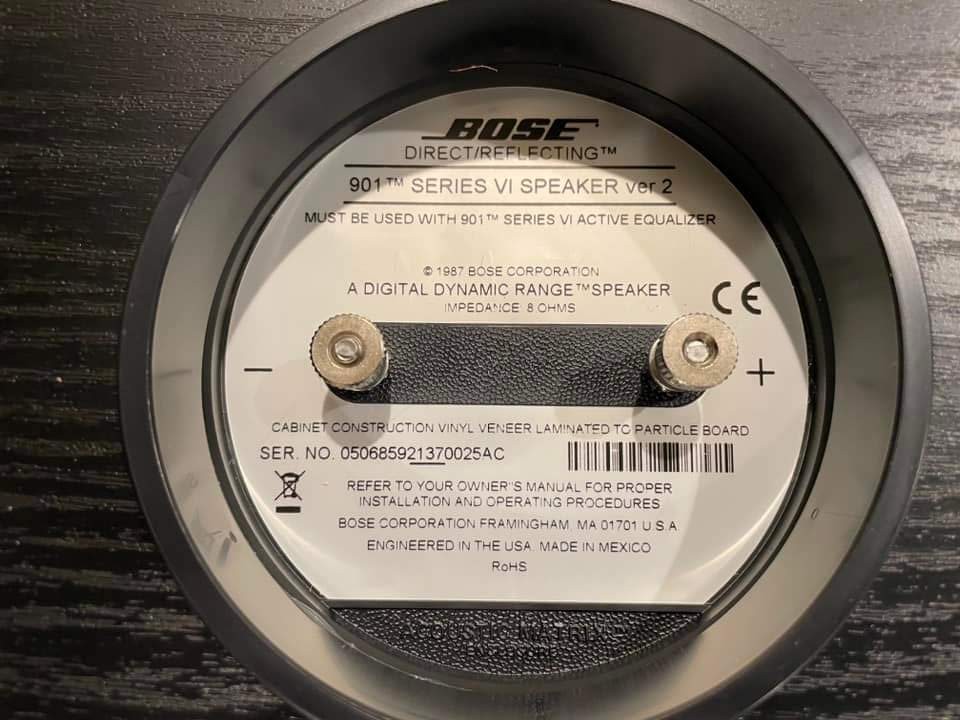
Note “ver 2” after Series number.
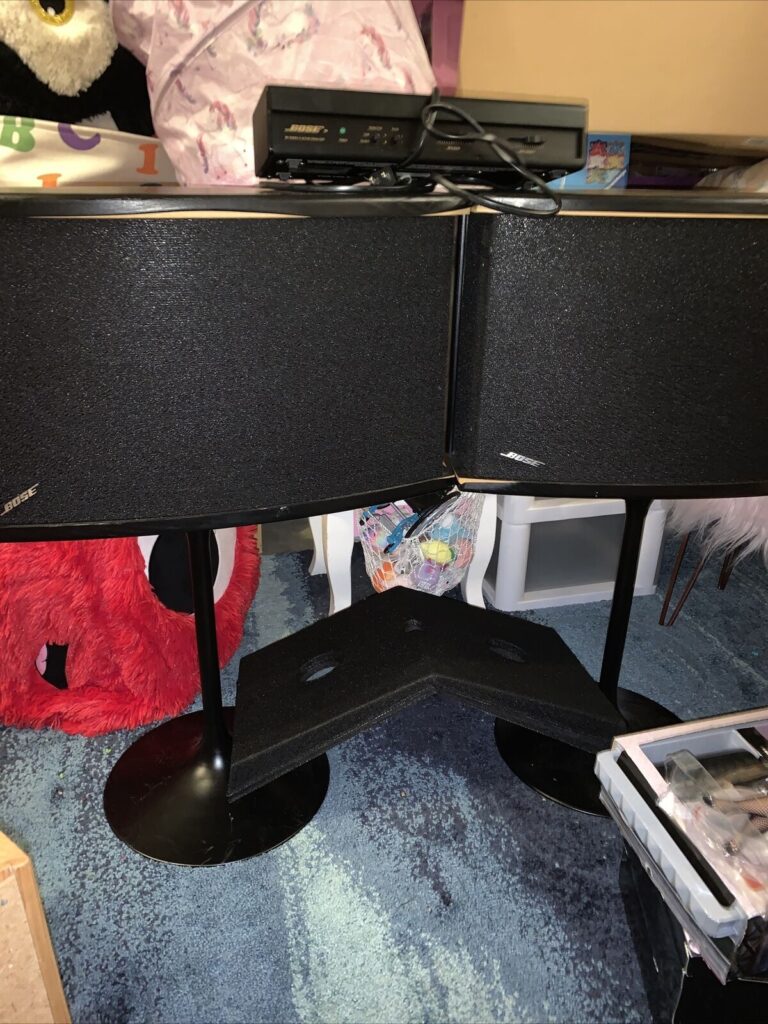
Wood: Walnut, Oak, Teak, Black vinyl veneer, concerto still?
Grill: Dark Brown, Black, Sand
Stands: Black
Series VI ver 2 “Active Equalizer”
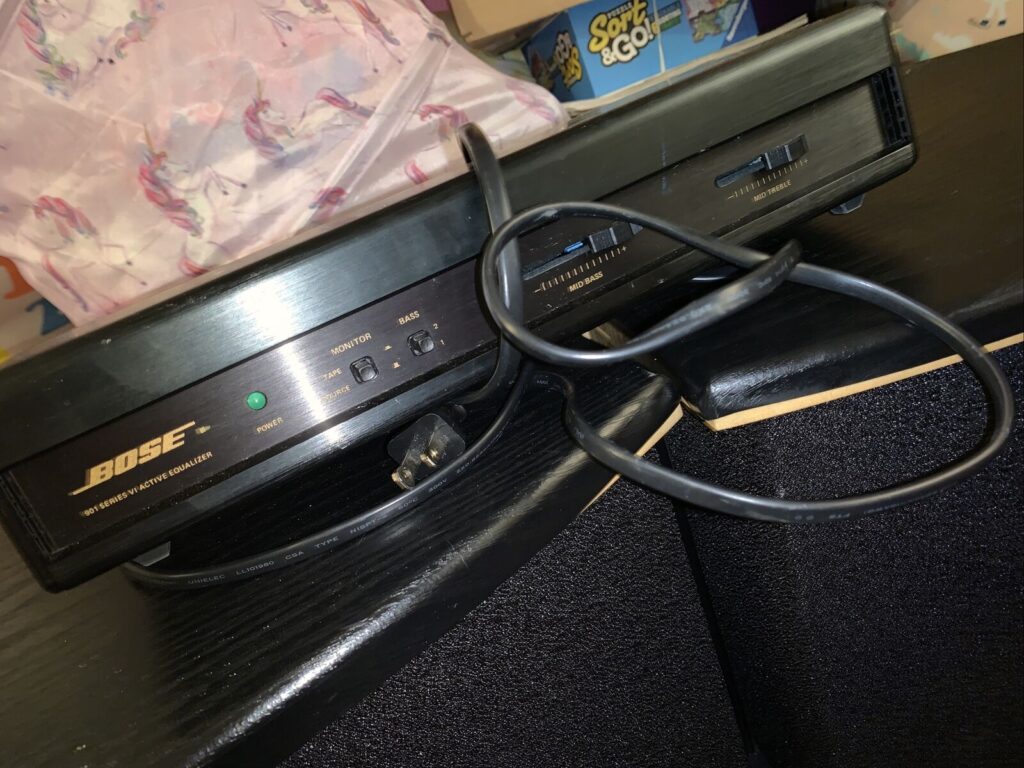
Series VI ver 2 “Active Equalizer”
Black metal box, red or green LED, 2 pushbutton, 2 slider.
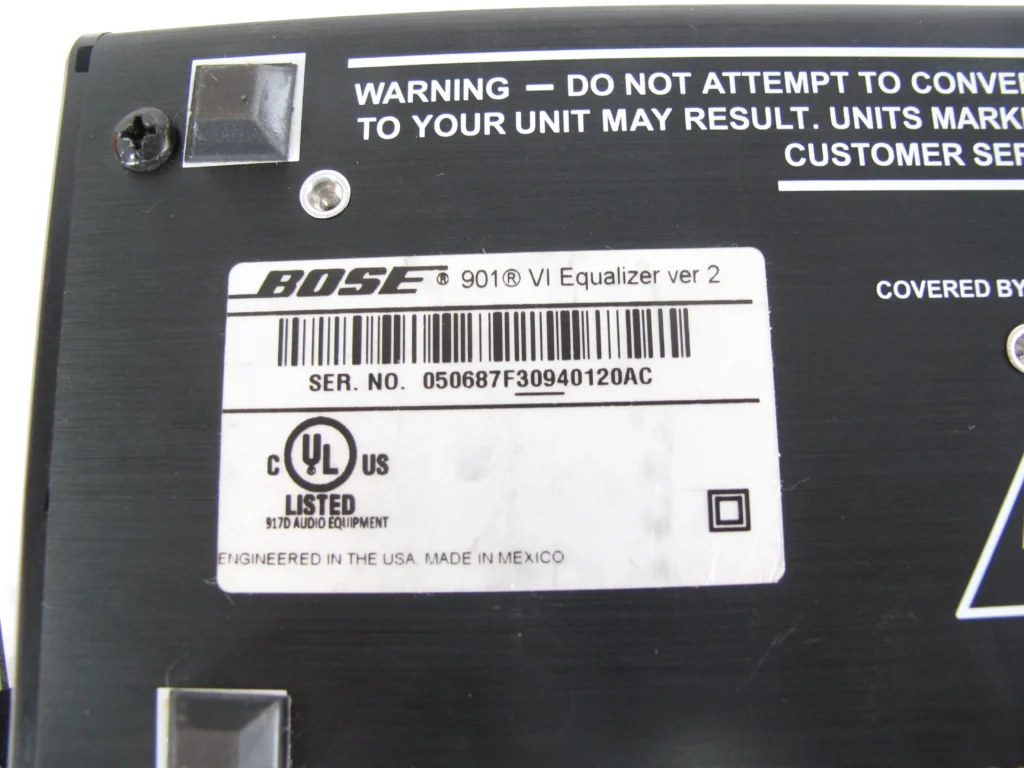
New EQ curve from the std VI, look for a version 2 label on back or bottom of the processor box.
From service note, controls:
Mid-Bass, ±6dB at 225Hz
Mid-Treble, ±3dB at 3kHz
Bass Switch, -6dB at 35Hz
Comments:
Some (all?) of version 2 are made in Mexico
System price with Active Equalizer: MSRP $1499 – ?
– R.I.P. – 901’s ceased production in 2017 –
901 Variants
Lifestyle 901P (1996-2001)
There was a brief run of a 901 powered version, the 901P, which was part of the “Lifestyle” music system. Made in the timeframe of the 901 Series VI, so the 901P shouldn’t have the surround rot problem.
I came across a 901P Owners Guide, dated November 2001 with some details. The 901P’s were designed for (and connected to) the Bose® model 20 music center or the Bose® model AV28 media center via a special 5 conductor (DIN to something) cable.
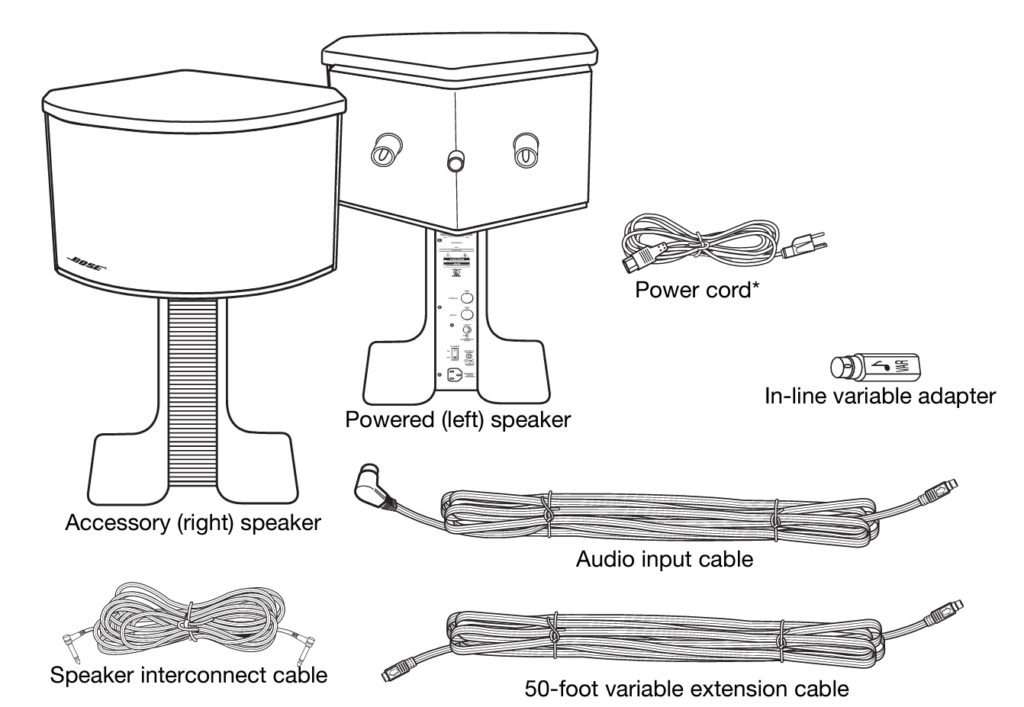
The 901P cabinet and 9 drivers are somewhat different from the Series VI. The speakers have a 16 ohm impedance total, and the driver cabinets themselves are perched on a largeish pedestal that contains the EQ, a module based power amp, and a switched mode power supply.
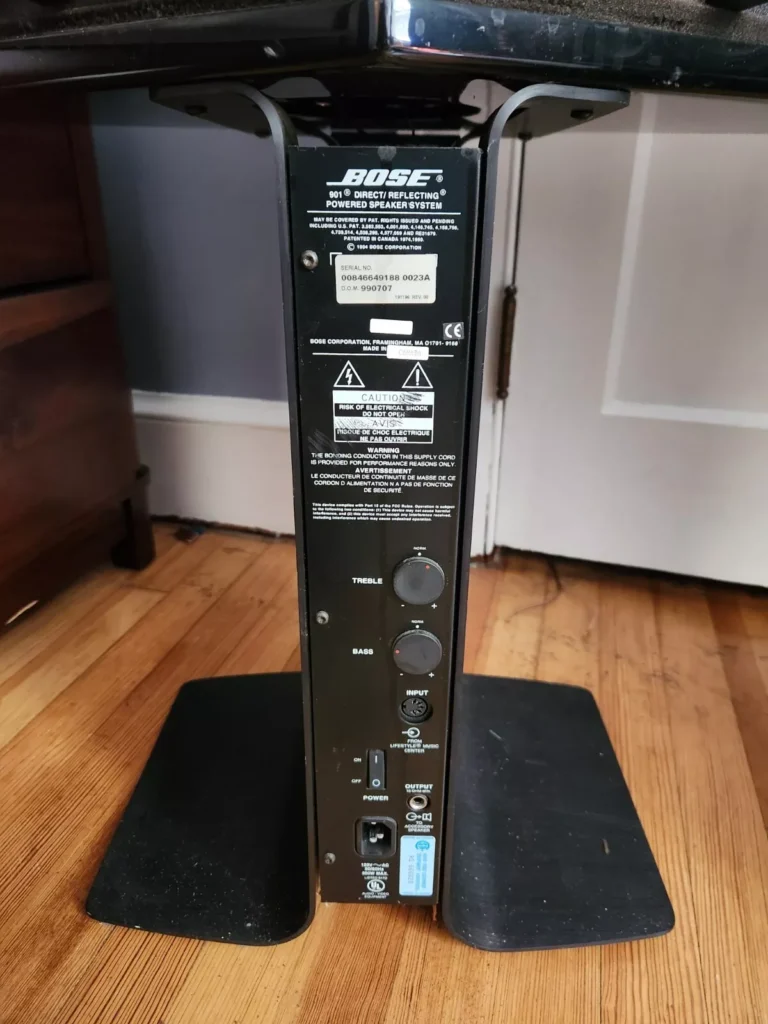
The 901P schematic shows that the internal amp design of the 901P uses a pair of TDA 7294 IC amp chips in a bridged config for each channel, which means the clean amp output power is about 100 watts/chn, or up to 150 watts at much higher THD for short peaks.
The audio input five wire cabling appears to be gnd, a floating audio common, Left, Right, and a mute/power-on? line. This should be hackable for use with a standard preamp out, but I haven’t tried it myself.
Bose 800 / 802 Panaray® Series
The 80x “Pro” series was in production from the early 1970s to about 2012.
(The Bose Professional division formed in 1972, and a spec sheet for the Panaray 802 II is copyright 2012).
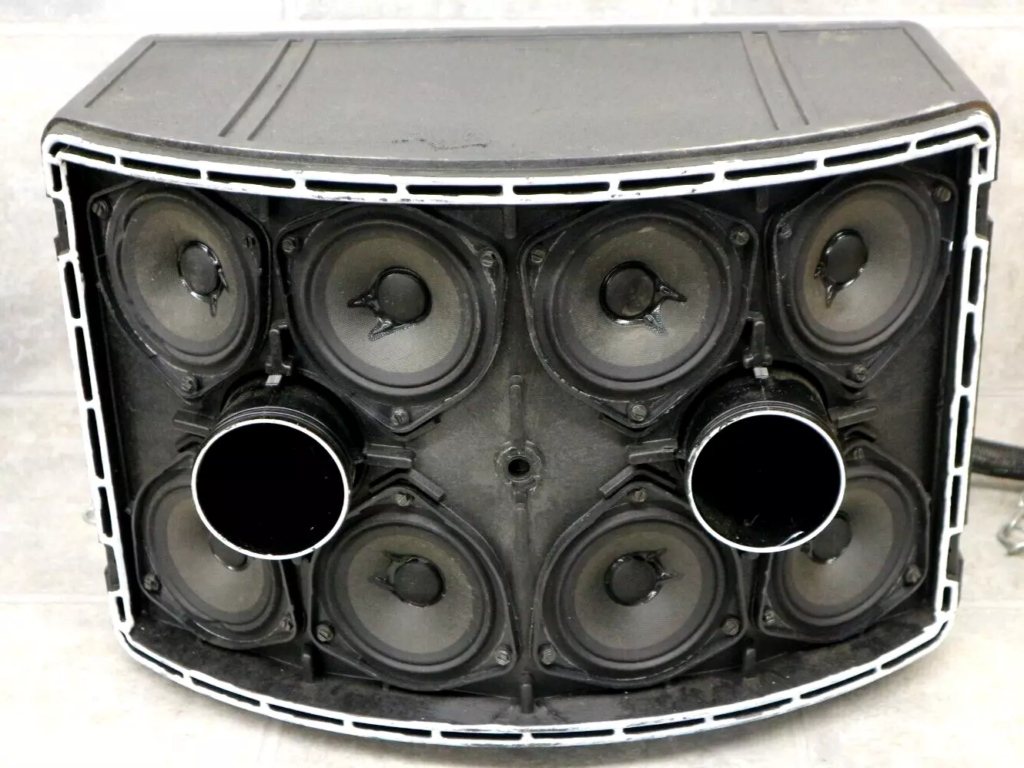
The “pro” series Bose 80x (or Panaray) speakers are basically the 901’s turned around, with the 8 speaker side facing the audience and the single “front” speaker omitted.
It’s housed in a weather resistant PA style ruggedized case with a snap on cover.
Oddly, the pole mount was via an optional adaptor plate that bolted to the cabinet rather than a built-in socket in the molded case.
Bose 800
The “Bose PA speaker concept” was first shipped as the 800. It was a “stepping stone” version between the 901 home speakers and the later molded case 802 series.
This was the first product from the newly formed Bose Professional Group in the early 70’s (1972). (Saw an ad for these from 1973.)
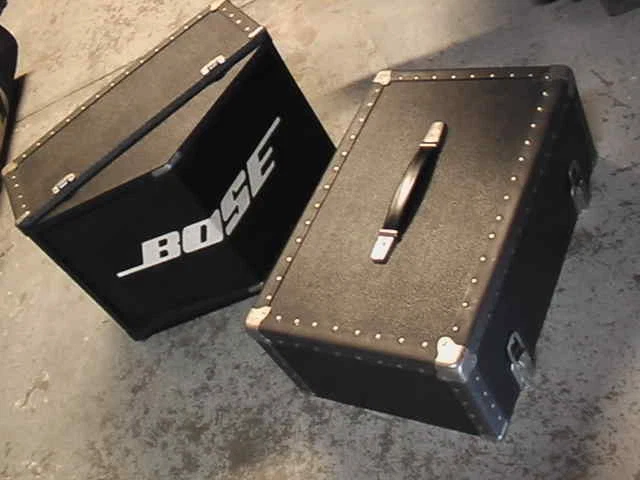
Had a vinyl fabric covered wood case with a triangle front like the first gen 901’s.
Initially used 4 screw 8 ohm speakers in a 3×3 series/parallel config with a 10 ohm resistor in place of the 9th speaker to even out the power and impedance. I have seen a pic of an 800 with the later 3 screw drivers, which probably matches up with the evolution in the 901 gen 2 series, around 1978.
Rated: maximum continuous signal, 90w
Sensitivity: (haven’t found a spec, probably in the mid to low 80s, like the first gen 901’s)
Connectors: 1/4″ (2), wired parallel
Drivers: 8 11.4 cm, 4 screw, 8 ohm
Weight: 43 lbs (from a german spec sheet!)
Controller: 800 Active Equalizer
More info: https://www.audiosciencereview.com/forum/index.php?threads/bose-800-rebuild.48695/
(Still running down info on this 802 precursor)
Bose 802
Per the Bose Pro site, the Bose 802 Series were first released in 1978. The cabinet was overhauled and the drivers changed from the 800 series.
Per Greg Szekeres, a Moderator on the The Bose 901 / 802 Speaker Connection facebook group:
“Most of the 802 series have both horizontal and vertical improvement in dispersion. Its obvious there are 4 horizontal sections. Not so obvious is the steering circuit internally. I have no data from Bose or measurements but the phase changing capacitor should improve vertical coverage.
The EQ settings are much more moderate to limit LF response and improve overall system efficiency compared to 901.”
[end quote)]
The recommended EQ settings for the 802 is listed later in this document; observe the boosts at the frequency extremes is about half the ones used on the early home 901. This implies the 901 “Bose house sound” is a typical smiley face EQ, applied in the 901 equalizer along with the speaker correction EQ.
The Bose 802 Series I were first released in 1978, and the last generally available system (802 Series IV) first shipped in late 2015. It is unclear when production on the 802 Series IV ceased, but retailers likely just finished selling thru their stock on hand for another year or so.
It is also unclear why a limited Series V run is again available (as of 2025)… but only in a few far east counties. https://boseprofessional.com/company/newsroom/2024/bose-professional-releases-802-and-402-series-v-loudspeakers
My guess is Bose is now pushing their newer line array technology world-wide, but the 802 still has high demand in those certain regions.
Speaker Cabinets ( System Controllers following)
Series I:
Injection molded cabinet, foam surrounds (rot prone), dust filters
The Bose site says the 0.9 ohm helical wound voice coil drivers happened in 1978, so it seems likely the drivers in this product built off of that technology.
I saw a print ad dated 1981 showing the “E” controller.
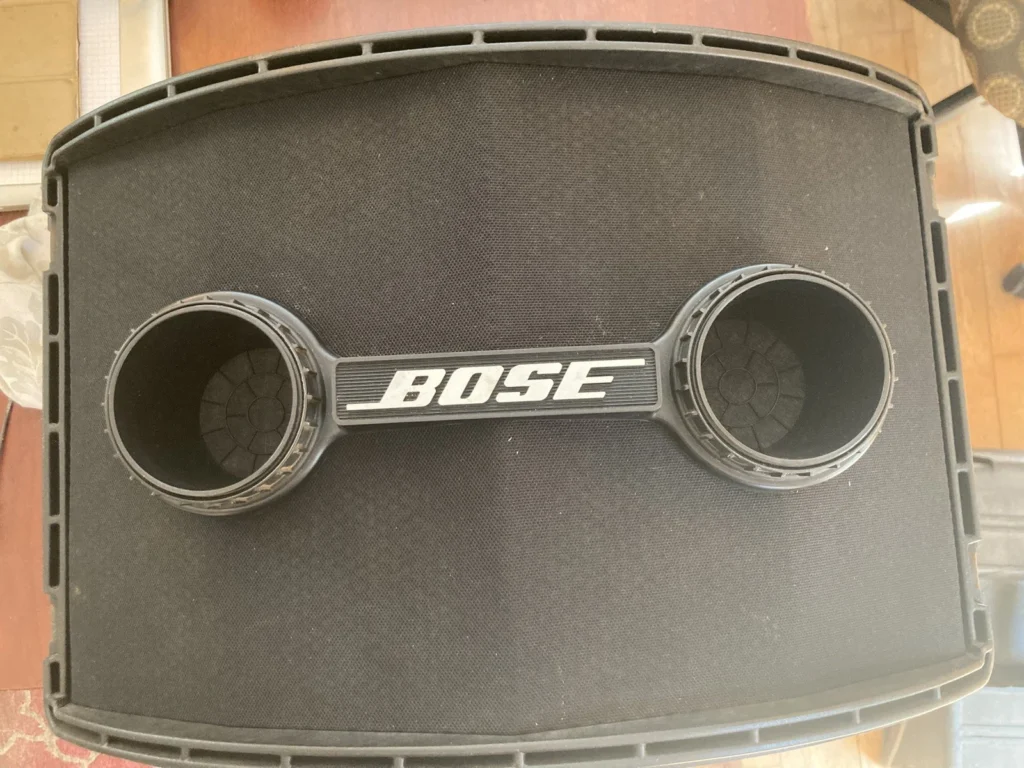
Rated:
Sensitivity:
Connectors: 1/4″ (2), XLR-M(2) wired parallel ( -W for indoor wood grain finish model, it has screw terminals)
Drivers: 8 11.4 cm, 3 screw, 1 ohm, wired in series
Weight: 31 lbs
Controller: 802-E
Series II
Switched to doped linen surrounds, dropped dust filters
Spec sheet dated 1996
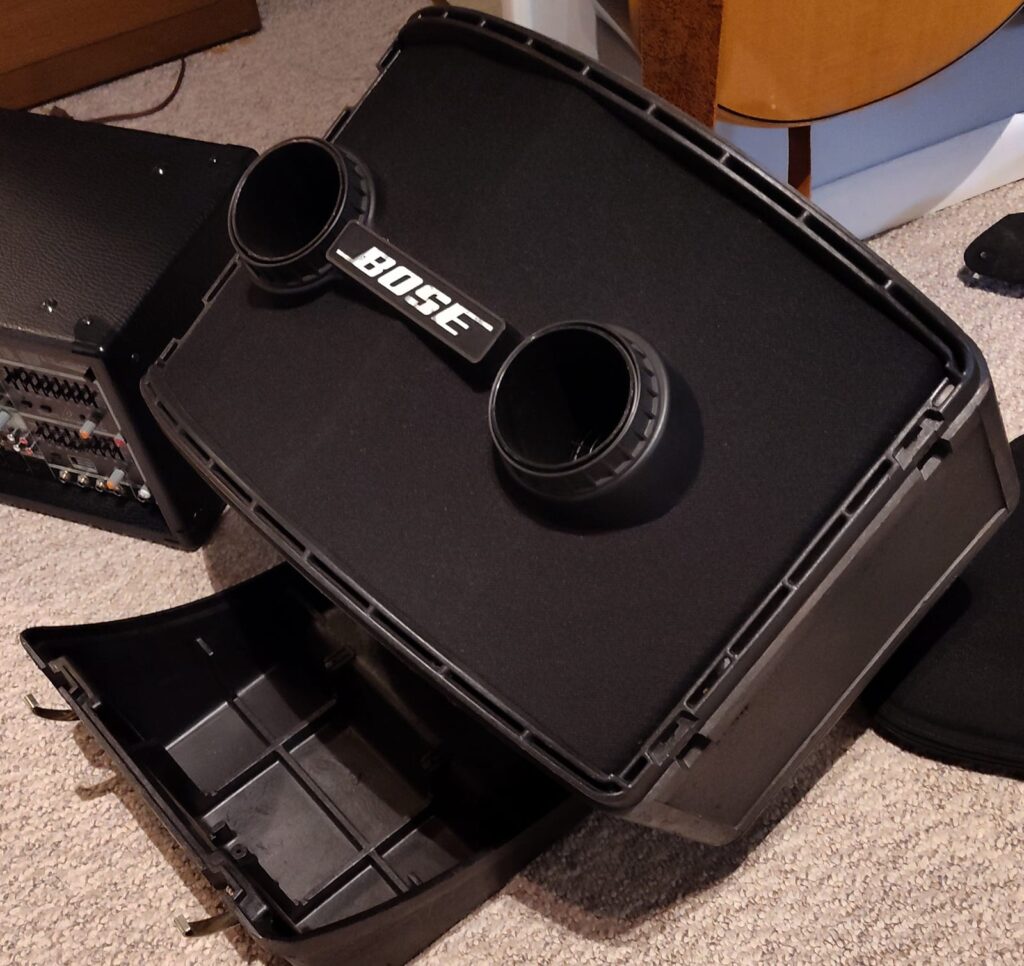
Rated: 240 watt continuous, 114 dB SPL pink noise
Sensitivity: 91 dB SPL, 1 watt, 1 meter. pink noise
Bandwidth: 55Hz to 16kHz (recommended high pass filter at 55Hz (12dB/octave) )
Drivers: 8 11.4 cm, 3 screw, 1 ohm, wired in series, ports tuned to 55 Hz
Pattern: 120H/100V
Connectors: 1/4″ (2), XLR-M(2) wired parallel ( -W for indoor wood grain finish model, it has screw terminals)
Weight: 31 lbs
Controller: 802-E, 802-C
Series III
A face lift. The “eyeball” ports are now less obvious, placed behind the new grill.
Finally! The connections are now Speakons, dropping the confusing XLR’s and easily damaged 1/4″ connectors.
This is the last of the 802 series that was targeted to the portable market.
It still has the cover and polemount option.

Rated: 240 watt continuous, 114 dB SPL pink noise
Sensitivity: 91 dB SPL, 1 watt, 1 meter. pink noise
Bandwidth: 52Hz to 15kHz (recommended high pass filter at 55Hz (12dB/octave) )
Pattern: 120H/100V
Connectors: Speakon NL4 (2x, wired parallel), no 1/4″ anymore.
Drivers: Drivers: 8 11.4 cm, 3 screw, 1 ohm, wired in series, ports tuned to 55 Hz
Pattern: 120H/100V
Weight: 31 lbs
Controller: “PANARAY system digital controller”
Series IV – switching to install focus
Here’s a quote from Bose, from the Series IV service manual:
“The 802® Series IV loudspeaker is a continuing engineering update to the 802 Series III to transition it from a Pro Portable product to a Pro Installed product.
The loudspeaker enclosure has been re-designed to include two additional inserts per side in order to better facilitate hanging them in system installs using the newly designed U-bracket from Bose®. The drivers, grille, logo are the same as the 802 Series III.
The crossover PCB is new to the Series IV due to RoHS updates, but uses the same value components as the Series III crossover PCB.
The 802 Series IV does not have a front cover available as an accessory, like the Series III does. The Series 802 III front cover will not fit on the Series IV loudspeaker.”
[END QUOTE]
EDNOTE: It looks like the pole mount option for the III still works, needs verification.
Rated: 240 watt continuous, 117 dB SPL pink noise
Sensitivity: 92 dB SPL, 1 watt, 1 meter. pink noise
Bandwidth: 52Hz to 15kHz (recommended high pass filter at 55Hz (12dB/octave) )
Pattern: 120H/100V
Connectors: maintain 2 x Speakon NL4 wired parallel
Drivers: Drivers: 8 11.4 cm, 3 screw, 1 ohm, wired in series
Weight: 30 lbs
Controller: “PANARAY system digital controller”
See here for OEM info on the Series IV: https://boseprofessional.com/resources/discontinued-products/loudspeakers/panaray
Series V:
As of 2025, it appears the 802 series has been deemphasized, in spite of a 2024 announcement of the Series V system with limited availability: https://boseprofessional.com/company/newsroom/2024/bose-professional-releases-802-and-402-series-v-loudspeakers
Bose 80x system controllers
“Active Equalizer model 800” for the 800 speaker – First Gen Electronics
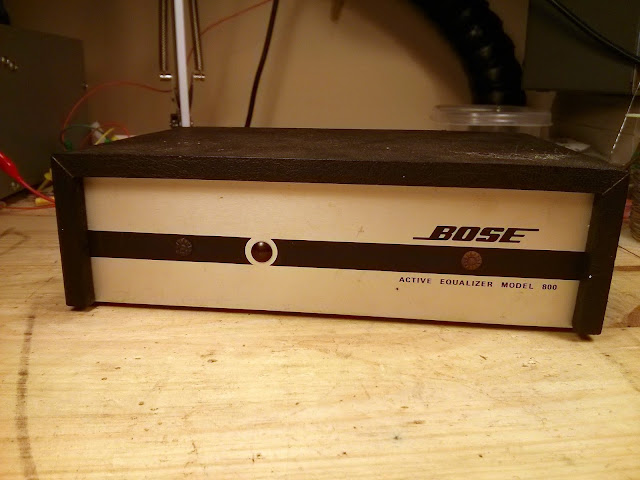
The 800 Active Equalizer was for the first “800” speaker system, the precursor to the 802 speaker lineup. The 800 EQ box had 1/4″ unbalanced jacks and used a discrete transistor filter circuit to flatten out the mid hump inherent in the design.
Notice Bose was still using the confusing “Active Equalizer” nomenclature carried over from the 901 home system series here.
See https://retrovoltage.com/2014/04/09/bose-active-equalizer-model-800-repair-bose-800-active-equalizer/
System Controller for the 802 speaker systems
The follow-up 802 series again used the outboard Active EQ concept, and as usual, there were several versions of electronics, now dubbed the “System Controller” for better clarity.
Oddly, the first controller was the “E” series. The “C” series followed, and then they went digital with the “PANARAY system digital controller”.
I have unofficially categorized these by generations, based on major form factor or feature set changes.
Form factor
Early generations versions were in an awkward consumer styler small form factor with 1/4″ connections. An optional (and rather crude) rack ear conversion plate enabled rack mounting.
– For the E series box, a weird milled aluminum clamp and plate was used.
– For the C series 1 box, there was a slightly more elegant flat plate to bolt the controller to, PN RMK-8.
-And then finally, the 802C series 2 was in an actual 1U rack housing, as was the follow-on Panaray digital controller. Yay.
802E – Second Generation “System Controller”

No sub xover.
It’s possible there was also an earlier version in a plastic box with only 1/4″ connections, like the earlier 800 and 402 controller. I spotted an ad for the “Super Bose” system, circa 1981, with two pairs of 802’s and a smaller looking plastic box 802E controller.
802C – Third Generation controller
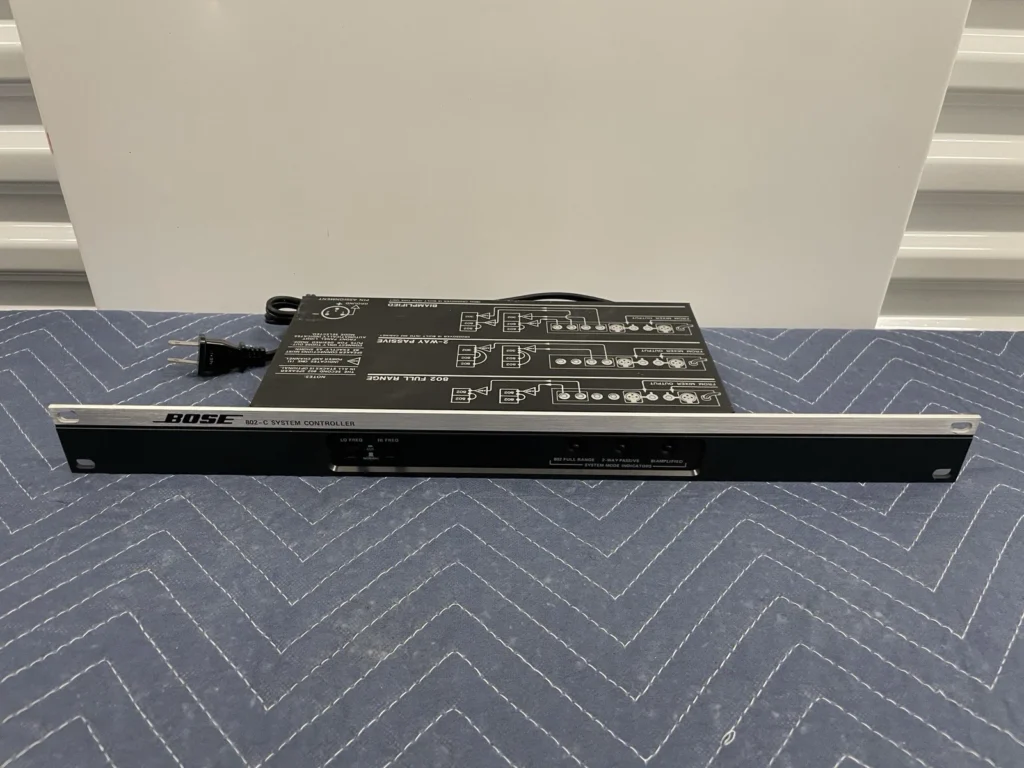
802C System controller (The 802C service manual is dated 1997 )
XLR inputs, 1/4″ outs, now includes a sub xover.
There were two flavors: The first flavors have SN’s start with 100000, the second “SMD” flavor has SN’s start with 200000.
These units have the same specs and functionality, the difference was production. (Switching to SMD parts simplified the mechanical design & assembly, and SMD usually increases reliability at the expense of repairability.)
802C-2 – Fourth Generation
A later 802C “2” version was re-housed in a standard 1U rack chassis with all XLR connectors. I’ve seen a black face with std LCD and a silver face with a bright blue backlight.
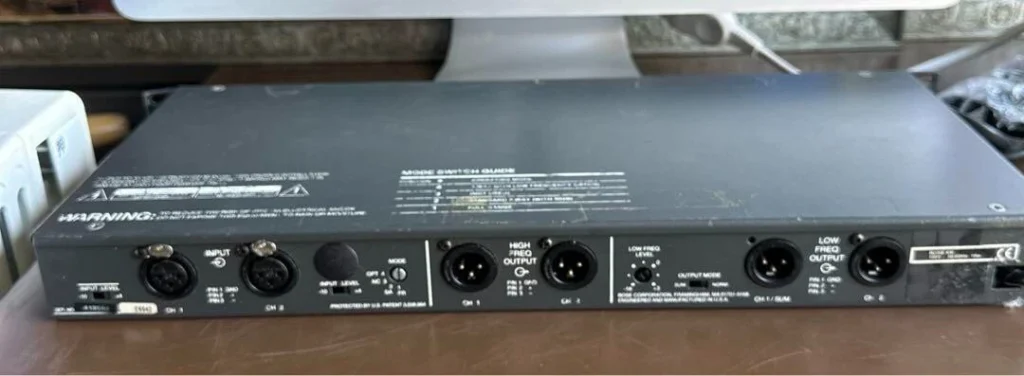
802C-2 System controller
There appear to be some more variations in this “fourth gen” controller, but still searching for more info. AFAIK, this was the last of the analog signal path controllers.
PANARAY system digital controller – Fifth Generation Controller
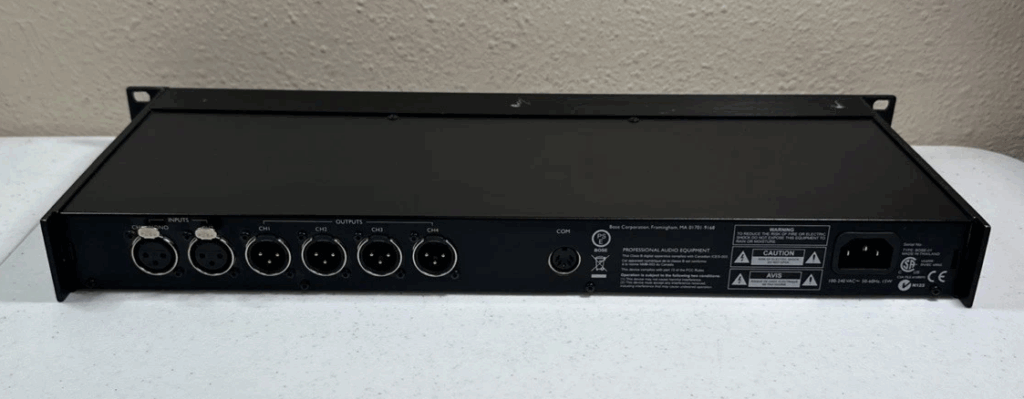
Lastly, a digital/DSP controller version appears. And again, there were a couple of versions.
The first one mentions the 802-III as the current 802 speaker, so early 2000’s?
Looks to be a 24 bit, 44.1 DSP implementation with a 1.2 mSec latency. Digital added more flexible level controls, limiters, and a more flexible crossover.
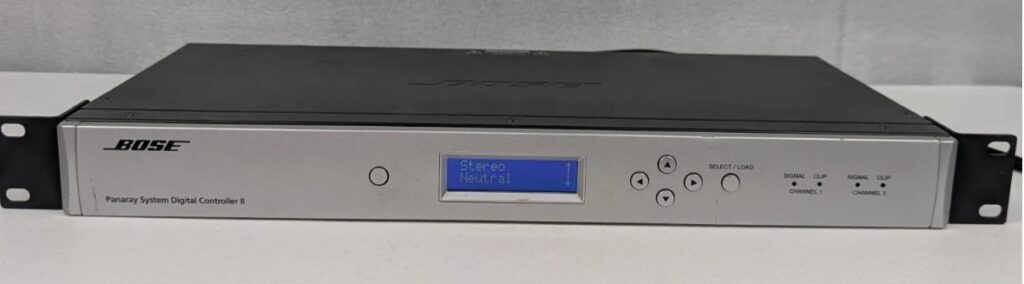
Front view of the 800 controller, version II, probably the last version of the original run.
Some info on EQ shaping
This is the recommended Parametric EQ settings for the Panaray 802 Series IV speaker:
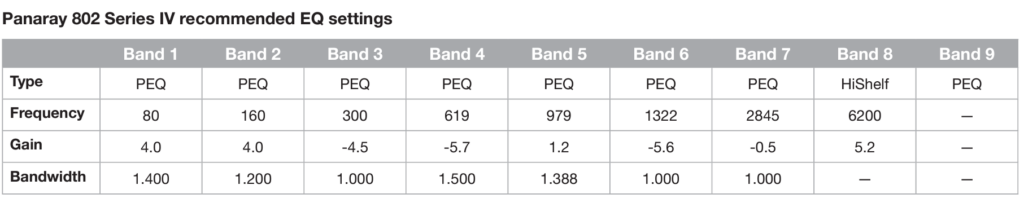
The interesting thing here is the PEQ settings aren’t as extreme as the home version Bose 901, even the later generations. That implies the Bose 901 “Golden Curve” or house curve is indeed a typical “smiley face” GEQ curve on top of the actual speaker PEQ correction curve.
[ End of 80x specific info ]
Bose 901 Odds-n-Ends
Author notes, the tulip stands, some comments n power amps, and email traffic captures.
Still looking for info on
- A more precise surround rot fix change point, ie serial number, date code, labeling, etc? – (per Bob Douglas, not available but hope springs eternal)
- The “syncom” grading system; implementation, metrics, etc? – (some info thanks to Bob Douglas, seeking more)
- Bose part numbers for the raw speaker drivers. I have a few listed based on the service notes, but still many missing.
Tulip Stands
It appears the OEM tulip stands came in two designs.
The earlier version was a one piece design(spun steel, most likely), model PS-6.
The later design was a 3 piece that bolted together, probably to make shipping easier. The pedestal base was larger on the second design, making it more tip resistant.
The sands are 17.75″ (45 cm) in height.
OEM Colors were: Black, Chrome, White, Light Tan(beige), Brown, ??
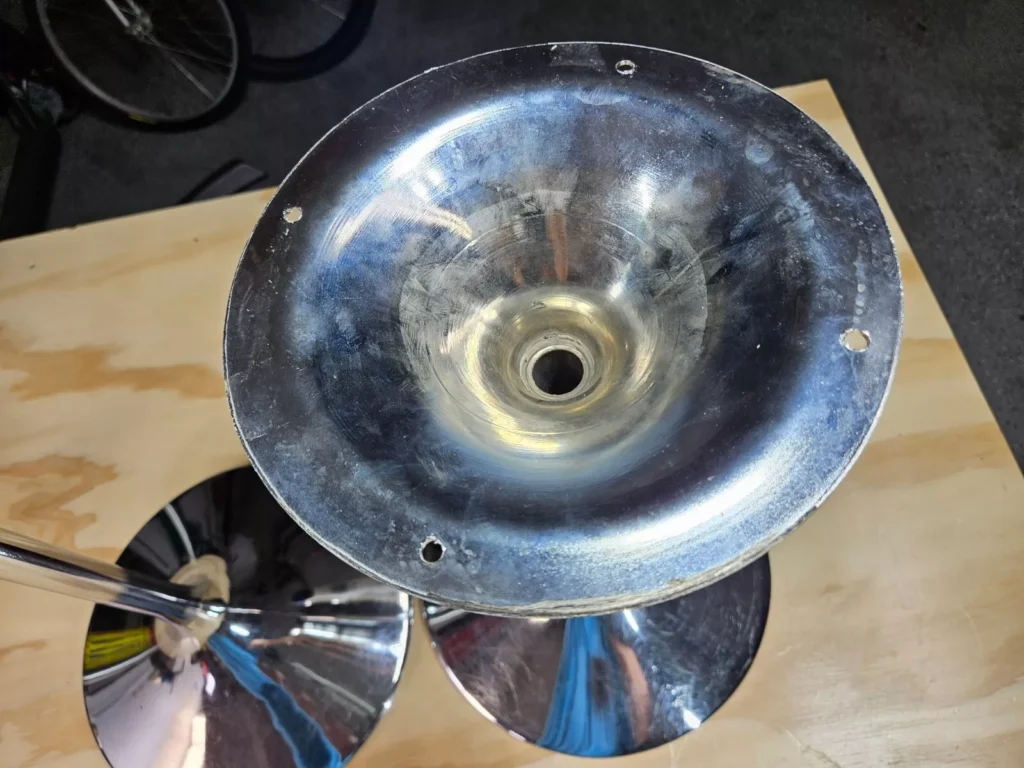
First, one piece design – PS-6
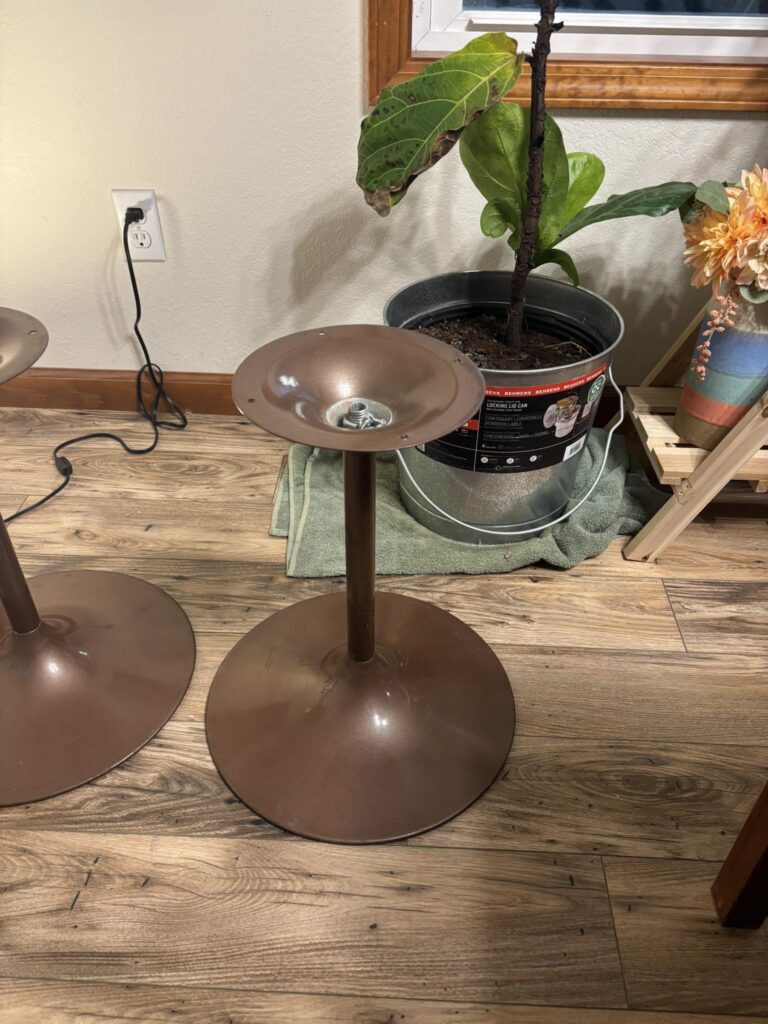
Later, three piece design
I have also seen single samples of dark brown(muddy color) and a copper/bronze color that matches version V aluminum sidepiece. My guess is these are aftermarket painted, as I haven’t seen them represented in any of the advertisements I’ve perused.
The stands look cool, but suffer from stability issues. Use caution around cats, dogs, small children, drunks, and butterflies.
Some words on power amps…
The low speaker sensitivity of the 901’s series (I/II appx 81 dB sensitivity – 2.83V @ 1 meter, later appx 89 dB in models with ported design), suggests a higher power amp (with a commensurate high damping factor) will yield the best results for these speakers. The series I/II service manual suggests that a 250 watts amp with a damping factor over 40 amp is a good match.
Per Andrew David, a Bose 901 forum moderator: “The Crown DC 300A – Dr. Amar Bose used that very Amp to develop the 901.”
Its specs are 155 watts per channel into 8 ohms, 1Hz to 20kHz, THD 0.05%, damping factor of 750, and S/N of 110dB.
[ Author note: These are good specs, even by todays standards. ]
If you peruse the specs for the Bose engineered 1801 power amp, it’s a 250 WPC amp with “a damping factor of over 40”. As it was released about 1973 and features 901 speakers in the sales brochures, it’s a fair bet it was designed from the ground up to correctly showcase the 901’s.
Experts weigh in:
User Hoho (From Audio Karma, circa 2013) says this about the various versions:
(begin snip)
The odd numbers are the major upgrades. The I and the II are almost alike, the III and the IV should sound exactly alike, the V and the VI are almost alike. Or you might consider the Series III to be the only radical change.
The I and II have fabric surrounds, treated with oil, which seem to last forever. They have 4″ drivers. I recently found out that late Series II’s have foam surrounds. The cabinet is also made out of solid wood. I’ve never heard the early ones. Some people say they were the best. Other people say that they lacked detail in the bass and smoothness in the treble, compared to newer generations. The I and II went deeper in the bass, if one doesn’t engage the Bass switch on the EQ. By cutting off the bass below 40hz, that control reduces the required amplifier power.
The originals and the Series II were flat in front. They had cloth grills, but with an optional walnut cover with a gap for the front driver.
The Series II was available in an edition known as the Continental, which should sound the same as other Series II’s, but has a curved front, so it resembles the later Series III and IV, but with a corded grill.
The Series III and later have 4.5″ inch drivers. The early ones are known for being power-hungry. this was fixed with the Series III, by giving them a more flexible voice coil, made of flat (helical) aluminum. The III also introduced the plastic internal compartment known as the Acoustic Matrix, in part to improve the bass. The ported designs have attenuated bass below 38hz (without the need for a switch). They also have wind noise, which isn’t noticeable as noise, but which can make the bass sound somewhat muddy.
The original acoustic matrix was enclosed only by the particle board cabinet. The later ones are enclosed in plastic, so theoretically, you could remove the outer cabinet and still play them. They made this change in the middle of a Series run. I don’t recall if it was when they were making Series III or IV.
The V added a coating to the back of the cones, to smooth out the low treble and high midrange. This ostensibly gives you more natural female voices.
To my ears, the VI do sound subtly clearer than the IV.
The V had aluminum on the sides; nobody liked the looks, and some also claimed that the aluminum sides hurt the sound. That was the main reason they were replaced by the VI. The VI also had changes to the equalization, partly to adjust the sound to compensate for the change to particle board and wood veneer on the sides of the cabinets, partly because Bose “performed research” (changed their minds) about the acoustics in an average home.
If you have the III, IV, or early V, or II with foam surrounds, then by now the foam surrounds should be brittle, unless, of course, they’ve already been replaced. If you don’t do the work yourself, replacing the surrounds is expensive because each speaker has nine of them. Later V’s and original VI’s have improved foam, replaced with some antibacterial substance to increase their life. Now Bose is selling the Series VI Version 2, which returns to cloth surrounds.
[ED NOTE: THIS PARGRAPH IS HISTORICAL INFO ONLY, this program ceased long ago.]
Bose has (had) a transferable trade-up policy. If the foam surrounds go bad, you pay for the shipment to Framingham, Massachusetts. For a discounted price, which keeps going up, you get new speakers and equalizer. they tell you to keep your present pedestals.
(I wonder what they do with the old speakers and equalizers.)
I used to own the 901 Series IV. I asked a Bose representative if I could upgrade them by replacing just the equalizer. His answer was no, that would make them spikier. Each generation of EQ is optimized to each generation of speaker. However, as I pointed out before, there is relatively little difference between EQs of Series I and II, between III and IV, and between V and VI.
Suffice it to say that the Series I and the Series II are *basically* the same speaker, and the Series III, IV, V and VI are basically alike. The III and IV had with an extra connection for the Bose Spatial Control Receiver, which permitted the user to attenuate either the inner or outer rear banks, to widen or narrow the image.
(end snip)
From FB 901 forum, circa 2023: Greg Szekeres, Moderator
(Begin snip)
The early two models have 4 1/2 inch drivers which typically how you measure drivers between screw holes Not cone diameter. I never measured later models dimensions. Series II EQ has slight different curve but mainly has more low and high boost. Series II uses Rola drivers not CTS. Series III EQ uses transistors pretty sure. Series III and IV have NO internal polyester fiber damping. Series V up have it. Wad of fiber right behind drivers. Series IVb somewhat mysterious, could have been a EQ component change. To my knowledge the matrix does not have top and bottom plastic like material and is joined to wood top and bottom, but I could be wrong. Series IV had change to curve from III pretty sure. Series V up also had change to EQ curve, smoother on top end. Series VI might be same electronics as V but I think there was some EU power input change or something like that. I have no EQ curve data for latest model.
Added: the first two models had fiberglass stuffing, I thought my unit had more fiberglass compared to another I looked into. Fiberglass works better than polyfill at both attenuation and adding effective box size. My original Series II bought in 1975 had a electrolytic coupling capacitor failure after it was just over 10 years old. One channel mostly. I think thats how I first noticed it by channel matching, no low bass on one side. Thats why EQs need checked out carefully like all electronics no matter how old, and especially when old.
Part Two:
The first two models have both plywood and veneered particle board. Top and bottom are particle board and middle 5 walls are plywood. this made it much better for attaching drivers and saving weight. Its a bit trickey to make the rear angled pieces but I have made a box or more myself ! The use of the new matrix enabled making the ports a success, but the small odd shaped chambers minimized reflections in the upper ranges. However they still had a bit remaining sound, and I think thats why the small easy improvement was to add a handful of polyfill stuffing right behind driver but not obstructing ports. Did this change EQ curve requirement starting with Series V I cannot say, but there was a new curve starting with the Series V. A note about the first two models. The advertising speaks about combining resonances of all drivers to smooth out differences. All drivers used the same interior which also combined pressure. The newer Syncom testing also insured they were also compatible with each other. You could also say any multiple driver scheme averages response thus providing a more balanced sound.
(end snip)
From FB 901 forum, circa 2023: Bob Douglas, ex Bose Employee
(begin snip)
The foam surround deterioration fix was the result of a research project that Dr. Bose ordered after becoming aware of the issue. it was found that not only were environmental factors like UV, and chemicals in the air causing it, but microbes were actually eating the foam as well. Mid Series 5, the formula was changed from polyester foam to polyether foam across-the-board, in all Bose speakers. Since then, for almost 35 years, Bose speakers no longer rot out. Unfortunately, Bose, being a privately held company, never published or released manufacturing data regarding the actual switch date, believed to be circa 1986.
(end snip)
From Dean Minor, series VI, version II driver designer)
(Begin snip)
Changes were made for performance and cost reduction. The cone manufacturing process would use our own cone plant’s standard black pulp formula, no more purging of blue pulp which was tedious and time consuming. The dust caps were polycarbonate and more consistent, not from a supplier with an eight up tool that was highly variable part to part. UV cure dustcap adhesive was used. The cure was instant, not dependent on solvent/solids ratio that degraded while sitting on the production line and didn’t need a 24 hour wait time for VOCs to leave. And the surround roll attach points were repositioned to allow a linear mechanical displacement. Along with the grooves that eliminated buckling. I don’t think the EQ was changed but if so it was a minor tweak. Lots of things we did and I was so privileged to be a part of working on such an iconic product.
(And to a query about the VI series two surround:)
“It’s SBR coated cloth. The best material for surrounds ever. Light and flexible. The grooves control buckling thereby increasing mechanical linearity and reducing distortion.”
(end snip)