
Last Updated on 2026-08-21 by Daev Roehr
So…
First off, I’m not one of those obsessive audiophiles that insists vinyl is superior to sex, a pangalactic gargle blaster, and all other audio mediums… although a good LP recording on a good system can be stunningly engaging.
So, why then LP’s and such? Because I appreciate retro audio equipment and the joy of listening to music in it’s original format, or music that isn’t available any other way.
And it’s cool to get 60-100 year old audio technology working again!
Jump to About PhonoPreamps-Gain and EQ
My Turntables
In the mid 70’s, I was a budding teenage hi-fi nut, but had no money. I got a job mixing and hauling cement for a month, no mean feat for a 110 lb weakling. I saved almost every dollar I earned from that job, then used it all to buy my first new turntable; a spiffy BIC 960 with a Micro Acoustics 2002e cartridge.
This was pretty much audio nirvana for me, and a huge step up from the old garage sale Garrard clunker I was using.
The BIC 960 served me well for years, until it got crushed in the California 80’s earthquake. The turntable base, platter, and tonearm were all mangled and I had to scrap it.
But I kept the cartridge and my records, thinking someday maybe I’d get another turntable… But then, I moved to that new digital thing, CD’s. ( See D5 CD player. )
I bought and listened to a lot of CD’s, and even had a pair of 200 CD changer/players.
However, there’s a lot of music that was too niche to get remastered for CD’s, and it’s fun to be able to experience these musical artifacts directly. And there’s a set of sensations to playing a record; the smell of vinyl and cardboard, the feel and look of the album cover, the ritual of cleaning and cuing the record up. All that is really engaging, like opening a book and sitting down to read. Meditative even.
A – Technics SL-1210 MK5 (circa 1972-2010) – “My Last Turntable”
So about twenty-five years went by (2007-ish) and I decided it was time to re-engage with records. At that time, it looked like turntable production would be ceasing soon in favor of just digital disc players. I assumed this would be the last turntable I’d ever need, so I wanted one that would be low maintenance and extremely durable. I selected the Technics 1210 MK5 and purchased it from kabusa. I had KAB “hot-rod” it with their mods for 78 RPM, a record clamp, and their precision prep. It’s still my primary turntable: rugged, reliable, quiet, and has easily swappable head shells; a key feature for me to play 78’s and other battered microgroove records like 45’s.
Specs:
Rumble: –78 dB (IEC 98A Weighted), –56 dB (IEC 98A Unweighted)
Wow and flutter: 0.01 % WRMS\0.025 % WRMS (JIS C5521) ±0.035 % peak (IEC 98A Weighted)
I use a variety of pickups on this unit, depending on record type, record condition, or just sheer whimsy.
LP’s: (in good condition)
1 – Micro Acoustics 2002e with a retipped micro-ridge stylus, tracking at 1.1 grams
2 – Shure V15 /// w Jico VN35SAS stylus – tracking at 1.25 grams
3 – Audio Technica AT440MLa w purple grip stylus – tracking at 1.4 grams
4 – Just in(2025): Ortofon Blue – tracking at 1.8 grams, haven’t set this one up yet
45’s: (good condition)
Shure M97xE w blue grip N97xE stylus with the damper brush – tracking at 1.25 grams or so.
LP’s, 45’s misc: (poor or unknown condition)
– Low cost AT something cartridge with indestructible conical stylus, appx 2 grams
78’s:
– Shure M70BX w green grip N78S spherical 2.5 mil stylus – tracking at 2 grams. Note: 78’s need that large tip stylus and a special phono preamp with variable turnover/rolloff settings. If you’re using a 78 needle in a stereo cartridge (like me), you also need a sum-to-mono circuit.
See below in the preamp section for more on all this.
B – BIC 981 (circa 1976-1978) –
Vintage TT re-creation project
In July of 2020 I was cleaning out my turntable accessories box and came across my forty-plus-year old Micro Acoustics 2002e cartridge, two worn styli, and the original BIC alignment jig & 45 single play adapter. Hmmm… I liked that turntable and its sound. For fun, I decided to recreate that system for nostalgia’s sake.
The BIC series of turntables were capable of decent sound quality, but they were very lightly built to keep the price affordable. If you handle them roughly (especially the tone arm), they’ll definitely break. Not suitable for DJ use, but great for home use by a careful hi-fi enthusiast like myself.
Specs: (Not as good as the 1210, but good enough.)
Rumble, -65dB (DIN)
Wow/flutter, < 0.05%
Perusing eBay, I immediately tumbled into a BIC 981 with all the key bits intact… minus the alignment jig. The 981 was a slight upscale version of the 960 I had, so this is fate at work, methinks. This unit has the head shell, the LP single play spindle, and even the dust cover, all in good shape.
The turntable should arrive shortly, hopefully it survives transit.
For cartridges, I have the rare vintage Micro Acoustics 2002e w two stylus’s, and a vintage Shure V15 /// with the red 35-SE stylus pull. These two are still both highly regarded today, and there are still a few meticulous jeweler types that patiently repair and retip these 40+ yr old cartridges and styli. So off they went for refurbing and retipping, courtesy of Andy at Needle Clinic: https://phonocartridgeretipping.com/
(He did a fine job with the refurbing, see below. I went with the micro-ridge upgrade, well worth it!)
UPDATE: After some thought, the regular cartridge in this unit will be the V15 ///, I’ll enjoy the Micro Acoustics 2002e on the Technics table.
The BIC 981 Rebuild:
(980/981/1000 motor speed board alignment instructions: BIC980-motor-speed-board-adjustment.pdf )
UPDATE 1: As insurance, I wound up getting a spare “working 981” turntable. If things went well, I would have two working units; if things did not go well I could raid one for parts.
UPDATE 2: That turned out to be very wise, as one of the 981’s was crushed and badly damaged in transit. I need to look at it more closely, but it’s almost certainly a parts unit now. 🙁
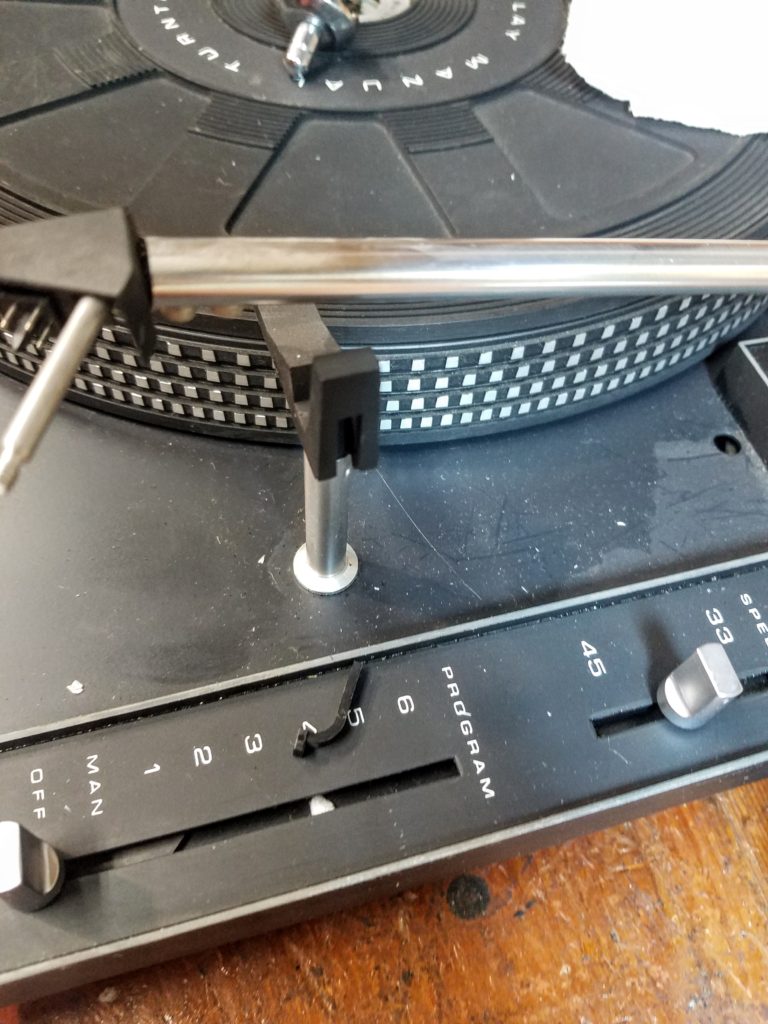
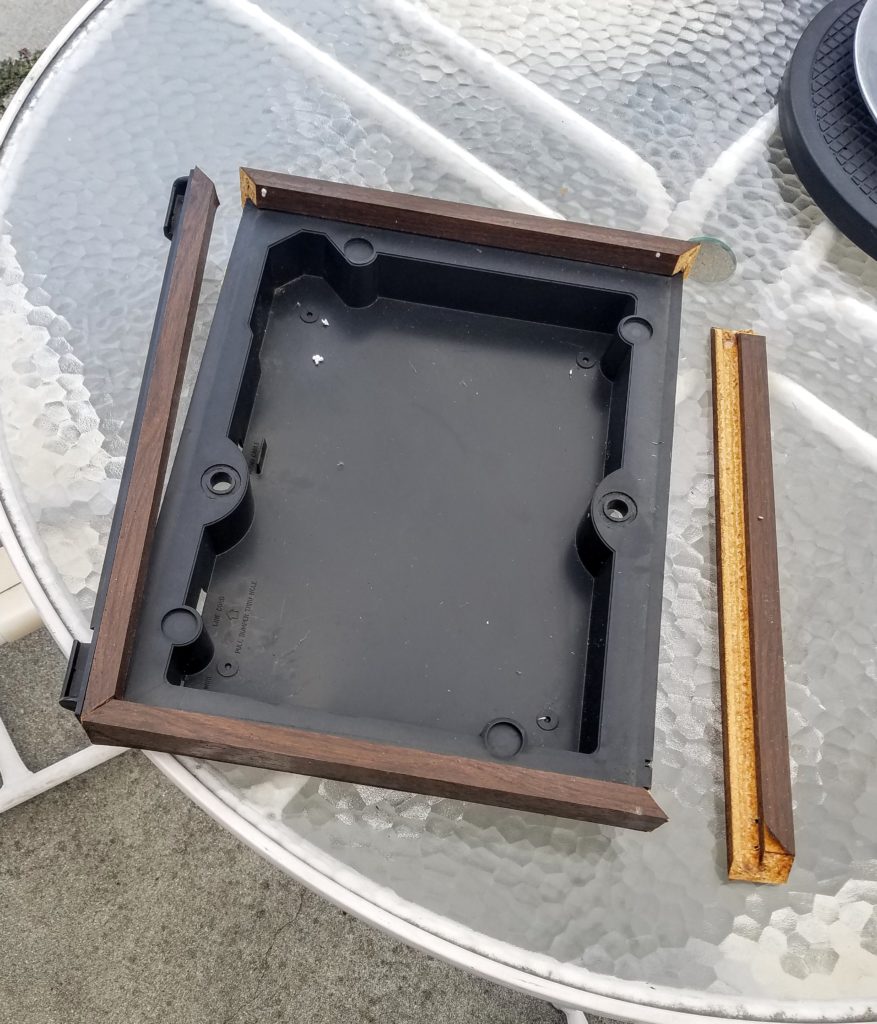
The bent tonearm is a real bummer, these things are quite delicate.
Also very bad is the platter is crushed into the base and doesn’t turn. It might have a unfixable bent spindle. Rats again. The seller kindly reduced the price to what a parts unit would be, so there’s that.
On the plus side, the precious 2nd gen head shell is in good shape, the base can be re-glued, and the dust cover is usable with no major cracks. Oh, and the motor and drive assy electronics still looks good too.
However, the other turntable arrived in really good shape (most excellent packaging), and a cursory examination shows it’s basically working. A forty year old turntable will undoubtedly require some refurbishing so that’s next on the docket for this unit, which I’ve now dubbed “Prime”.
UPDATE 3: 2020.07.16
Prime’s base needed cleaning and some orange oil, and the dust cover buffed out fairly well with plastic restorer. A few under chassis parts parts needed lubrication, and viola! things were more or less working!
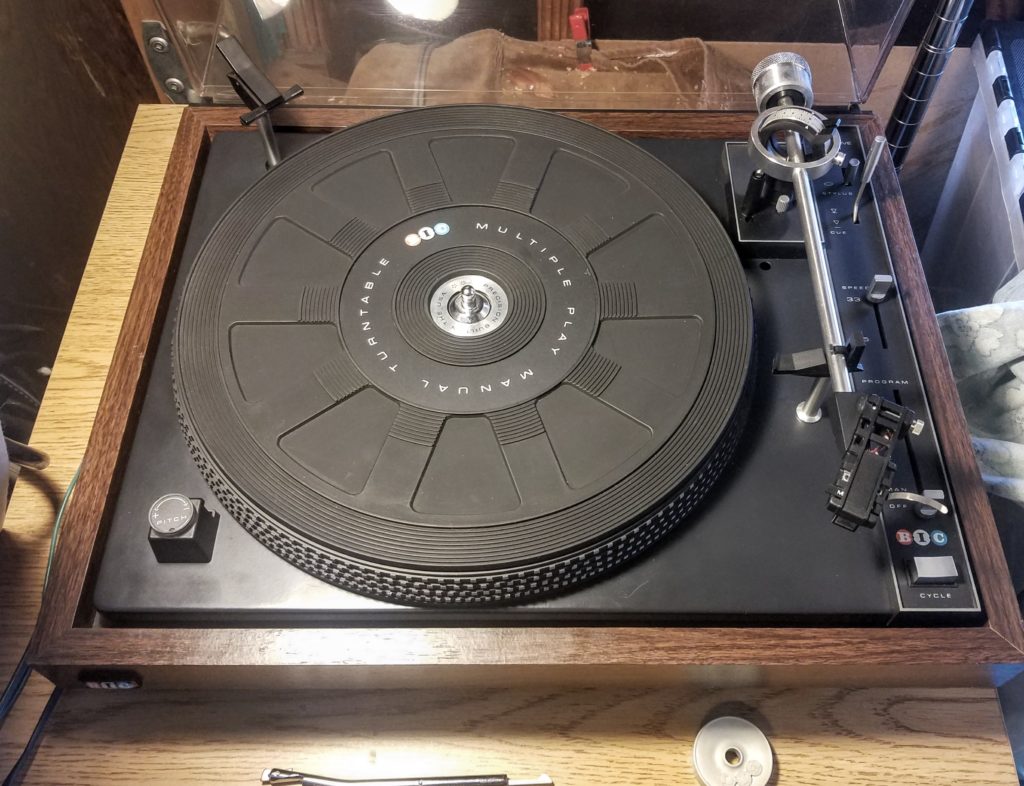
I noticed the special tray “hinge” the dust cover rests on was broken/missing, so parts unit made it’s first donation to prime. Prime now looks like:
Next up, investigating the motor speed control board and it’s poorly documented adjustment pots. The motor driver board is a Wien bridge op amp oscillator design with an incandescent bulb for the AGC servo.
( Alignment instructions: BIC980-motor-speed-board-adjustment.pdf )
Once properly adjusted, this design outputs a stable, low THD sine wave to the motor and provides a quiet and stable ride, along with a bit of pitch control.
UPDATE 4: 2020.07.21
The rebuilt cartridges have returned!
I promptly installed the Shure V15 /// in the special BIC headshell, carefully aligned it, and put it on the tonearm. After setting tracking force and such, played an old Michael Franks jazz LP. Wow, sounds great!
The micro ridge profile stylus apparently rides in a different spot on the LP groove than the elliptical profile stylus of old, as the LP was quieter and had a lot more top end air than I remember. Most encouraging.
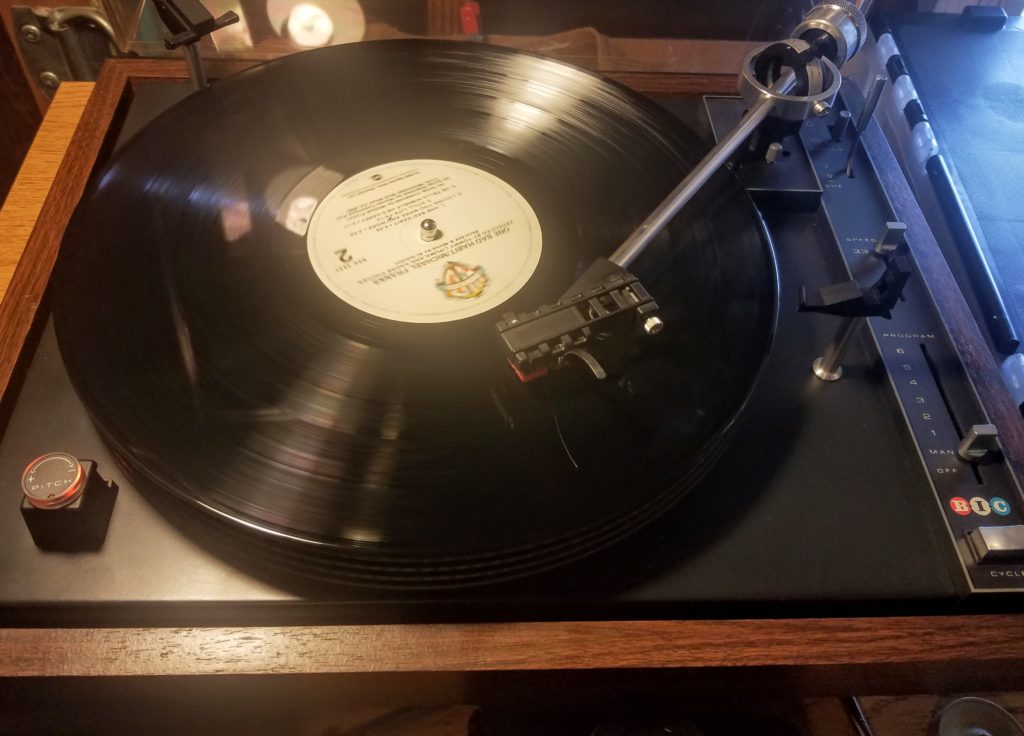
Checking the work
The alignment jigs, precision scale, and test record have all arrived, so I can do a proper setup and test soon.
C – Dual 1242 (1978-1979) – prop unit
Around June of 2012, I picked up this turntable to use as a photo prop for a 70’s themed photo shoot. However, it was in excellent condition and with very little work it actually ran as well as it looked. It’s a nice belt drive with some automatic features. For now, it remains a prop though, as I already have two turntables in use.
Specs:
Rumble, -42 dB unweighted, -63 dB weighted (DIN 45 500)
Wow/flutter, 0.09% (DIN 45 507)
D – JVC L-F210/L
In 2022, this Direct Drive Turntable jumped into my lap, along with a pile of other JVC stuff. I think it has an Ortofon F/FC cart?
TT Specs:
Rumble: not spec’d
Wow/flutter, 0.03% (WRMS) 0.055 (DIN)
Got it for free, so I’ll probably set it up to play any “beater” LP’s and 45s, as it has a rugged and cheap conical tip.
About phono preamps: Gain and EQ
Connecting a turntable to your system typically requires a special high gain “phono preamp”… and now things (might) get really complicated.
Gain:
If you have the typical Moving Magnet (i.e. MM) cartridge, then you need around 35-40 dB of gain from your preamp.
If you have a less common, and usually more expensive, Moving Coil (i.e. MC) cartridge, then you need a lot more gain, around 50-60dB.
The phono preamps for these two categories of cartridges are usually called (you guessed it) MM or MC phono preamps.
(There is also an old cartridge type “ceramic” mostly used in cheap old consoles and portables; it does not require a preamp. However, these are not recommended as they are decidedly lo-fi and the high tracking weights required are very damaging to record grooves.)
As of this writing (2024), current release turntables sometimes have newfangled technology convenience features built in, such as a bluetooth transmitter or a low cost version of the required preamp. This can be handy for beginners, but may limit your choices later on if the original audio signal is not also available. And if you’re after hi-fi sound, bluetooth “ain’t it”, although the convenience is attractive.
Equalization:
Applying the proper playback EQ is key to getting the best sound from records.
Almost all post acoustic era “electric records” were created with a frequency equalization schema that was designed to help compensate for the physical record limitations. This EQ is usually a bass cut and a treble boost applied at master cutting time. (Observe many 78’s didn’t use the treble boost, see below.)
So, to play back the record with the correct spectral balance, you merely reverse these compensations and get back to the original source frequency response.
IOW, you apply bass boost “turnover” and treble cut “rolloff”) at playback time.
-If you want to play LP’s and 45s from about the mid 50’s on, then all you need is a phono preamp with the now standardized IEC/RIAA playback EQ curve, which is:
-> 6dB/octave boost at 500Hz, or a +12 dB boost at 100Hz. This is the “turnover”, specified relative to 500Hz.
-> 6dB/octave cut at 2122Hz, or a -13.7 dB cut at 10KHz. This is the “rolloff”, specified relative to 2KHz.
These are usually normalized into a 1 kHz center frequency, see the chart below.
(I won’t wade into the IEC vs RIAA debate here, look it up if curious.)
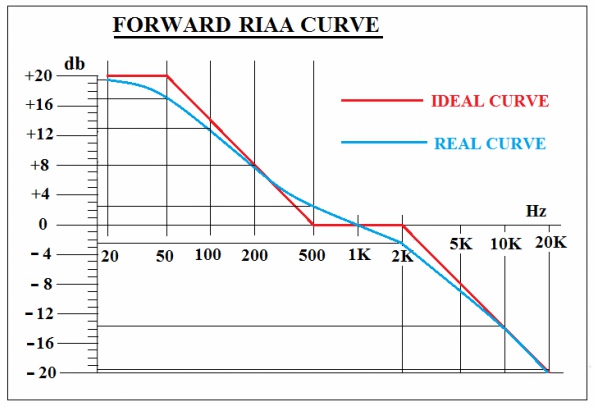
If all you want to do is play LP’s (33 1/3) and 45’s, get a phone preamp, hook it up, you’re done, enjoy! But if you want to play earlier pre-standard media (most notably 78’s), read on!
Special notes for playing 78’s
Prior to the new microgroove records (LP’s and 45’s in the mid 50’s) the popular medium was a 10″ shellac 78 RPM “record”. As industry wide standards had not yet been established, every record plant did what they though sounded best or worked best for their customers and music types when mastering and cutting these records.
Very early 78’s (pre-1925) were created and played back mechanically via a steel needle and a non-too-stable spring motor drive. That means these early recordings can span quite a wide speed range, and sometimes vary in the middle of a recording!
Later 78’s were electrically created, but the exact RPM to play them back still varied quite a bit, as did the pre-EQ (if any) applied,
Lastly 78’s are monaural, and have a wider groove size than later LP’s and 45’s; this too must be addressed.
78 Details:
SPEED:
– 78 RPM was the later “nominal” speed, early speeds varied from low 70’s to over 86 RPM. Very few 78’s have the cutting speed labeled, you’ll have to rely on concert pitch. And since concert pitch has also changed over the years, a definitive answer is “correct pitch is per record, adjust by ear”.
Myself, I don’t stress about it much, but I do have a turntable with an 8% pitch range control when desired.
EQ:
– Since mechanical rumble and surface noise was a big problem, bass turnover and treble eq was a hot topic. Each record company had their own ideas on what was best, and it varied a lot.
Acoustic only, appx pre-1925
The early all acoustic recordings were made with no pre EQ, and so a flat preamp is best.
Turnover:
When electric recording started , so did the use of pre-eq to reduce bass excursions f the needle. As usual, no standards to start, but a 6dB /octave boost starting at 300-400 Hz for playback turnover is a reasonable close compromise for most electrically recorded discs.
Rolloff:
Many early electric 78’s were cut with turnover but no treble boost, so the later “RIAA standard” roll-off makes them very murky sounding indeed. And some had both. Ugh.
So a good starting place is flat treble, then cut or boost a bit around 7-8K.
MONO:
– These recordings were before stereo records, so you need either a mono cartridge or a sum to mono switch for a stereo cartridge. failure to do so will pickup a lot of extra surface noise.
LARGER GROOVE SIZE:
– 78’s need a much larger stylus tip than the micro-groove sized ones for LP’s and 45’s. The wider grove means a wider stylus is needed to “seat” properly and avoid excessive noise, and again there was a broad range of groove sizes over the years.
I use a Shure M70BX cartridge with a green grip N78S 2.5 mil spherical stylus tracking at 2 grams. This is a “middle of the road” approach to a cartridge and needle that works well most of the time.
A good solution for all this crazy is the right tool, like this vintage Scott mono preamp 121-B (from the mid 50s) I use. See some familiar terms there? It has most of the eq variations designed in.
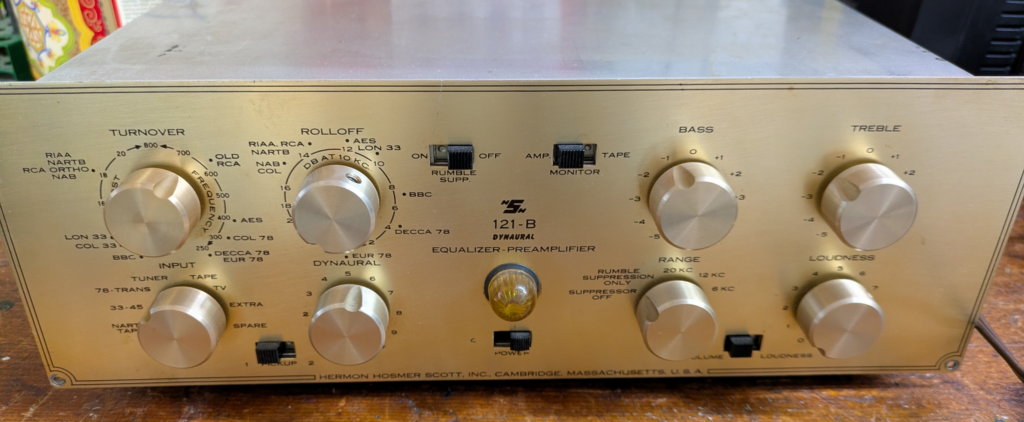
Of course, finding one and getting it restored can be a challenge…
Another good solution is a flat (also called a “needle drop”) phono preamp (example?) with an appropriate tone control unit. The Bellari EQ 570 is a good cost effective solution here, electrically quiet and the control points are right where you’d want them.
A pop/tick remover can be very useful, like the analog SAE 5000A “Impulse Noise Reduction System”.
Play on!
Resources:
EQ:
About: http://pspatialaudio.com/record_characters.htm
A handy chart – http://www.shellac.org/wams/wequal.html
Another good reference: https://midimagic.sgc-hosting.com/mixphono.htm
Speed
https://charm.rhul.ac.uk/history/p20_4_3.html
Groove widths and Stylus recommendations
Other resources:
78rpmrecord.com
78’s digitized by George Blood: https://archive.org/details/georgeblood
Other interesting links:
The science behind step up transformers for MC
http://www.rothwellaudioproducts.co.uk/html/mc_step-up_transformers_explai.html